Rights on Paper · November 16, 2026
A Federal Court in 2026: We Received Your Email. Please Don’t Email Us Again.
Federal appellate administration · Case 26-1444
A federal appellate court. In November 2026. Sending a paper letter explaining why it will no longer answer ordinary case email.
The First Circuit clerk's November 12, 2026 letter in Tahai v. Stanfill, et al., Appeal No. 26-1444, is a pointed example of the gap between formal electronic filing and modern, trackable court communication.
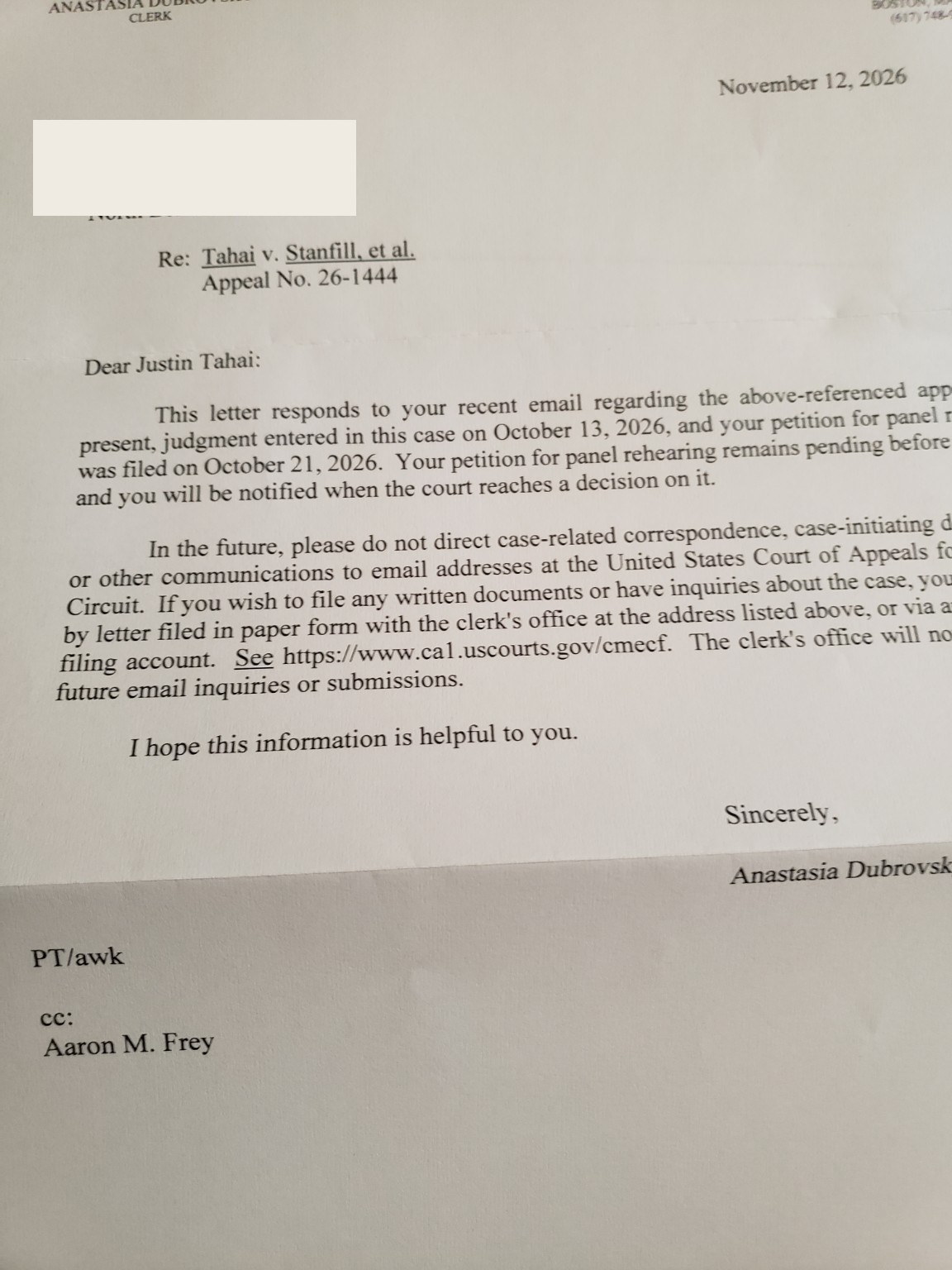
What the letter actually establishes
- The court entered judgment on October 13, 2026.
- A petition for panel rehearing was filed October 21, 2026 and remained pending when the letter was written.
- The clerk directed future case-related submissions and inquiries to paper correspondence or an authorized CM/ECF filing account, stating that the office would not respond to future email inquiries or submissions.
- The letter copied Maine Attorney General Aaron M. Frey.
The letter is not a denial of panel rehearing, a change to the judgment, or proof that the First Circuit lacks electronic filing. It is an administrative communication restriction.
Formal access versus usable access
A self-represented litigant may be able to file through an authorized electronic account while still lacking a convenient, trackable way to ask whether correspondence was received or routed. Postal mail and CM/ECF remain real alternatives, but each may carry cost, delay, and procedural complexity.
It is reasonable for courts to require secure filing channels. It is equally reasonable to ask why a modern public institution cannot provide a clear, documented channel for ordinary status questions that do not seek ex parte relief or alter the merits of a pending case.
Access to a courthouse is not necessarily meaningful access to justice when navigating the courthouse becomes a second litigation of its own.
A concrete administrative standard
Courts should distinguish correspondence from filings, provide accessible status-checking instructions, acknowledge valid submissions, and explain where to route questions when email is not accepted. Such improvements need not compromise judicial independence or the rules governing merits submissions.
First Circuit CM/ECF information · Related Maine emergency email outage editorial
Based on the photographed November 12, 2026 clerk letter. No claim is made that the pending rehearing was decided by this correspondence.