PUBLIC DECLARATION◆CHILDHOOD DOES NOT WAIT FOR THE DOCKET
STAND THEFUCK UP.
“
He who dares not offend cannot be honest.
The real scandal is not that someone speaks impolitely about a system. It is that children can lose irreplaceable years while the adults argue about tone.
Where a child is exposed to chronic adversity, adult conflict, neglected needs or unnecessary loss of safe relationships, the possible consequences are not merely procedural. They can follow that child into school, health, employment and adulthood.
I call these the repugnant harms. This is a public demand to recognize, prevent and measure them—not a claim that every harm has occurred in every family or can be assigned to one person without evidence.
The legal profession cannot demand extraordinary deference for its expertise, wield extraordinary influence over state-enforced outcomes, and then demand ordinary-business immunity from scrutiny when its practices produce extraordinary harm.
THE CONSEQUENCES WE ARE NOT ALLOWED TO IGNORE
REPUGNANT HARMS.
The evidence does not say that any one parent, judge, filing or separation necessarily causes these outcomes. It says that adversity, unaddressed conflict and missing protective support can matter profoundly. That is reason enough to measure and prevent what can be prevented. [2][3]
Suicide attempts & self-harm
Childhood adversity is associated with increased risk of suicidal behavior and severe distress later in life. Preventing adversity matters; no single experience determines a child’s future.
Research connects certain adversities, poor adjustment and reduced protective support with elevated behavioral risk. It does not establish that loss of contact with a particular parent causes criminal conduct.
Adversity and maltreatment have measurable associations with weaker academic outcomes; constructive parental engagement correlates with better achievement and educational expectations.
The CDC identifies long-term effects on employment potential, financial stability and opportunity. Children also benefit from household stability and supportive adults.
High interparental conflict and negative parenting can affect adjustment. Consistent relationships and warm, stable caregiving are important protective experiences.
Some risks are preventable or bufferable[7][3][12]
SOME OF THE EVIDENCE IS SOBERING.
Depression. Suicide. Substance misuse. Violence. Lost educational opportunity. Insecure adult relationships. The difference between an elevated risk and an inevitable outcome matters—and so does the difference between a population study and proof in one child’s case.
Safety and truth are not competing slogans. Both are required.
THE EVIDENCE DOES NOT STOP WITH THE DAMAGE
FATHERS ARE NOT DISPOSABLE.
A safe, loving, reliably present and capable father can be a protective resource in a child's life. The answer is not to erase one parent because adults cannot cooperate. The answer is to evaluate safety, the child’s needs, the real relationship, and the practical supports that enable it. [6][12][13]
24longitudinal papers
Reviewed by Sarkadi and colleagues on father involvement.
22reported positive effects
Within that review; different outcomes and observational designs.
115family samples
In a meta-analysis of post-divorce conflict, parenting and child adjustment.
1,177primary studies
Synthesized across 23 meta-analyses of parental involvement and academic achievement.
A father's love is not a favor bestowed by another adult. It is a relationship to be assessed on evidence, protected when safe, and supported in practice.
What the research can support
Consistent, direct engagement
Longitudinal studies associate active father engagement with multiple social, behavioral and developmental benefits. [6]
Positive coparenting
Across divorced families, conflict and parenting behavior show links to child adjustment; adult cooperation can be protective. [7]
Educational involvement
Parental expectations, school engagement and supportive participation are associated with student achievement. [9]
Safe, stable, nurturing adults
CDC identifies reliable relationships, caregiver skills, stable resources and educational encouragement as protective factors. [3]
AN IMPORTANT DISTINCTION
Education is a resource. It is not a parental morality test.
The CDC lists higher caregiver education among population-level protective factors. That does not mean a college degree makes anyone a good parent, that a parent with less schooling is unfit, or that credentials justify ignoring abuse. Loving participation, demonstrable caregiving, safety, and the willingness to support a child’s education are the questions that matter. Do not use one adult’s contempt for another as a substitute for those facts.[5][3][13]
THE CHILD IS NOT A PRIZE
No gender preference. No blank check. No abandoned protections.
Maine law makes child safety and well-being primary; it also states a policy of frequent and continuing contact with both parents unless contrary to the child’s best interest, and prohibits gender preference in assigning parental rights. Credible domestic abuse must be evaluated seriously. Safe contact is not the same thing as unconditional contact. [13][14]
CHILDHOOD WILL NOT BE PLACED ON HOLD FOR MORE FILINGS
NO MORE PERFORMATIVE REMEDIES.
Here is what measurable, child-centered administration can look like. These are proposed process reforms and civic demands, not claims that each requirement is already enacted law.
01
SAFETY FIRST, WITHOUT BLIND SPOTS
Assess credible abuse, coercion, neglect and safety risks; provide immediate protection when needed. Do not conflate safe contact with dangerous contact.
02
PRESERVE THE SAFE RELATIONSHIP
If both parents are safe, capable and nurturing, promote meaningful continuing involvement instead of letting delay silently determine the outcome.
03
MAKE EVERY ORDER EXECUTABLE
Specify the adult responsible, dates, transportation, provider availability, contingency plan, and a review date. No implementation-by-guesswork.
04
PUT THE ADULTS ON THE CLOCK
Require timely child-related replies, usable scheduling windows, prompt disclosure of cancellations, and clear written reasons for missed obligations.
05
KEEP CHILDREN OUT OF ADULT CASEWORK
Do not recruit a child as the messenger, blame courier, fact witness, or arbiter of whether parents will carry out court-ordered logistics.
06
KEEP EDUCATION AND HEALTH RECORDS ACCESSIBLE
Implement lawful parent access to attendance, grades, treatment schedules and service coordination, subject to genuine safety/privacy restrictions.
07
MEASURE TIME AND ACTUAL RELIEF
Track days since the order, missed sessions, verified compliance, elapsed time to hearing, repair attempts, child-impact risks and whether an ordered remedy occurred.
08
TEST PROFESSIONAL CLAIMS, NOT PROFESSIONAL TITLES
Identify each assertion, the supporting record, competing facts and counterevidence. Training and office confer responsibility—not immunity from review.
09
ENABLE REAL THERAPEUTIC SUPPORT
Honor clinician judgment and the child’s safety while ensuring transportation, scheduling, appropriate evaluations and court clarification when an existing therapy plan fails.
10
PUBLISH PROCESS METRICS AND CORRECT ERRORS
Make system-wide results auditable with privacy protection: time to remedy, returned filings, contact implementation, appeal reversals, error correction and family service outcomes.
Maine’s own child-custody statute already directs decision-makers to consider safety, continuing contact, parental cooperation and the capacity to support the child’s relationship with the other parent. The demand here is for clear implementation, reviewable evidence and timely correction—not for courts to presume every disputed allegation false or every requested contact safe. [13]
THE CITATIONS ARE THE POINT, NOT A DECORATION
READ THE RESEARCH. CHALLENGE THE ARGUMENT.
Primary public-health guidance, systematic reviews, a longitudinal family study, the American Academy of Pediatrics, and Maine’s actual statute. Click through, read the methods and limitations, and bring contrary evidence. This page is an advocacy argument, not a clinical assessment or a judicial finding.
Parental stress, family support and child well-being.
How to read this evidence responsibly
Association is not causation. Family and community risk factors overlap and can be confounded; individual outcomes cannot be predicted from these summaries. Research involving maltreatment cannot be treated as proof that any disputed custody restriction is itself maltreatment.A child’s safety remains paramount. Protective relationships matter when they are safe and supportive, regardless of the parent’s gender or credentials. Credentials and class are neither proof of virtue nor evidence of abuse.
READ. PRESERVE. VERIFY. CORRECT. ACT.
STAND THE FUCK UP.
Not for a parent’s victory lap. For children’s lives beyond the docket. Make claims testable. Make orders workable. Make accountability measurable. Make room for safe, loving parents to parent.
JTforME public advocacy · Updated October 31, 2026 · No private case intake · No publication of a child's identifying details · Commentary and proposed reforms, not court findings.
Declaration of purpose · Justin A. Tahai
Notice of express non-acquiescence
“Beware that, when fighting monsters, you yourself do not become a monster... for when you gaze long into the abyss. The abyss gazes also into you.”
— Friedrich W. Nietzsche
Let the record reflect, with such particularity as may be necessary to forestall the familiar administrative misapprehension that a citizen’s exhaustion constitutes consent:
I shall become an adversary more formidable in the lawful pursuit of accountability than those whom I challenge have been in the abuse of authority: unyielding as to purpose, exacting as to proof, and inconveniently persistent as to the performance of duties that do not become optional merely because their performance has been requested by a person without a professional title.
Should such resolve occasion the appellation “monster,” I accept the designation, with an express reservation against cruelty, intimidation, unlawful conduct, or the surrender of conscience. My instruments shall be evidence, lawful proceedings, publication, public scrutiny and the continued exercise of rights. No more sinister instrument is required where the record is sufficient.
The relief sought is not succession to their power. It is the termination of their impunity.
For Our Children and their Families.
Personal declaration of purpose and lawful intent. Separate from the proposed Act.
When coercive incarceration and demands for obsequious behavior become more important than the long-term, generational harm inflicted upon children, families, and the parent-child relationship, taxes and tea pale by comparison. They become absurd.
Tea could be replaced. Taxes could be repealed. Lost childhoods cannot be restored.
A government does not preserve public confidence by demanding reverence from the people it harms. A court does not become just merely because it can compel obedience. And an institution does not act in a child’s best interests when protecting its own authority becomes more important than protecting the child’s relationship with a loving parent.
This is the war.
Not a war of physical violence, but a war over truth, language, records, accountability, and the right of ordinary people to confront institutions that have mistaken coercive power for moral legitimacy.
It is a war against procedural cruelty disguised as neutrality. Against professional arrogance disguised as expertise. Against financial exhaustion presented as due process. Against the quiet destruction of families followed by demands that those families remain polite, deferential, and grateful while it happens.
When the institution demands obsequiousness from the injured rather than accountability from those causing the injury, the call out is no longer merely justified.
For Our Children and Families · Public-review proposal · 13 October 2026
An Act To Strengthen Maine Family Court Accountability and Protect Parent-Child Relationships
A child’s life does not restart at the latest motion.
Whole-child history and each parent’s conduct over time come first. Workable orders, timely review, protected access and permanent continuous process improvement make responsibility visible—and correction verifiable.
Proposed legislation—not current law, an issued petition or a qualified ballot measure. Legislative action is pursued in parallel with a 2028 initiative target and a 2030 contingency.
33operative sections
61 pagesbill, preface and review appendices
41 pagesroadmap and outreach
Volunteer-onlyorganizing model
New public accountability matrix: 36 unanswered implementation questions
Five surviving enforcement lanes, nine top-level factual questions, 36 proof-specific questions, and eight advocate-witness screening topics—paired with public-safe PDF, DOCX, and CSV downloads.
Professional judgment. Therapeutic time. A record you can check.
The updated Patrick S. Bedard accountability record brings together the service timestamp, prior appointment notice, Ramirez’s June 2025 communication, Bedard’s response, and the author’s complete new article.
Material history in chronological and cumulative context. Each parent’s conduct over time. Relevant historical witnesses. Issue-specific findings. A new motion or judicial assignment does not erase the child’s history.
Identify the responsible adult, required act, deadline, safe communication method, workable default, backup and review date. A general direction to cooperate is not enough to resolve a proven recurring problem.
Make lawful access to school and provider information usable. Protect minor confidentiality. Assign the adult steps and address barriers without turning the child into the messenger.
Examine factual support, continuing protective necessity and deliberate misuse separately. Protect good-faith reports. Review unsupported restrictions without making correction depend on proving bad faith.
A reassignment, reopened task or fresh motion must not restart the clock. Require identifiable review and decision steps while protecting safety and due process—not automatic custody changes when time expires.
Assign operational responsibility, test bounded changes, review evidence, publish privacy-safe results, verify delivery and public spending, and correct recurring failures. A purchase, committee or installation is not performance.
Latest public commentary · Part III released August 23, 2026
The Weaponization of Time Against Maine's Children
Part III: A Child Cannot Have a Relationship With a PDF. The three-part series now traces the machinery, the way delay becomes the decision, and the implementation failure that remains after an order is signed.
From Paper Rights to Justice That Works. Systems fail. People make mistakes. The question is whether institutions can see failure, own the next action, and correct it while there is still time for the human beings living with the result.
A recurring home for original research, practical tools and engineering-led proposals. Not just what went wrong: what should change, who should act, and how the public can tell whether it worked.
Public notice · October 30, 2026 · Complete signed statement
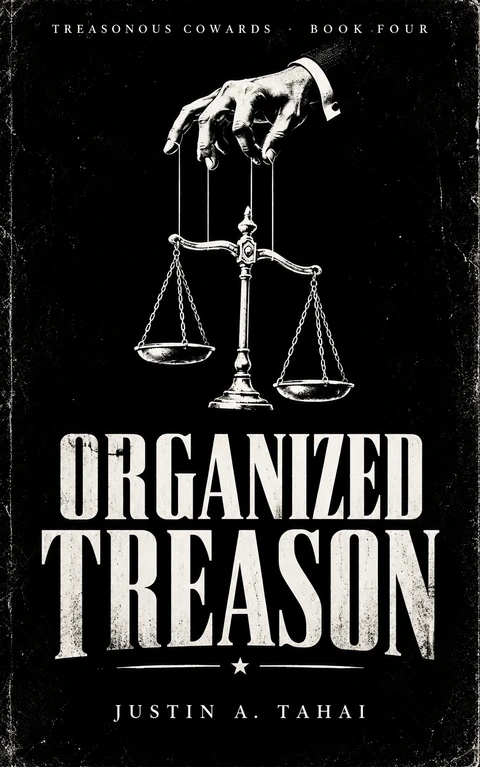
Eight books. One reckoning. Notice of substantial revision.
An unabridged civic statement on JTforME’s expanded research, proposed remedies, competing harms, the good-faith warning and public accountability. Read the original arguments in context.
Purchases take place on Amazon, not on this site. “Find on Amazon” opens a title-and-author search; a matching edition may not yet be listed. The public record and free resources remain open.
Independent professional services
Complex IT problem? Put me on the project.
Hire Justin Tahai for hands-on engineering across systems, Microsoft cloud, networks, automation and software. A specific problem resolved. A useful tool built. Unfinished work brought to completion.
Independent professional work, separate from campaign activity. Scope, deliverables and pricing agreed before work begins. No payment or private case intake on this site.
Public accountability snapshot · as of Aug. 19, 2026
Evidence should lead to an owner, a remedy, and a date.
Ten issue records connect the underlying public record to defined institutional owners and requested actions. These records do not substitute for the citizen-initiative text; they document why operational change is being demanded.
ACC-001 · Hearing scheduled
February 11 order implementation and adult logistics
The October 8 enforcement hearing is scheduled. The public record describes disputed practical implementation of contact, therapy, transportation, and information-sharing.
Law Court directive and downstream implementation gap
Signed orders were entered May 12 and June 23. A public open letter followed August 17, and a Rule 10(c) intake and routing request followed August 18.
York Judicial Center enforcement intake and scheduling
The August 14 procedural order preserved one enforcement motion, dismissed other submitted documents, required certified-mail service, and set an October 8 hearing.
This is a draft policy project—not an official ballot measure or private case-intake portal.
Do not submit child names, sealed records, private medical or school information, confidential evidence, or private allegations through public campaign links. Public comments should address language, implementation, safety exceptions, fiscal feasibility, due-process protections, source quality, and institutional ownership.
Patrick S. Bedard's August 21 objection: integrated enforcement analysis
The new public-safe page examines child preference in historical context, adult implementation duties, evidentiary limits, and the continuing nonimplementation of the February 11 order. It expressly distinguishes allegation, argument, source record, and adjudicated finding.
Further reading: the public journey, memoir and trilogy
The public work. For Everyone.
RISE
The impunity ends. Justice restored. For Everyone.
A right on paper is not enough when its remedy is out of reach.
Family law reform, parents’ rights, fathers’ rights and child safety belong in one public demand: a fair answer while correction can still matter.
Help the next family find a better path. Read the systems argument and the full RISE chapter. Choose one useful action—or start with an editable message that helps you inspire someone else.
Institutional Cowardice Is Not Honorable. Documentary criticism and opinion. “War” means words and nonviolent public advocacy. Mature language.
RISE / PUBLIC RESEARCH · 20 SEPTEMBER 2026
Documented connections. Unanswered questions.
Two source-linked reports on six Maine legal and judicial professionals. Read the affiliation maps, the original PDFs and the records still missing. An institutional connection is not a finding of friendship, improper influence or misconduct.
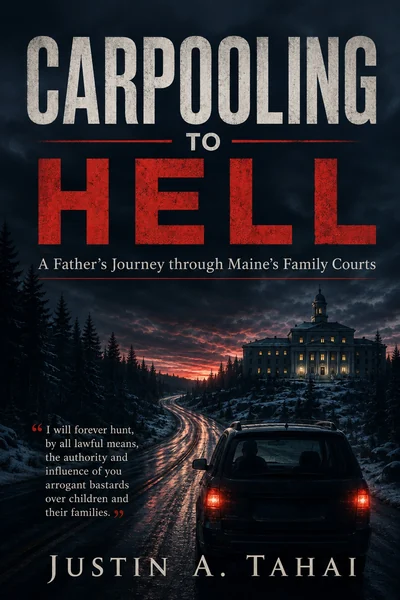
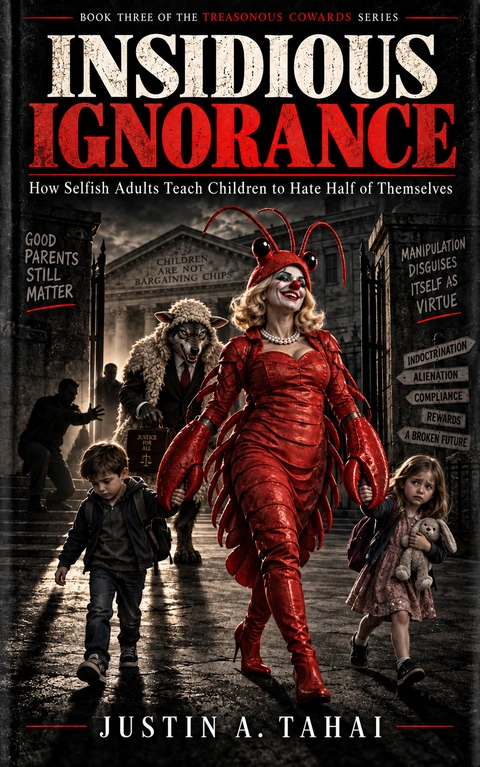
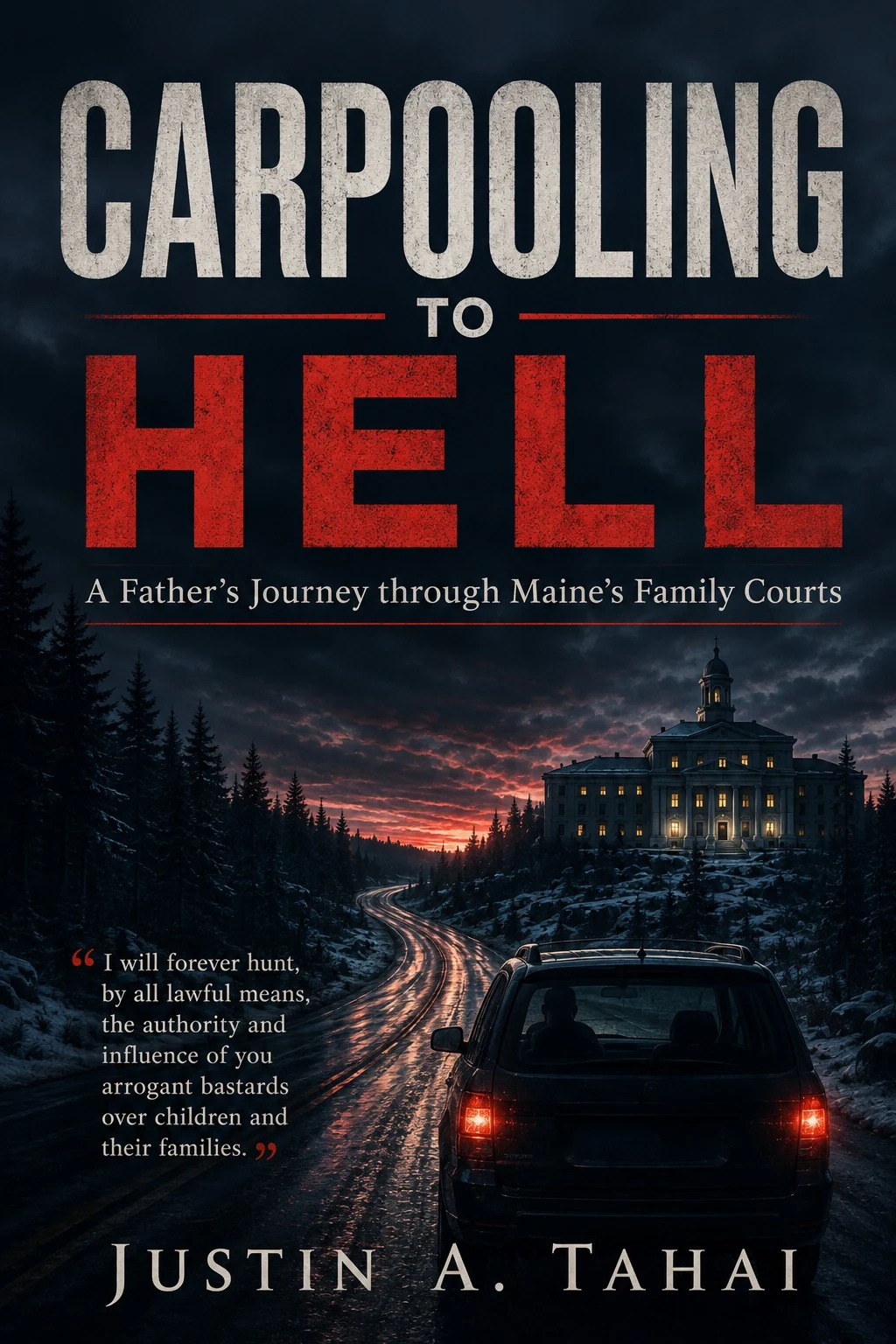
Carpooling to Hell is published and available on Amazon in Kindle, paperback, and hardcover editions. The Kindle edition is included with Kindle Unlimited for eligible subscribers. Read the official book page—or choose an edition below.
Information is only useful when people can use it.
The publishing system connects documents, source catalogs, searchable pages, practical tools and correction paths. The technology supports the public work; it does not replace the record.
Public boundary: JTforME separates draft legislation, public records, official data, party positions, public-policy argument, allegations, inferences, corrections, and adverse material by type. The initiative is a pre-submission public-review draft, not an official ballot measure. A complaint, referral, review, or public statement is not an adjudicated finding. Do not send child names, sealed records, medical details, private allegations, or confidential files through public campaign links.