01
Earlier recusal
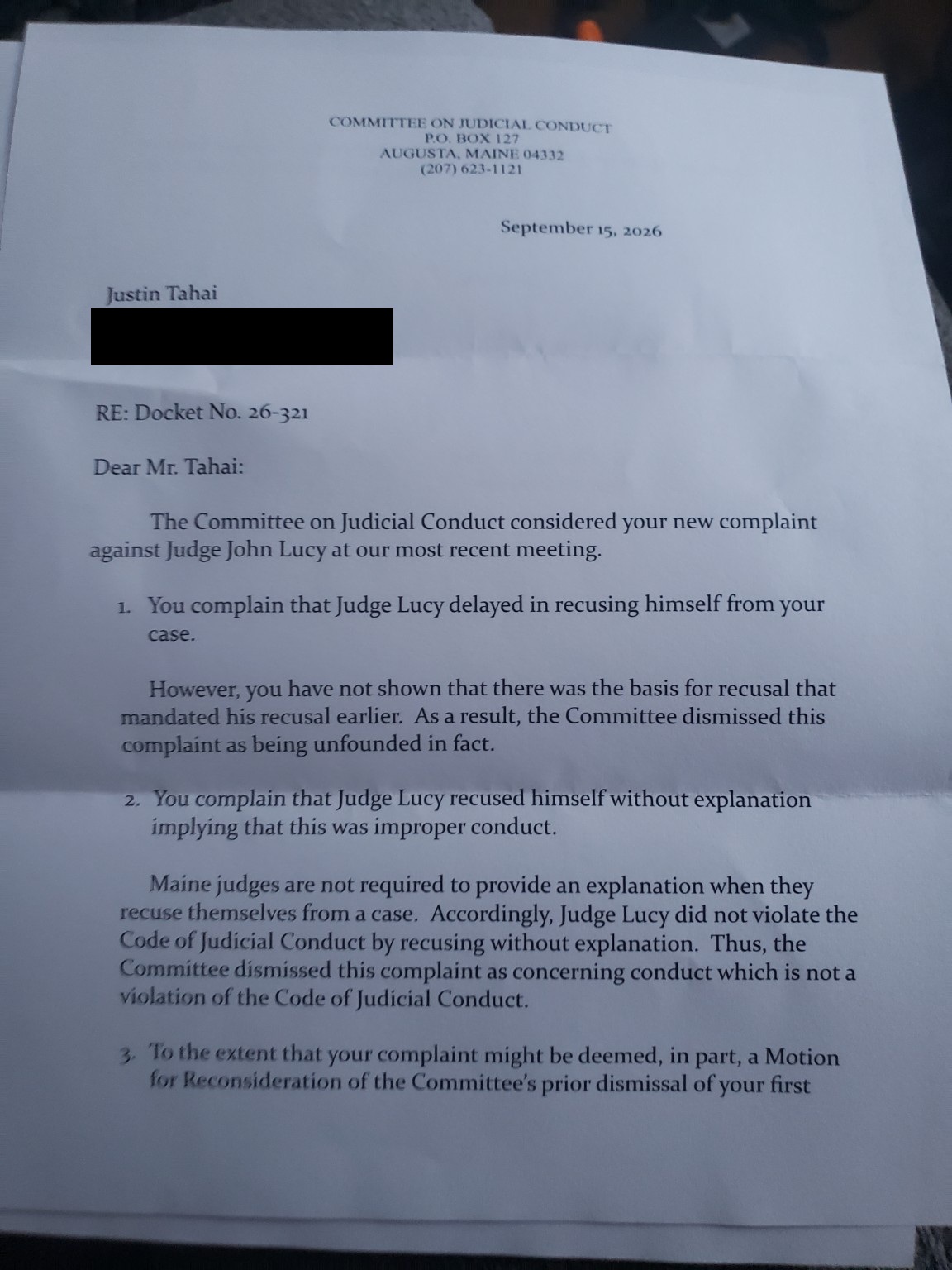
The Committee said the complainant had not shown a basis requiring earlier recusal and dismissed that complaint as unfounded in fact.
Committee on Judicial Conduct · Docket 26-321
A closure letter is not the end of public accountability.
The answer must address the question actually raised.
01 / What the document establishes
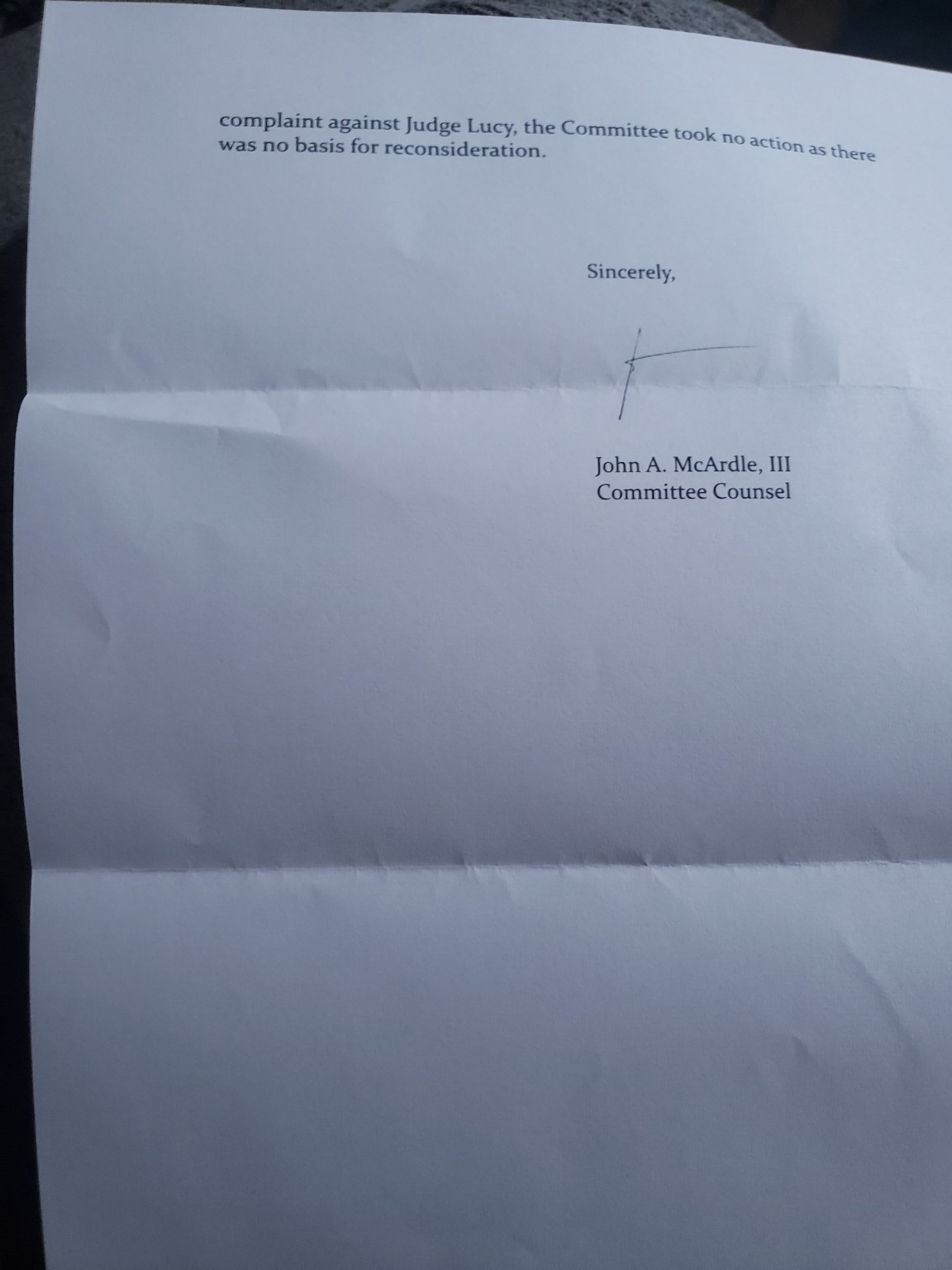
That outcome is not hidden here. The September 15 letter reports the Committee’s decision; John A. McArdle, III signed it as Committee Counsel. The available letter does not establish that he alone made the decision. Source A, pages 1–2.
The Committee said the complainant had not shown a basis requiring earlier recusal and dismissed that complaint as unfounded in fact.
The letter states that Maine judges are not required to explain recusal. It treats recusal without explanation as conduct that does not violate the Code.
To the extent the complaint sought reconsideration of the earlier dismissal, the Committee reported taking no action because it found no basis for reconsideration.
02 / What the retained submissions asked
The retained addenda address delay, the handling of unresolved motions, access to a reviewable record, and what happened to pending work during reassignment. These are the complainant’s allegations and requests—not findings that those allegations are true. Source B: selected verbatim excerpts.
This addendum is not a request for the Committee to change custody, support, protection-from-abuse, appellate, transcript, or federal rulings. It is a request for review of judicial conduct, delay, non-disposition, assignment/routing, docket administration, public confidence, and the failure to correct or protect the record after known procedural blunders.
“Recusal did not answer the status of the work already assigned.”
Section II.C asks about review, pending-motion status, expedited requests, and transfer to a successor judge. It does not merely demand a personal explanation for stepping aside.
The Committee may ultimately determine that some delay was attributable to appellate jurisdiction, eFiling correction, clerk procedure, litigant volume, or legitimate recusal concerns. That possibility is precisely why an investigation should examine the actual routing and work-queue records rather than rely on assumptions from the face of a crowded docket.
July 15, 2026, page 5, §IV. Quoted to preserve the limiting context.
The September 15 response does not list the submissions considered. Retained copies and sent correspondence show what the complainant prepared and circulated; they do not independently prove Committee receipt or association with Docket 26-321. The reply asks the Committee to reconcile that history before anyone claims the broader issues were ignored.
03 / The complainant’s response
The reply below is prepared for mailing. No mailing date, delivery, reopening, or new Committee response is asserted in this release. It requests clarification and preservation; it is not an appeal or a finding of wrongdoing.
September 18, 2026 · Re: Docket No. 26-321
Mr. McArdle:
Your September 15, 2026 letter in Docket No. 26-321 reports the Committee’s dismissal of my complaint concerning Judge John Lucy. I understand that you signed as Committee Counsel and that the dispositions reported are the Committee’s. My criticism concerns that official response—not your private life.
A closure letter is not the end of public accountability. When the concern is the handling of time-sensitive matters affecting children and families, the explanation must confront the concern actually raised. A child’s time is not an administrative rounding error.
Your letter addresses three matters: whether I showed a basis requiring earlier recusal; whether recusal without explanation violated the Code; and whether there was a basis to reconsider the prior dismissal. It reports dismissal on the first two points and no action on reconsideration. I am not representing that disposition as a finding in my favor.
But my retained June 10, 2026 second amended addendum expressly sought review of “judicial conduct, delay, non-disposition, assignment/routing, docket administration” and record protection. My July 15, 2026 addendum separately stated: “The complaint is not limited to dissatisfaction with a ruling,” and, “Recusal did not answer the status of the work already assigned.” Those passages concern administration before and during reassignment—not merely a demand for a personal explanation of recusal. [1–2]
I do not ask a disqualified judge to keep deciding the merits. I ask how pending work was identified, handled, and transferred, and how the conduct allegations concerning the preceding period were evaluated. Those are different questions.
The September 15 letter does not identify which submissions were considered or expressly explain how those broader concerns were resolved. That omission does not prove that no review occurred. It does mean I cannot determine from the letter whether those issues were reviewed, treated as part of the prior dismissal, excluded, or never associated with this docket. Please answer that distinction.
The Committee’s own published procedures say a complainant may communicate again to seek further explanation or provide additional information. That is what this letter does. It is not a substitute for an appeal, a demand to change a family-court order, or a claim that the dismissal letter proves a crime. [4]
I am preparing a source-linked public comparison of your letter and the scope of my retained submissions. It will distinguish the Committee’s stated disposition, my allegations, and facts not established by the available materials. It will not publish my child’s private records. A substantive response and supported corrections will be presented alongside the criticism.
No robe, title, professional credential, or committee letterhead substitutes for a reasoned explanation. Legal immunity in a particular proceeding is not a reason to withhold public criticism of official reasoning. I am asking for accountability, not deference.
I just wanted to be a father. The point of this record is not professional comfort. It is whether children and families receive meaningful attention before time changes their lives.
Justice does not belong to a profession. It belongs to the People.
A promise kept is public respect earned back.
Warmest regards,
Justin A. Tahai
04 / Read the sources, not just the criticism
Both pages of the Committee’s response are shown below. The recipient’s home address is covered in the public copy; the substantive text is not removed. These are photographs supplied by the complainant, not certified copies.
The June 10 addendum was located as an attachment to a sent June 10 email; the July 15 addendum was located in sent July 15 correspondence. Those transmissions do not establish the Committee’s own intake history. Only selected scope passages from those retained copies are reproduced here.
The complete original complaint as received by the Committee, its receipt log, the earlier dismissal cited in paragraph 3, its deliberations, and its full review file have not been established by these materials. The page does not claim criminal racketeering, money laundering, a proved cover-up, or a finding that no review occurred.
05 / The response belongs beside the criticism
The Committee’s published procedures allow a complainant to seek further explanation or provide more information. Its stated limits also matter: it is not an appellate court and cannot change the underlying court proceedings. Read those procedures.
This is criticism of official reasoning. It is not an invitation to threaten anyone, contact private family members, or flood inboxes. Private child, medical, and school records are not published in this new material.
Justice does not belong to a profession. It belongs to the People.
A promise kept is public respect earned back.
Copy this direct page address:
https://www.jtforme.com/committee-on-judicial-conduct-accountability