Valerie Stanfill
The Board of Governors, institutional leadership and the proposition that public confidence cannot be compelled by court order.
Complete free ebook · 61 illustrated PDF pages
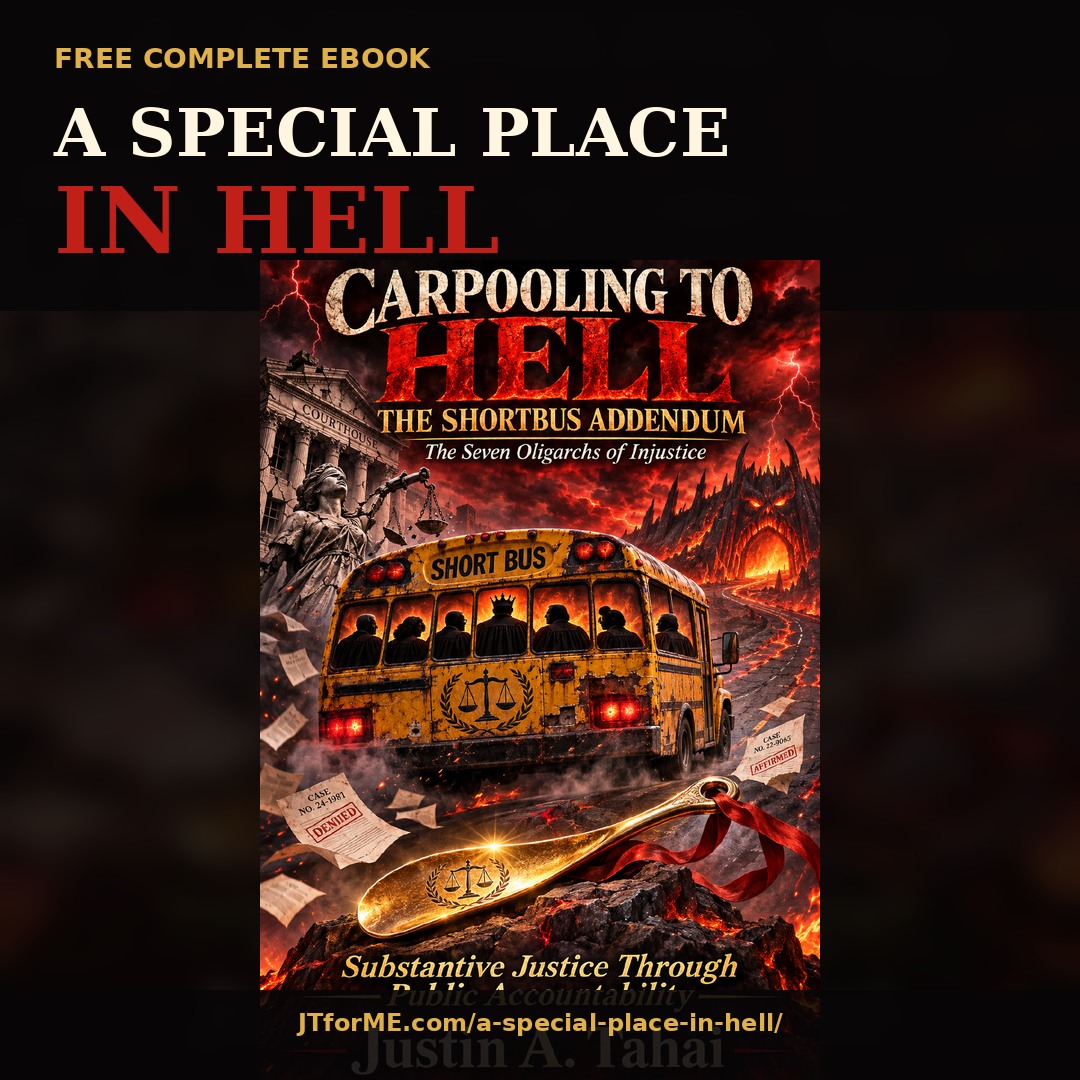
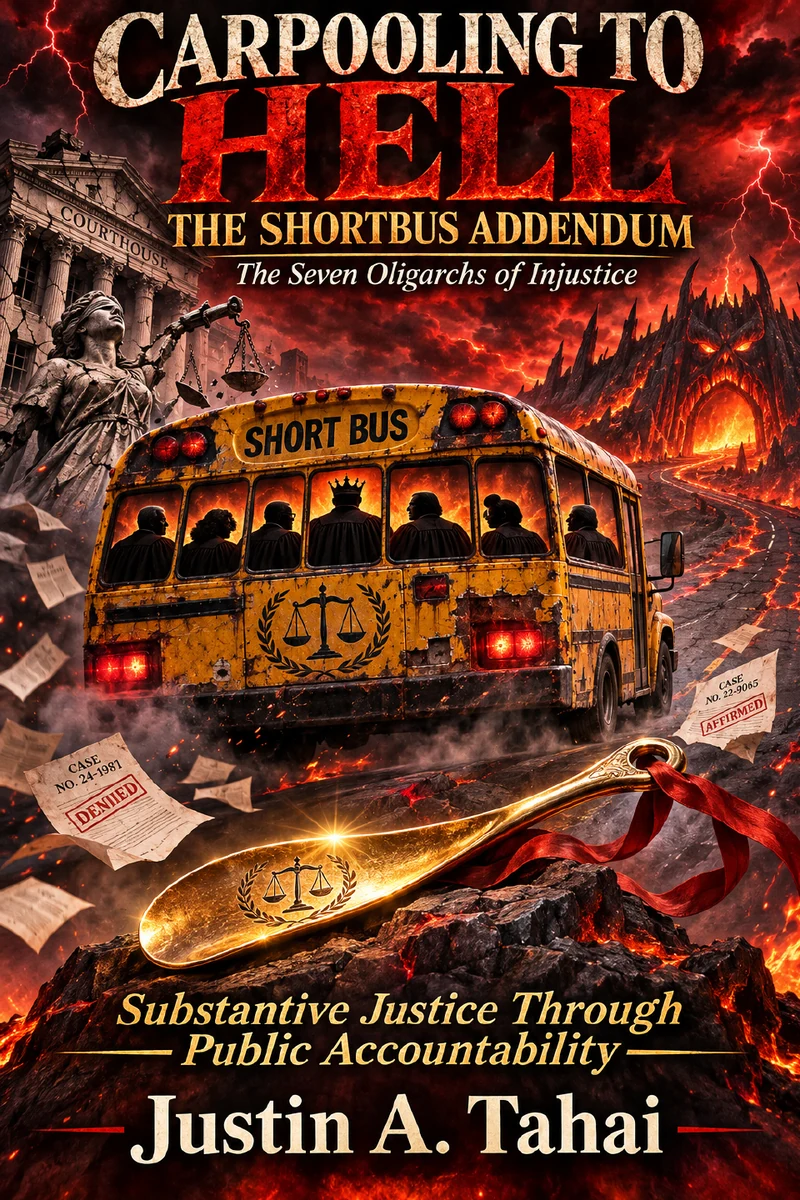
Carpooling to Hell
The Shortbus Addendum
The Seven Oligarchs of Injustice
Seven passengers. Seven mandatory stops. One publicly available Instrument of Justice. The dialogue, infernal proceedings and mock holdings are satire. The public questions about power, delay, access, reasons and accountability are not.
Substantive justice through public accountability. The seats belong to the People.
Before departure
This addendum takes the language of institutional authority—findings, conclusions, standards of review, mootness, remand, dispositions—and sends it back through a fictional infernal tribunal. It does not manufacture a judicial finding of individual malice. It asks whether the administration of public power can survive the same scrutiny routinely demanded of ordinary people.
The governing standard announced inside the satire is direct: when challenged, supply reasons; when mistaken, correct the error; when entrusted with public power, remember whose it is.
Seven mandatory stops
The Board of Governors, institutional leadership and the proposition that public confidence cannot be compelled by court order.
Electronic filing, broken correction paths and the difference between digitizing a process and making it usable.
Impartiality, competing published reasoning and the obligation to preserve the actual disposition while examining what it reveals.
Parental rights, implementation and the child who should never be required to administer adult obligations.
The calendar, perishable interests and the reality that no later order can add a month back to a child's life.
Meaningful appellate review, inaccessible records and the price of trying to challenge an error from a record beyond reach.
Inherited practices, present authority and the difference between retroactive blame and responsibility to improve what one now governs.
The final appeal belongs to the people: question, criticize, investigate, publish, advocate and pursue lawful reform.
Purpose-built for loosening intellectually immovable objects and substantially substantial cranio-rectal entrenchment.
Complete edition
The edition includes the prologue, seven chapters, final judgment, author's source note, and documentary anchors. The PDF itself controls the wording and pagination.
The email circulated with the book
This public edition preserves the complete body and subject of the sent message. The recipient-address list and technical mail headers are omitted. The original email was sent on November 11, 2026, at 8:47 a.m. Eastern, with the revised illustrated ebook attached.
PUBLIC ACCOUNTABILITY NOTICE — LITERARY SATIRE AND THE PUBLIC RECORD
To the Maine Judiciary, the Governor’s Office and incoming administration, counsel, members of the Legislature, and the press:
Please find attached my new, illustrated, seven-chapter satirical sequel:
CARPOOLING TO HELL: THE SHORTBUS ADDENDUM
The Seven Oligarchs of Injustice
Substantive Justice Through Public Accountability
This is a literary public-accountability statement, not a court filing, a motion, a request for ex parte relief, or a substitute for service in any pending proceeding. Its fictional infernal bus carries Maine’s seven named Supreme Judicial Court justices through the uncomfortable doctrines of accountability, meaningful appellate review, procedural regularity, institutional independence, and the irrecoverable cost of delay when a child’s welfare is at stake.
It is written in the professional language so often used to dispose of ordinary people’s urgent concerns: findings, conclusions, objections, standards of review, mootness, remand, and dispositions. Those devices are returned, with interest, to the institutional practices they are too often used to defend.
The book is deliberately severe. Its dialogue and infernal proceedings are fictional; the documented record, individual roles, and limits of the underlying claims remain separate. Criticism of a public institution is not proof of personal misconduct by any particular member of the Court, nor is disagreement with an outcome a license to manufacture a fact. It is, however, entirely proper for the public to question whether the judicial branch’s procedures actually deliver timely, meaningful justice.
My central question has not changed: what does a right written in an order mean when practical enforcement, accessible records, a usable hearing record, and meaningful review remain out of reach while a child continues growing up?
A learned profession unwilling to examine its mistakes cannot demand that the public mistake institutional self-preservation for substantive justice.
The judiciary may require compliance with lawful orders. It cannot require applause, compel public confidence, or convert a ceremonial title into evidence of competence. Public respect must be earned through reasoned decisions, transparent processes, correction of demonstrable error, and the protection of rights in the lives of actual families.
This publication invites readers, reporters, policymakers, attorneys, and judges to test the satire against the record, examine the source limitations, and consider what institutional improvements are warranted. Any judicial relief in my matters must still be sought through proper noticed procedures, and nothing in this circulation asks a judge to act on an off-docket communication.
I do hope they enjoy it as much as I enjoyed producing it.
Substantive justice through public accountability.
The seats belong to the People.
Justin A. Tahai
Father • Engineer • Author
https://www.JTforME.com
Attachment: Carpooling to Hell — The Shortbus Addendum (revised illustrated PDF ebook)
PUBLICATION NOTE: The attached satire is commentary, not a factual finding that any named justice personally caused each event it discusses. The source note distinguishes invented dialogue from documented public history. Please avoid circulating private minor-child records as part of any independent coverage.
Built to be shared
The page carries full Open Graph and large-image metadata for Facebook, LinkedIn, X and other platforms. The kit includes 1200×630, square and 4:5 portrait images plus ready-to-copy post text.
Documentary anchors
The edition identifies its public sources and distinguishes official history from fictional dialogue. Its source register includes the official judicial roster and biographies, the February 12, 2026 State of the Judiciary address, the published Connors disciplinary decision, the Supreme Judicial Court's institutional role, and the privately supplied chronology used as a navigation aid for cited family-law and appeal events.
The complete source note appears at the end of the free ebook. Original orders and native records control over summaries, chronology aids and satire.
Send the bus
Copy the direct link, a short introduction or a citation. Nothing is posted or sent automatically.
Continue through JTforME
Continue to the memoir, free-ebook library, public record, evidence tools or reform work.
New in Carpooling to Hell: The Addenda
Seven fictional infernal proceedings apply the institution’s own doctrines back to Maine’s seven-member Law Court. Read each issue in full, download the collected edition, and put the standard of review where it belongs: on public power too.