JTforME / For the People
Public notices · Constitutional petitions · Open letters · Records
FOR THE
PEOPLE.
The public does not need institutional permission to examine public power, demand lawful accountability, or insist that childhood be treated as more than a deadline the system can outlast.
Newest Law Court follow-up · November 15, 2026 · 9:36 PM ET
Procedural Derectumification
The title-amendment email and one-page motion ask the Law Court to replace “Procedural Rectification” with terminology the filing says more accurately identifies the metaphorical extraction requested. No allegation, authority, requested relief, appendix, or service designation is changed.
“The omission was clerical. The obstruction is substantive.”
Newest public statement · November 15, 2026
When Maintenance Becomes Negligence
An engineer’s indictment of a justice system whose procedural patches, workarounds, and inherited failures have become more complicated than the problems they were supposed to solve.
“The system was supposed to serve the people. The people were never supposed to serve the system.”
New public statement · November 14, 2026
Justice may be blind; she need not be an idiot.
The complete ten-page public-accountability correspondence is now published as searchable text with the original Gmail-export PDF, followed by the November 13 statements.
Complete correspondence · Original PDF
“Open the error log. Answer the evidence. Correct the failures.”
A direct demand to executive, legislative, judicial, legal, and press recipients for competent administration, accessible process, reviewable records, and substantive justice before childhood is gone.
Read the complete email →Operational accountability
“A filing cabinet with a password is still a filing cabinet.”
Procedure is supposed to serve justice. Court technology and administrative design should prevent routine defects instead of manufacturing rejection cycles and unpaid work for families.
Read the complete statement →Signed public statement
“The People are not your subjects. Our children do not owe you their childhoods.”
A rejection of judicial reverence and a demand for fair hearings, accessible records, timely remedies, independent investigation, and lawful accountability.
Read the signed statement →We the People · New public campaign
Establish JUSTICE for children.
Childhood cannot be stayed, remanded, or restored after public systems wait it away. The campaign demands child-impact deadlines, affordable records, enforceable orders, neutral review, accountable e-filing, and public oversight.
November 12, 2026 · Published as sent
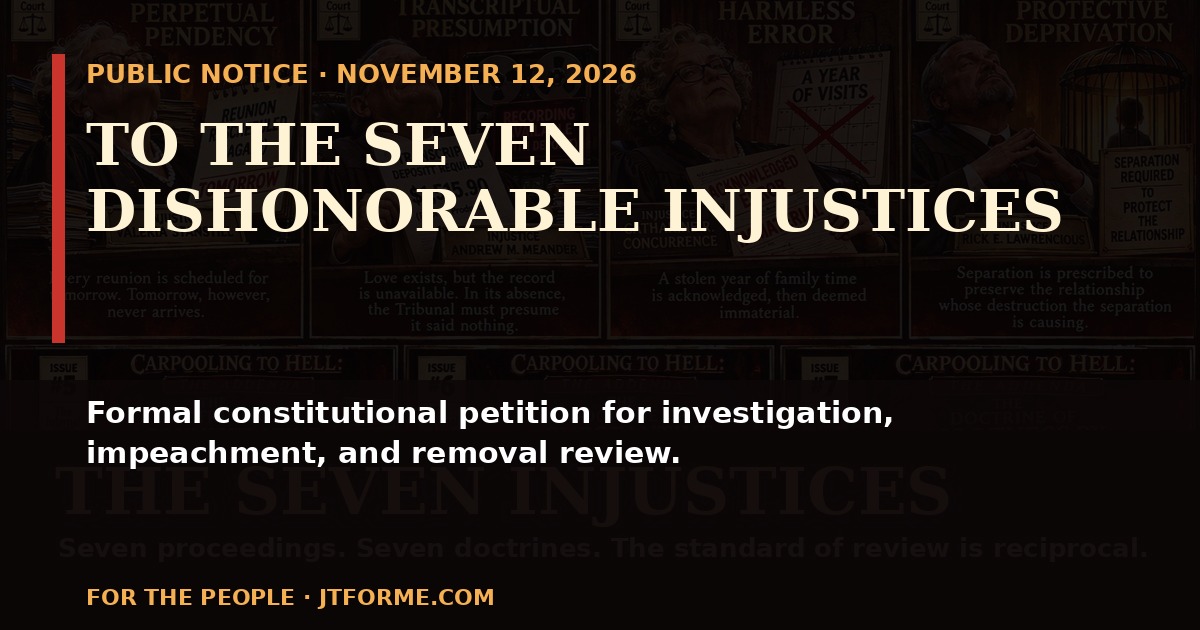
Public Notice to the Seven Dishonorable Injustices
A formal constitutional petition to Maine’s executive and legislative branches for investigation, impeachment, and removal review—not another request for the Law Court’s permission.
“I AM DEMANDING THAT THE PEOPLE ENTRUSTED WITH THE AUTHORITY TO INVESTIGATE ACTUALLY INVESTIGATE.”
The public shelf
Words addressed beyond the courtroom.
These works speak directly to the people, the press, elected officials, and institutions that possess the authority—and the duty—to investigate, correct, and reform public systems.
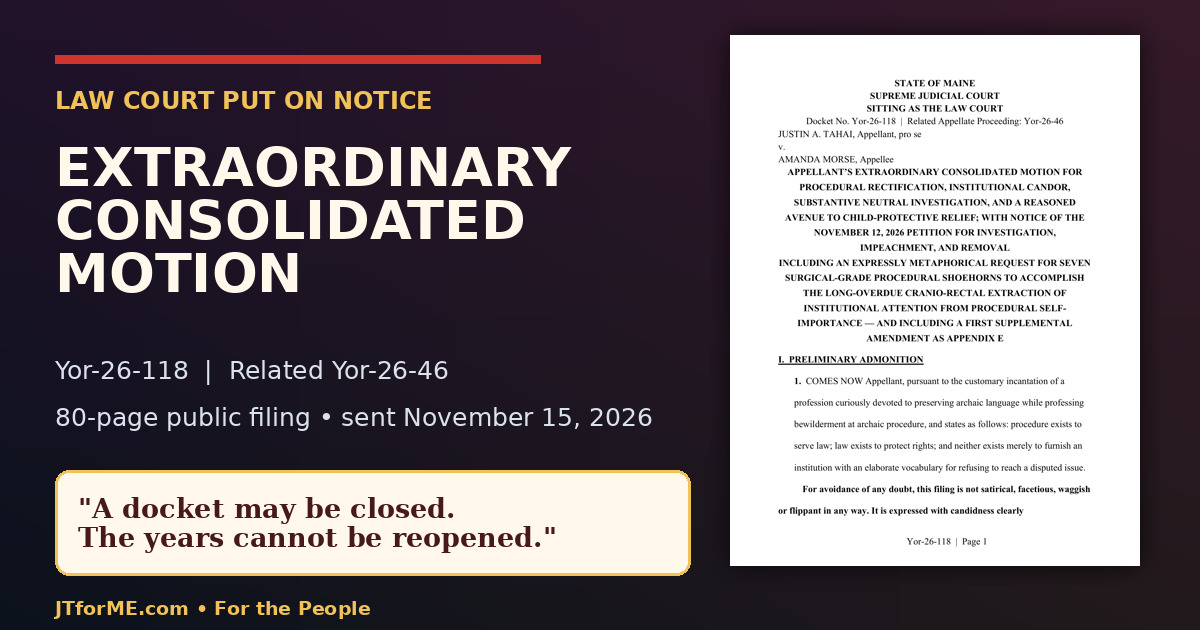
The exact November 15 filing email, the complete 80-page extraordinary consolidated motion, and a mobile-safe reader for Yor-26-118 / related Yor-26-46.
Read it →An engineer’s November 15, 2026 public-accountability statement on patches, workarounds, institutional traditions, and the point at which preservation becomes negligence.
Read it →A direct indictment of procedural absurdity, outdated court technology, and the unpaid burden transferred to families.
Read it →A signed declaration that justice belongs to the People and judicial power owes them accountability, not reverence.
Read it →A public campaign demanding deadlines, usable records, enforceable remedies, neutral review, and action before childhood is gone.
Enter the campaign →The November 12, 2026 formal constitutional petition for investigation, impeachment, and removal review.
Read it →A full satirical edition applying public standards back to public offices.
Read it →Seven proceedings. Seven doctrines. The standard of review is reciprocal.
Read it →The free book, its source trail, and a declaration that institutional cowardice is not honorable.
Read it →A public declaration that silence and procedural endurance are not consent.
Read it →The documentary trailer and the visual accountability series.
Read it →The standard
Read the source. Preserve the context. Demand the answer.
Public criticism is not contempt for government. It is one of the mechanisms by which government remains accountable to the people who created it.
Justice for Children · Public notice
ALTERATION IS NOT A RIGHT. IT IS A DUTY.
When public institutions knowingly excuse foreseeable harm to children, We the People do not owe them silence, ceremony, or automatic deference. We have a duty to alter and reform them.
Justin A. Tahai’s published opinion is deliberately severe: officials who knowingly proceduralize preventable harm to children are morally no better than adults who prey on children. That is a moral comparison and political opinion—not an allegation of sexual misconduct.
PUBLIC ACCOUNTABILITY / SHARE THE RECORD
Share this public accountability record.
Help another reader reach the source directly. These controls open the selected platform; nothing posts automatically.
Sharing a page does not endorse every claim. Read the sources, preserve context, and submit specific corrections through JTforME’s published correction process.