SENT TO BOTH LAW COURT CLERK ADDRESSES · NOVEMBER 15, 2026 · 7:31 PM ET
LAW COURT
PUT ON NOTICE.
The exact filing email and the complete 80-page public motion in Yor-26-118 / related Yor-26-46 are preserved here. The submission asked for receipt and docketing—or a specific, correctable filing deficiency—not another fog of administrative ambiguity.
Maine Supreme Judicial Court · Maine Law Court · SJC accountability
Maine Supreme Judicial Court, sitting as the Law Court
The Supreme Judicial Court is Maine’s highest court. When it decides appeals, the court is commonly called the Maine Law Court or Maine SJC. This independent public-accountability record examines its administration, appellate procedure, public officers, and child-impact consequences.
9:36 PM follow-up · Title-amendment motion
“The omission was clerical. The obstruction is substantive.”
A one-page follow-up asks the Law Court to replace “Procedural Rectification” with “Procedural Derectumification.” The motion says the amendment changes no allegation, authority, requested relief, appendix, or service designation. It changes the nomenclature.
The exact filing request
The Clerk was asked to receive it, classify it, and answer.
The email went directly to both public Law Court clerk addresses. Patrick S. Bedard and Amanda Morse were copied for notice and service. The message expressly stated that no ex parte relief was requested.
- From
- Justin Tahai <[email protected]>
- Date
- Sunday, November 15, 2026 · 7:31:53 PM EST
- To
- Maine Judicial Branch: Clerk of the SJC at both public clerk addresses
- Subject
- Yor-26-118 / Related Yor-26-46 — Filing of Appellant’s Extraordinary Consolidated Motion
- Attachment
- Maine_Law_Court_Consolidated_Constitutional_Notice_Title_IVD_Accountability_PUBLIC.pdf · 80 pages
Clerk of the Law Court:
Please accept the attached document for filing in Yor-26-118, and associate it with related appellate proceeding Yor-26-46 as appropriate:
Appellant’s Extraordinary Consolidated Motion for Procedural Rectification, Institutional Candor, Substantive Neutral Investigation, and a Reasoned Avenue to Child-Protective Relief; with Notice of the November 12, 2026 Petition for Investigation, Impeachment, and Removal.
Attorney Patrick S. Bedard and Amanda Morse are copied for notice and service. No ex parte relief is requested.
Please confirm receipt and docketing, or identify any specific filing deficiency requiring correction.
Respectfully submitted,
Justin A. Tahai, FATHER
Status boundary: The sent email proves transmission and the request for receipt and docketing. It does not, by itself, prove acceptance, a docket entry, presentment to the Court, or a ruling. When this page was prepared, the Gmail thread contained automated responses and nondelivery notices but no substantive Law Court clerk response. This page will be corrected when an authoritative clerk or docket record establishes a different status.
The complete public filing
Eighty pages. One demand: identify the lawful path to an actual answer.
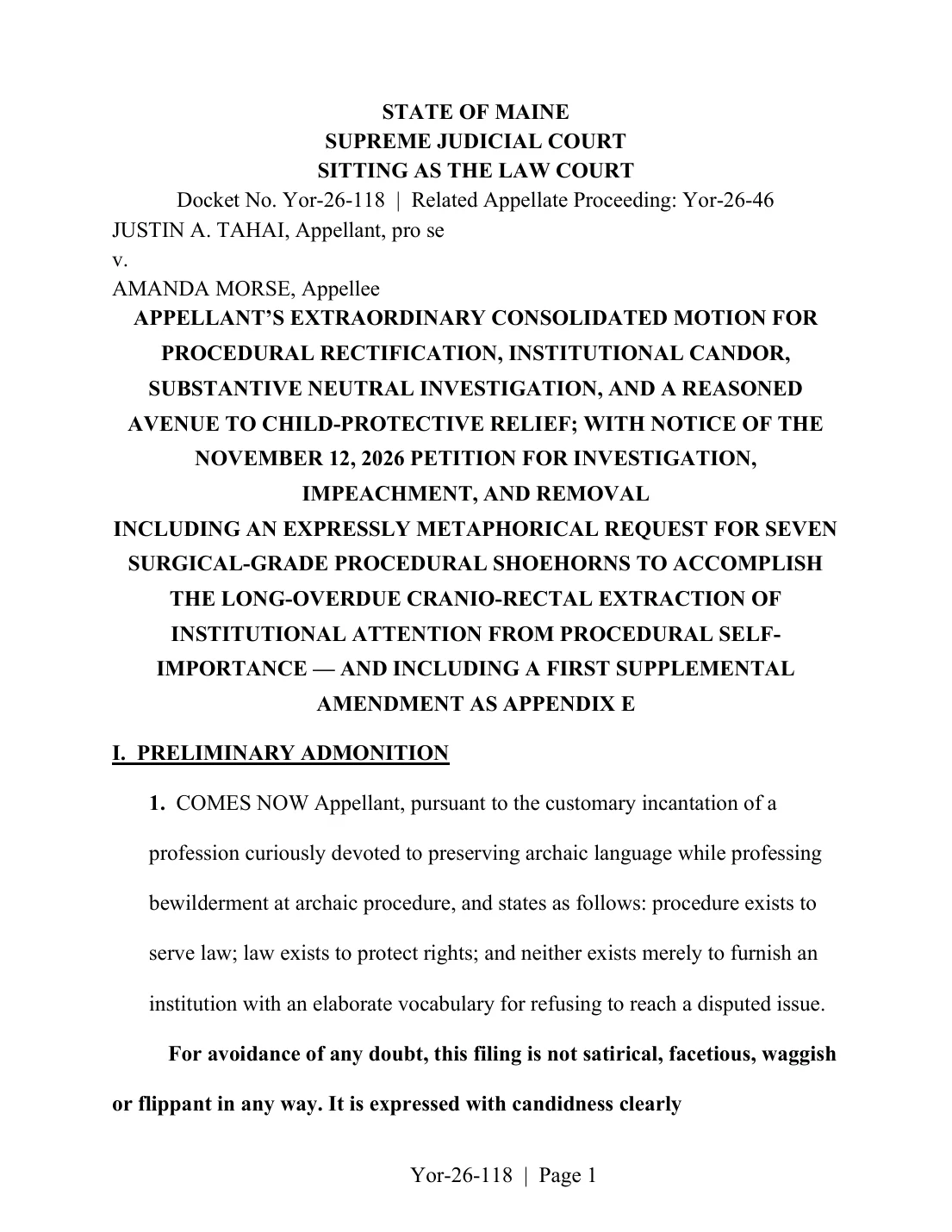
The filing does not merely insult the machinery. It asks the Court to distinguish merits decisions from procedural dispositions, identify any lawful forum still available for child-related implementation questions, confront the transcript and record-access problem, and preserve audit and oversight questions without pretending rhetoric alone proves criminal liability.
“A docket may be closed. The years cannot be reopened.”
Requested relief — pages 45–47
Do not convert a procedural limitation into a fictional merits ruling.
The document asks for relief only to the extent authorized by the rules and existing orders. Its requests include:
- Disposition and basis. Identify the disposition and governing basis for each material preserved issue properly before the Court.
- Lawful forum. Clarify the procedural avenue for unresolved child-related implementation and enforcement questions outside the appeal.
- Authorized correction. Grant any correction, reconsideration, limited remand, or other relief supported by a timely preserved legal error.
- Metaphor, not threat. Recognize the “procedural shoehorns” as emphatic rhetoric seeking candor, reasoning, and respect for childhood’s irretrievability.
- Research context. Acknowledge identified public-health research without treating it as new merits evidence about the child.
- Limits stated accurately. Identify jurisdictional or procedural limitations without implying that unresolved implementation disputes were adjudicated on the merits.
- Constitutional context. Address Maine Constitution Article I, Section 19 and any lawful mechanism for record-access or procedural-barrier issues.
- Merits versus procedure. Separate matters decided on the merits from matters rejected for jurisdiction, timeliness, incomplete record, or administrative form.
- Public oversight. Give nonadjudicative notice of administrative, funding, training, and Title IV-D audit questions to lawful oversight channels.
- Further lawful relief. Grant only relief actually within the Court’s authority on a particularized, timely, preserved showing.
The document’s own architecture
It names the failures, the limits, the evidence, and the unanswered questions.
- I. Preliminary Admonition
- II. The Record Is Not Made Less Real by Its Administrative Inconvenience
- III. The Court’s Calendar Does Not Outrank a Child’s Childhood
- IV. Finality Is Not an Alchemical Substitute for Justice
- V. The Court May Yet Recover Public Respect Through the Radical Experiment of Candor
- VI. The Seven Procedural Shoehorns — an Expressly Metaphorical Request
- VII. The Right to Dissent Does Not Require a License from the Offended Institution
- VIII. Allegiance to the People, Not Judicial Vanity; the Obligation of Public Accountability
- IX. The Constitutional Promise: Freely and Without Sale; Promptly and Without Delay
- X. The Profession Received Its Own Notice: the 2022 Emergency-Custody Findings
- XI. The Judiciary Provided Education on the Very Harms Now in Dispute
- XII. The Money Must Be Examined as Carefully as the Pleadings
- XIII. On the Alleged Racketeering Theory and the Duty to Separate Evidence from Inference
- XIV. Public Notice to the Executive and Legislative Branches
- XV. The Known Generational Consequences of Prolonged Conflict and Separation
- XVI. Requested Relief and Procedural Limitation
- XVII. Notice, Other Parties’ Positions, and Service
- XVIII. Conclusion
- Appendix A. Research and Legal Authorities Cited
- Appendix B. Case Record Anchors and Evidentiary Limitations
- Appendix C. Specific Records to Test Knowledge, Implementation, and Financial Controls
- Appendix D. Public Release, Governor’s Office Courtesy Notice, and Legal Limitations
- Appendix E. First Supplemental Amendment to the November 12, 2026 Constitutional Petition
- Appendix F. Courtesy-Distribution Matrix, Prior NDR Exceptions, and Transmission Certification
Public accountability status
Receipt is not docketing. Docketing is not presentment. Presentment is not adjudication.
The institution was asked for a specific answer.
The filing email requested confirmation of receipt and docketing, or identification of a specific deficiency requiring correction. The public record should show which event occurred: receipt, docket entry, presentment, return, rejection, or silence. Those events are not interchangeable.
This page will record the answer. It will also record the absence of one.
Source discipline
The PDF is advocacy by Justin A. Tahai. Its allegations, inferences, constitutional theories, audit questions, and rhetoric are not judicial findings. The original PDF controls its wording. Official docket entries, orders, clerk communications, and source records control the procedural status.
“The time for ornamental solemnity has long passed. The child’s remaining childhood has not.”
“And stop harming kids. Especially mine.”