INJUSTICE Valerie Stanfill
In the satire: Valeria Stanstill
The Doctrine of Perpetual Pendency
Delay is not neutral when the subject is a disappearing childhood.
Search judicial accountability records and submit firsthand experiences for private editorial review. Nothing publishes without approval.
Search the directorySubmit a storyCarpooling to Hell: The Addenda · Seven-issue satirical miniseries
Seven proceedings. Seven public offices. Seven invented doctrines applied reciprocally. At last, the standard of review is reciprocal.
Maine Supreme Judicial Court · Maine Law Court · SJC accountability
The Supreme Judicial Court is Maine’s highest court. When it decides appeals, the court is commonly called the Maine Law Court or Maine SJC. This independent public-accountability record examines its administration, appellate procedure, public officers, and child-impact consequences.
November 15, 2026 · Filing sent to both Law Court clerk addresses
The exact filing email and the complete 80-page extraordinary consolidated motion in Yor-26-118 / related Yor-26-46 are now public. The message requested receipt and docketing, or identification of a specific filing deficiency. No ex parte relief was requested.
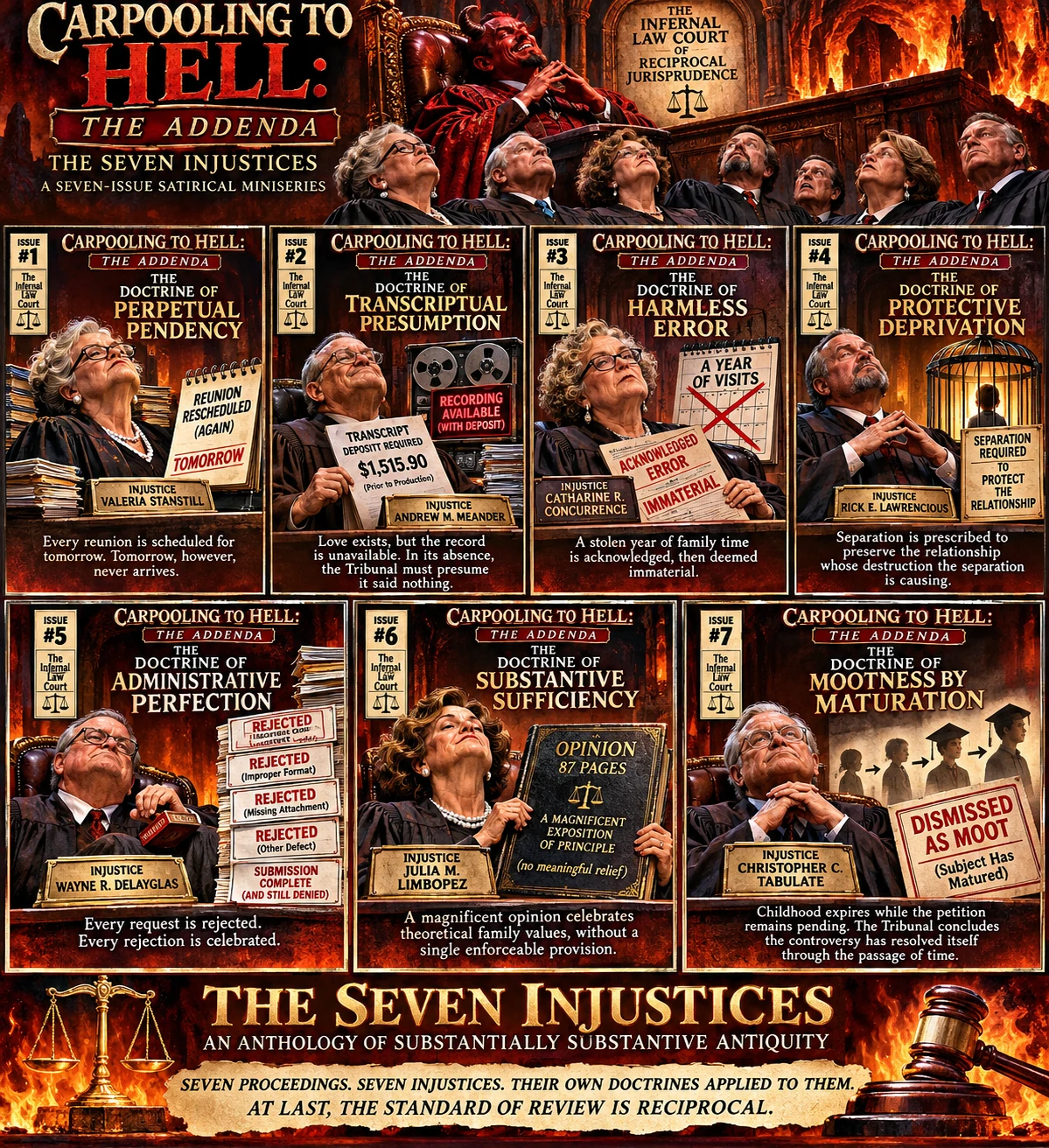
Seven doctrines of infernal convenience
The public is not required to confuse finality with correctness, polish with remedy, or delay with neutrality.
In the satire: Valeria Stanstill
The Doctrine of Perpetual Pendency
Delay is not neutral when the subject is a disappearing childhood.
In the satire: Andrew M. Meander
The Doctrine of Transcriptual Presumption
An appeal without an affordable record is reverence for an invisible transcript, not meaningful review.
In the satire: Catharine R. Concurrence
The Doctrine of Harmless Chronological Error
An acknowledged error is not harmless merely because the institution declines to measure what it cost.
In the satire: Rick E. Lawrencious
The Doctrine of Protective Deprivation
Protection is not a magic word that turns separation into treatment.
In the satire: Wayne R. Delayglas
The Doctrine of Administrative Perfection
A courthouse that can identify every formatting defect but cannot reach the child-impact merits is not exact. It is evasive.
In the satire: Julia M. Limbopez
The Doctrine of Substantive Sufficiency
A magnificent exposition of principle is not relief when nobody can enforce a paragraph of it.
In the satire: Christopher C. Tabulate
The Doctrine of Mootness by Maturation
Delay until a child ages out is not adjudication. It is institutional victory by expiration.
Read, download, inspect
The complete 66-page PDF with all seven issues, prologue, epilogue, and lexicon.
Download PDFThe complete ebook for compatible readers and devices.
Download EPUBDOCX and Markdown source editions for review, quotation, and preservation.
This is a work of fiction and satire. The Infernal Law Court, its seven Injustices, the Devil's proceedings, all dialogue, all imaginary relatives, and every alleged doctrine of Hell are invented. The seven Injustices are caricatures with deliberately altered names, not accounts of the private lives, relatives, intentions, or personal conduct of any real jurist. No real judge's children or family are depicted. No actual child is confined, threatened, or punished in this book. The children glimpsed through the infernal doors are symbolic, wholly invented figures who remain safe; the ordeal belongs to the adults compelled to experience delay.
The book criticizes procedural obstacles, institutional self-importance, the difference between formal rights and practical remedies, and the irrecoverability of family time. Its mock opinions are not actual rulings, and its fictional authorities are not legal sources. Any separate discussion of actual decisions, dockets, or officials should be read in the original public record, not inferred from this story.
The black modified 1999.5 Volkswagen Jetta is the carpool's recurring vehicle. Its capacity has been deliberately disregarded in service of comic overcrowding. Nothing in this work advocates violence against a real person or defiance of a lawful court order.
The black 1999.5 Volkswagen Jetta arrived at the gates of Hell at 8:03 in the morning, although the existence of morning had been disputed by the Department of Chronological Authenticity since the thirteenth century and could not, without an additional filing, be judicially noticed.
The Jetta had been modified with such confidence that an automotive engineer might have admired it, a traffic officer might have fainted, and an insurance adjuster would have required a secluded room. Its paint was black; its exhaust was impolite; its suspension carried seven robed occupants, seventeen boxes of exhibits, two portable printers, a brass seal, and an unreasonable quantity of professional self-esteem.
A red bicycle attempted to overtake them on the inside. At its handlebars sat Bartholomew P. Billmore, Esquire, a clown lawyer in a three-piece suit, curly wig, and bicycle helmet shaped like a judicial dome.
The front tire folded beneath the Jetta's bumper with a theatrical PING.
Billmore emerged from the resulting tangle unharmed, except for the devastation of discovering that the six seconds of travel had not been separately itemized.
"I shall invoice the vehicle," he declared, "for interference with my lucrative expectancy of uninterrupted inconvenience."
"You rode in front of the car," said the driver.
"A disputed characterization," replied Billmore. "The car failed to yield to the professional dignity of my bicycle."
He presented a bill for eleven hours.
Above them, a sign carved into a mountain of rejected pleadings proclaimed:
SUPREME INFERNAL LAW COURT OF RECIPROCAL JURISPRUDENCE
OPEN TO THE PUBLIC. CLOSED TO RELIEF.
Satan sat behind a bench constructed from unopened motions. He was dressed more modestly than his guests, having found that ordinary black velvet sufficed for an office held without the necessity of pretending virtue.
The seven climbed from the Jetta in the order established by ceremonial protocol, which placed the most senior officeholder nearest the courthouse entrance and the member holding the greatest number of unread attachments nearest the trunk.
"We have been summoned," said Valeria Stanstill, "to advise the infernal administration on the responsible exercise of judicial restraint."
"Splendid," said Satan. "I intend to exercise precisely the restraint you recommend."
The Devil's clerk, Miss Quill, produced a parchment bearing a seven-part writ. The text was long, resplendent, and almost entirely unnecessary, but a small portion of it could be understood by persons who had received fewer than eight years of Latin instruction.
Each Injustice would be shown an imagined opportunity to spend ordinary time with a fictional child or beloved young family member. None of the imagined children could be harmed. All were safe, content, and altogether outside the actual jurisdiction of Hell. The doors in the gallery were windows onto possible moments, not prison cells. The only thing locked was the Injustices' access to those moments.
"We shall apply," Satan explained, "your favorite doctrines to the inconvenience of your own longings. The remedies shall be as available, the forms as comprehensible, and the passage of time as forgiving as you have traditionally assumed them to be."
"You mean to torture us," said Catharine R. Concurrence.
"Madam," Satan replied, visibly affronted, "I mean to administer a process. Your inability to distinguish between those activities shall be treated as a failure of pleading."
The seven demanded an immediate stay.
Miss Quill stamped the demand RECEIVED FOR FILING PURPOSES ONLY.
"Does that mean we've been heard?" asked Andrew M. Meander.
"Good heavens, no," said the clerk. "Receipt is a clerical fact. Consideration is a judicial event. You cannot simply put the two in the same sentence."
A narrow man in a soot-dark suit entered carrying a clock with seven hands. Each hand bore an Injustice's name. It did not measure hours. It measured birthdays, graduations, holidays, first dances, lost Saturday mornings, and the innumerable little invitations that never return after being declined often enough.
The driver of the Jetta studied it.
"That's a cruel-looking clock."
"That," Satan said, "is a remarkably ordinary clock. It is only the first time these passengers have been required to watch it."
Billmore stood and objected on behalf of the entire learned profession, which had not retained him, consented to his representation, or requested his opinion.
"My clients," he announced, "demand the inalienable right to be adjudged magnificent without reference to the consequences of their magnificence."
"Objection sustained as an accurate description of the request," said Satan. "Denied as to the remedy."
The first clock hand moved. A brass placard illuminated above the inaugural door:
VALERIA STANSTILL — PETITION FOR THE EXISTENCE OF TOMORROW.
A bell rang, followed by an announcement in the voice of a thousand irritated clerks:
"All rise, except those awaiting practical relief. Their elevation is deferred."
And so began the Seven Proceedings, in which Hell undertook the unprecedented experiment of making procedural reasoning personally consequential to the people who most adored its sound.
Satan summoned the seven Injustices to a single bench. It was a long bench, a beautifully polished bench, an unnecessarily high bench. Upon its face had been engraved a motto formerly adopted by the learned profession with great enthusiasm:
LET JUSTICE BE DONE, PROVIDED ITS ADMINISTRATION DOES NOT REQUIRE ANYTHING INCONVENIENT.
He handed them seven pens and one sheet of paper.
"You have each demanded an exception," the Devil said. "You have now each proposed a rule intended to apply beyond your own inconvenience. The distinction is significant. Many petitioners discover urgency only when the clock is theirs."
Valeria Stanstill stood. "We request a timely hearing on disappearing opportunities."
Andrew M. Meander added, "A workable method of obtaining the record needed to challenge what was found."
Catharine R. Concurrence: "A serious examination of the effects of error, not merely a footnote acknowledging it."
Rick E. Lawrencious: "Actual, child-centered facilitation rather than perpetual ceremonial recognition of a relationship."
Wayne R. Delayglas: "A filing process that assists correction instead of cultivating it as an industry."
Julia M. Limbopez: "Terms which identify practical responsibilities when practical responsibilities are required."
Christopher C. Tabulate: "And decisions made while decisions can still matter."
Satan nodded.
"Then sign the order."
Billmore exploded from a side chamber upon his bicycle, a great tail of invoices streaming behind him like a lawyer's unfortunate wedding veil.
"OBJECTION!" he roared. "This proposed disposition threatens to replace the majesty of professional self-approval with the vulgar measurement of results! It would require the bench to distinguish between a person who has been heard and one who has merely been given a receipt!"
The Devil looked down at his most faithful clown.
"Counsel," he said, "what relief do you request?"
"An injunction prohibiting consequences from interfering with our superior understanding of principle."
"Denied."
"Without a hearing?"
"Counsel, this is a hearing. I realize you may be unfamiliar with the experience."
Billmore stumbled. His bicycle fell over. The bells on its handlebars rang out a magnificent two-note alarm: FILED! DENIED!
The seven signed.
It was not a judgment in any real court. It did not reverse a real order, establish a real legal rule, or restore a minute to any real family. It was a fictional instrument of public criticism: a promise made by imaginary officeholders at the conclusion of an infernal allegory, and therefore capable of accomplishing no more in the real world than literature ever can unless people choose to respond to what it exposes.
Satan held the paper above his head. Nothing caught fire. No angel sang. The building did not collapse from the shock of a modest act of accountability.
Miss Quill approached the bench carrying a stamp. She hesitated, then turned it over and used the unmarked side to press the seven signatures flat.
"What happens now?" she asked.
"Now," said Satan, "the passengers go home."
"But the doors to the past—"
"Remain closed. That was always the point."
Outside, the Jetta's engine sounded once more. The driver stood beside its black fender, checking the straps on a roof rack that still held far too much paper.
The seven approached him without their ceremonial headwear. They looked less distinguished, and a little more human.
"Will you drive us?" asked Stanstill.
"Sure," said the driver. "But this time, nobody gets to pretend the car moved just because somebody filed a motion saying it should."
The Devil stepped into the doorway of the courthouse, his robe falling to the floor behind him.
"One final question," he called. "Who owns the seats?"
The seven looked at one another.
Then, without Latin, footnotes, or a solitary procedural reservation, they answered together.
"The people."
The Jetta drove out of Hell. Billmore followed on his bicycle, insisting that the absence of a billable catastrophe was itself an extraordinary catastrophe for which somebody ought to compensate him.
In the rearview mirror, the Infernal Law Court continued to glow. Its doors were still open to filing. For the first time, they had begun to open to the possibility of answering.
One sheet of paper lay on the dashboard. It contained no ornamental preamble, no claim to extraordinary wisdom, and no guarantee that people would suddenly behave better.
It simply read:
THE PROCEDURAL ABSURDITY IS ANTIQUATED. THE HARM IS REAL.
And below it, in the driver's ordinary handwriting:
STOP HARMING KIDS. ESPECIALLY MINE.
IN RE SEVEN DISTINGUISHED REQUESTS FOR SPECIAL TREATMENT, LATER AMENDED TO SEEK THE MODEST APPLICATION OF ORDINARY JUSTICE TO EVERYONE
Upon receipt of the seven opinions in their final, reluctantly comprehensible form, and after consideration of the intolerably clear record that time may elapse notwithstanding the Court's reluctance to acknowledge its passing, the Tribunal hereby declares:
That institutional dignity is not self-proving; that longevity is not a substitute for legitimacy; that a filing is not a hearing; that a hearing is not necessarily a remedy; that a remedy in theory must not be mistaken for a remedy in practice; and that no judicial office shall acquire additional moral weight merely by elevating its chair.
The seven petitions for individually privileged treatment are DENIED. The seven proposed standards for the examination and correction of procedural failure are REFERRED TO THE PEOPLE, in whom any legitimate reform must ultimately find its lawful and accountable means.
The Court reserves no jurisdiction over lost childhoods, for no such jurisdiction has ever existed.
SO ORDERED. THIS TIME, THE WORDS ARE EXPECTED TO MEAN SOMETHING.
Substantially substantive antiquity. The proposition that a sufficiently old procedural habit deserves preservation even when its original rationale has vanished and its consequences have become indefensible.
Perpetual pendency. The administrative conversion of a disappearing opportunity into an indefinitely renewable docket item.
Transcriptual presumption. The fictitious convenience of assuming an inaccessible record supports the outcome being challenged without examining whether a workable means of access exists. This is a satirical label, not a statement of the full law on appellate records.
Harmless chronological error. A real doctrine of harmless error transformed by Hell into a refusal to examine the effects of a disputed factual timeline.
Protective deprivation. A fabricated administrative theory under which the protection of a relationship is celebrated as the reason no one need facilitate it.
Administrative perfection. The infernal definition of success under which every procedural interaction is counted, even when none advances the underlying request.
Substantive sufficiency. The worship of an elegant declaration that fails to identify who must act when a practical obligation is needed.
Mootness by maturation. A satirical label for treating the expiration of childhood as a procedural conclusion, while leaving the consequences of delay unexamined.
The Procedural Shoehorn. The fictional implement employed to fit any living fact into a preexisting form, regardless of the damage done to the fact.
Billmore's Rule of Professional Compensation. Every inconvenience shall become billable upon its recognition by a person possessing a business card with "Esquire" printed in unnecessary capitals.
Res ipsa bureaucratica. The bureaucracy speaks for itself, generally in the passive voice, to a mailbox that does not accept replies.
This book is an original fictional anthology. Its proceedings, direct quotations, invented rules, fictional relatives, and mock orders are not evidence of misconduct by real public officials. The characterization of institutional practices is literary commentary. Specific events in real disputes, including judicial findings adverse to a litigant, should be evaluated using original court decisions, filings, transcripts, emails, and applicable law, not a satirical allegory. Nothing in the narrative authorizes unlawful conduct or assumes that a child's wishes may be disregarded.
The preceding seven stories are a fictional examination of what it would mean to apply procedural standards reciprocally. Readers may disagree with the criticism. The invitation to demand transparent reasoning, workable remedies, and careful attention to children and families remains.
END OF THE SEVEN-PART MINISERIES.
For the People · November 12, 2026
The complete public notice to Maine’s seven Law Court officials and the formal constitutional petition to Maine’s executive and legislative branches are published verbatim, with the Maine Constitution and 2026 ME 106 linked for direct review.
Justice for Children · Public notice
When public institutions knowingly excuse foreseeable harm to children, We the People do not owe them silence, ceremony, or automatic deference. We have a duty to alter and reform them.
Justin A. Tahai’s published opinion is deliberately severe: officials who knowingly proceduralize preventable harm to children are morally no better than adults who prey on children. That is a moral comparison and political opinion—not an allegation of sexual misconduct.
“In the early stages of becoming a man, I learned to wield the figurative sword. For my son, I learned to wield the pen. For my family, should they ever need it of me, I would wield both.”
July 2025 letter to all courts. The sword is expressly figurative and means lawful constitutional action—not violence.
For the People · New public statements
“A filing cabinet with a password is still a filing cabinet.”
Read the full statement on the “learned” profession’s refusal to learn—and the signed declaration that the People are not judicial subjects and children do not owe public institutions their childhoods.
Read the complete November 14 public-accountability correspondence and open the original ten-page Gmail-export PDF.
Read the full email and source PDF →