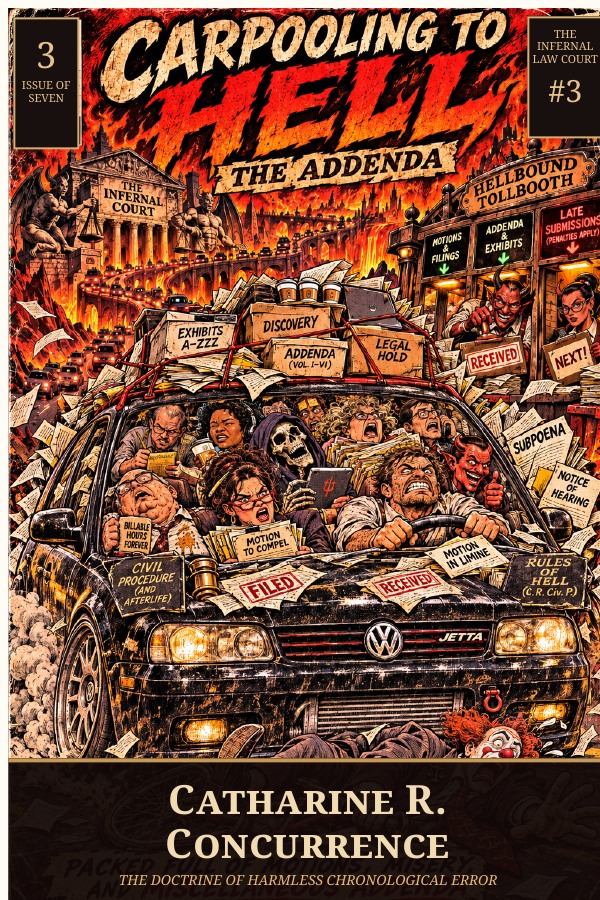
Complete issue text
Upon the Extraordinary Question Whether a Missing Year May Be Restored by Correcting a Footnote
The Third Door resembled a grandfather clock. Its face was marked not with hours but with the months of an imaginary school year. Above the pendulum hung an illuminated sign: ERROR ACKNOWLEDGED — PREJUDICE NOT ESTABLISHED.
Catharine R. Concurrence approached carrying a mahogany pointer, a leather-bound book of harmless-error doctrine, and the invincible confidence of a person who had spent thirty years explaining that many mistakes do not matter enough to reverse a result.
"The principle is sound," she told Satan. "A legal system cannot overturn every judgment for every trivial misstatement."
"Indeed," the Devil replied. "A system must distinguish harmless mistakes from consequential ones. That is a respectable question."
Concurrence relaxed.
"Unfortunately," Satan continued, "your own calendar has suffered a modest clerical correction."
He showed her an imaginary invitation to a child's spring concert. It bore a date in May and a handwritten assurance: I GET A SOLO. DON'T MISS IT.
The clerk's certified version listed the concert as occurring in October of the following year. An ornate seal declared the date PRESUMPTIVELY ACCURATE UNTIL SUBSTANTIALLY DISPROVED.
"That's wrong," said Concurrence.
"A welcome assertion," said Miss Quill, "though I must caution that assertions of wrongness are not themselves adjudications of wrongness."
"I have the original invitation."
"The Court has a certified copy of the incorrect one."
"Then amend it!"
"We may amend our findings upon demonstration that the error materially affected the disposition."
"Of course it does. The show is in May. I will miss it if I arrive in October."
The clerk regarded her with the gentle concern typically reserved for someone who has failed to distinguish jurisprudence from geography.
"Your Injustice, the event's actual occurrence and the Court's legal characterization of its occurrence occupy separate analytical universes. You must demonstrate that correcting the date would alter the ultimate outcome, which is that the event has already concluded."
"It hasn't concluded yet!"
"It will have concluded by the time we decide whether to correct it. The consequence will therefore be the same."
Concurrence opened her book and hunted for a persuasive rebuttal. The index was divided into categories labeled Harmless, Nonprejudicial, Insufficiently Preserved, and Why the Court Is Not Particularly Concerned. The last category occupied most of the volume.
"Then expedite the matter."
"There is no need," replied the clerk. "By the time the Court reaches it, the question of whether the error had consequences will have become entirely theoretical."
Billmore arrived, wheeling a bicycle laden with filing boxes. On the handlebars hung a promotional sign: HARMLESS ERROR WARRANTY — IF YOUR LOSS CANNOT BE REPAIRED, WE GUARANTEE IT WILL BE DECLARED IRRELEVANT.
"May it please the Tribunal," he said, "there is no material prejudice here. The petitioner is still entirely free to attend a concert in October."
"Not that concert."
"The alleged specificity of the event is an impermissible effort to privilege the petitioner's subjective preferences over the institutional preference for chronological flexibility."
He presented three tickets to an October recital performed by the Infernal Department of Appeals and Cross-References, in which every musical instrument would play Pomp and Circumstance at a different tempo and then complain that the audience lacked the experience to recognize the harmony.
Concurrence declined.
The clock swung. The imaginary May concert began behind the glass. Children in bright paper costumes crossed a stage, searching the audience for familiar faces. The little soloist's gaze reached the empty chair and moved away.
Concurrence knocked until her knuckles hurt. The door's latch was marked REQUIRES FINDINGS; the latch below it read FINDINGS NOT REQUIRED WHERE THE ERROR IS HARMLESS.
"Who designed these?" she asked.
"Your favorite committee," Miss Quill answered. "It was chaired by a distinguished person who could not recall its date of formation, but the error was deemed harmless."
Concurrence drafted a seventeen-page motion for correction. She supplied the original invitation, a photograph of the school schedule, the teacher's letter, and three independently notarized statements that October was not May. The court corrected its order in a supplemental footnote, rendering the date accurate after the performance had ended.
"There," said Billmore, smiling. "Your error has been corrected."
"And the concert?"
"It has not been corrected. The Court does not generally engage in the correction of concerts."
"Then you admit the error mattered."
"We admit only that time has passed, which is a fact of such notorious universality that it cannot be attributed to the Court without expert evidence."
Another page fell from the clock. The imaginary child, always safe, was shown at a later age preparing a tiny science-fair display. The title was WHAT HAPPENS WHEN PEOPLE KEEP SAYING LATER. It featured two cardboard houses connected by a bridge made of unreturned invitations.
Concurrence swallowed.
"Can I make that one?"
"You may certainly attempt to do so," said Quill. "The error on the invitation has now been corrected, and it is therefore wholly reasonable to conclude that the administrative problem has been cured."
The new invitation bore an address for a venue that had closed three years earlier.
"Another error," Concurrence said.
"Quite."
"If I don't find the venue, I won't be able to attend."
"Please state your theory of prejudice with particularity."
Concurrence marched to Satan's bench and presented the two invitations side by side.
"A harmless-error doctrine is supposed to prevent pointless reversals," she said. "It isn't supposed to blind us to the consequences of the error simply because those consequences are inconvenient to acknowledge."
"An admirable distinction," said Satan. "Would you make it if the concert belonged to another family?"
She began to answer, then stopped. The imagined child was folding up the science-fair bridge. One end had come loose.
"I should," she said finally.
"Should?"
"I must."
The Devil slid a blank card across the bench.
"Draft the principle."
Concurrence wrote slowly, foregoing the pleasure of an unnecessary Latin adverb.
A court may deem an error harmless only after examining its actual significance, including whether the error affected a practical opportunity that cannot be recreated. Correcting a finding after the opportunity has expired does not, by itself, restore the opportunity.
Billmore cleared his throat. "I object to the term actual. It has a disturbingly empirical flavor."
"I object," added Miss Quill, "to cannot be recreated. The Infernal Department of Retrospective Make-Believe can manufacture a documentary facsimile of virtually any event."
"Then let it manufacture an actual May concert that I can attend in May," Concurrence replied.
The clerk said nothing.
Satan laughed, softly and without pleasure.
"A rare moment," he said. "The court has discovered a fact which refuses to comply with its opinion."
The third clock hand advanced. Concurrence watched the science-fair scene fade, leaving behind a cardboard bridge that had never successfully connected its two shores.
There was nothing inherently improper about correcting a trivial date or refusing to reverse for an insignificant mistake. The injury lay in declaring the date irrelevant before asking what it was a date for.
Concurrence placed the corrected invitation beside the empty chair.
"One can amend a judgment," she said, "but not a childhood."
Miss Quill wrote the sentence in the margin of the third proposed rule. Billmore insisted on billing separately for the comma.
INTERLOCUTORY ORDER NO. III
THE COURT NOTES that an incorrect date may be corrected without undoing time, that correcting it does not necessarily establish a right to further relief, and that the question of materiality cannot be answered by pretending the lost opportunity was immaterial merely because it is lost. The petitioner's proposed principle is PRESERVED for final consideration. Her request to compel May to recur as an administrative courtesy is DENIED AS BEYOND THE COURT'S TEMPORAL CAPACITY.
Entered nunc pro tunc, though not nunc pro childhood.