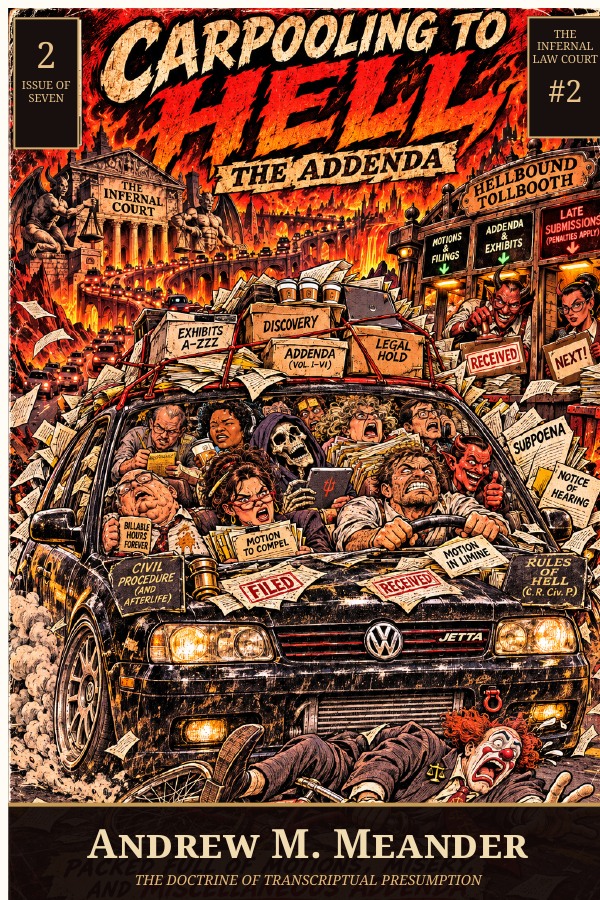
Complete issue text
In re Words Which Were Spoken but Cannot Be Received Unless First Purchased in an Acceptable Font
The Second Door was made of glass. Behind it, safe and unreachable, a fictional child was preparing a small backyard telescope and setting two folding chairs beneath an astonishing sky. On one chair lay a note: I SAVED YOU THE GOOD ONE.
Andrew M. Meander was delighted.
"A clear and unambiguous promise of familial access," he said. "I need only determine the proper evidentiary vehicle by which the promise may be authenticated."
"Or sit in the chair," said the Jetta's driver.
"My dear fellow," replied Meander, "that is precisely the kind of undisciplined shortcut that would leave civilization defenseless against chairs."
An antique gramophone was mounted beside the door. From its horn came an unmistakable voice: "Are you coming? I can see Jupiter!"
Meander smiled. "I hear the invitation."
Miss Quill snapped a velvet cover over the horn.
"The Court takes no position," she said, "on the existence of any sound not first converted into an official transcript."
"I just heard it."
"That is a private auditory experience. The institution recognizes only authenticated representations of such experiences, prepared in the required manner at the required expense."
Meander, who had spent a distinguished career believing the evidentiary record to be sacred, encountered the novel possibility that sanctity might be obtained by charging admission to the altar.
"Then produce the transcript."
A trapdoor opened. A ledger rose upon a hydraulic pedestal, attended by two imps in caps embroidered eSCRIBBLERS, INC. They explained that the forty-seven seconds of the child's invitation could be transcribed only by purchasing an entire 326-page hearing record, pursuant to the Infernal Rule Against Convenient Excerpts.
"Estimated deposit," announced the senior imp, "one thousand five hundred and fifteen dollars and ninety cents."
"For a handful of words?"
"For all words. The public institution recorded them. The vendor has custody of their written future."
"I don't have that sum."
"Then you may elect to proceed without a transcript."
"And the consequences?"
The imp bowed. "In the absence of a transcript, the reviewing tribunal shall presume that every conclusion reached by the lower tribunal is fully supported by the words you could not afford to have written down."
The silence that followed was so entirely substantive that Billmore attempted to invoice it by the minute.
Meander was not accustomed to being on the losing side of a presumption. Like most admirers of deference, he had principally encountered it while sitting above the people from whom deference was demanded.
"But the recording exists," he said.
"An unfortunate redundancy," the imp replied. "It is the raw material from which an acceptable expense may one day be manufactured."
"Give me the audio, then."
"Audio is not a transcript."
"What about a statement in lieu?"
"We would require a formal settlement process."
"Set one."
"The motion requesting that process must be supported by an adequate record."
"The very record I'm trying to obtain?"
"You have finally grasped the elegance of the arrangement."
From the other side of the glass, the safe, invented child pointed toward the sky. Meander could no longer hear the words. He watched a little finger trace the outline of a planet, then turn toward the empty chair and hesitate.
He submitted an application to proceed without payment of fees. The infernal court granted it with unusual speed. He received a beautifully framed order waiving the cost of entering the building, the cost of receiving a docket number, and the surcharge ordinarily imposed upon persons who could not afford surcharges.
"Excellent," said Meander. "Now the transcript."
"That is a different expense," Miss Quill explained. "The order concerns the filing fee, not the optional evidentiary material without which your challenge is impossible."
"A transcript is not optional if its absence defeats review!"
Miss Quill nodded with professional sympathy. "Our procedures have an exceptional talent for making indispensable things optional."
The Devil arrived carrying an old-fashioned reel-to-reel tape recorder. He pressed PLAY. From the speaker came the child's invitation in full, followed by the modest sound of a garden gate clicking in the breeze.
"Your proof," said Satan.
Meander lunged toward it.
The Devil pulled the tape away.
"Not so quickly. I am told that the presence of a recording is legally beside the point if the approved documentary abstraction has not been produced."
"You are tormenting me with an absurdity!"
"I am repeating an argument," Satan replied, "in the solemn tones associated with its distinguished acceptance. Why does it cease to comfort you when you stand where the appellant stands?"
"Because I know the facts!"
"An excellent point. We shall have it entered as a dispute over whether a person lacking access to a factual record has nevertheless attempted to dispute the facts. The presumption shall then supply the answer to the very question the missing material was sought to test."
Billmore emerged from behind a stack of invoices, rubbing his hands together.
"May it please the Tribunal, this is a masterpiece of procedural economy! By preventing the appellant from establishing the record, we prevent him from establishing the basis upon which the appellant could question the record. We have reduced the number of potentially troublesome facts to zero."
"And therefore the judicial workload?" Satan asked.
"Also zero."
"A remarkable efficiency," the Devil murmured. "What a pity it serves so few people other than the efficient."
Meander went to the driver's Jetta and sat on its hood. The car was warm. Its windshield was half covered in parking tickets issued for remaining stationary during legal review.
"I always thought the burden of supplying the record was a neutral rule," he said.
"It is a rule," replied the driver. "But whether someone can actually get the record is a different question."
"The appellate court cannot invent testimony."
"Of course not. But it can explain whether anyone has a fair way to get the testimony that already exists."
Meander looked back through the glass. The backyard was now empty except for the two chairs, the telescope, and a blanket carefully folded over the seat reserved for him.
"What if the recording contradicts the finding?" he asked.
"Then the contradiction matters," said the driver.
"And if it doesn't?"
"Then at least somebody checked."
The directness of the answer affected Meander more profoundly than any thirty-page concurrence he had ever written.
At the recording desk he filled out one final motion. This time he omitted the phrases insofar as, subject to the foregoing, and as the Court may otherwise deem just, which left a great deal of white space but clarified the request magnificently.
If the court records a hearing, an appellant who cannot pay for a transcript must have a realistic, orderly way to seek an authorized alternative record when the applicable rules permit it. The court should decide such requests openly, and explain what is missing and why.
"That is dangerously comprehensible," Miss Quill warned.
"Then I will accept the danger," Meander said.
The imp from eScribblers arrived with a cancellation letter for the first transcript order. It was dated yesterday, printed on tomorrow's letterhead, and addressed to a person who had never been notified that either day existed. A small check box marked NOTICE SERVED had been checked because the letter itself was aware of its own existence.
"We shall require proof of service," said Meander.
"Surely the letter is proof that the letter exists," the imp said.
"Existence is not delivery."
"You sound like a layperson."
"I sound," Meander said, "like someone who wants to know whether the door was ever opened."
He asked Satan for the tape once more. This time he asked not for special access but for a published process governing access for everyone similarly situated. The Devil nodded and placed a second bookmark into the ledger of proposed universal remedies.
The glass door remained closed. It was not a punishment of the imaginary child, whose safe evening had unfolded beyond its reach. It was a measurement of the adult's lost opportunity to hear and answer a question before the answer ceased to matter.
Meander returned the two empty chairs to their imagined place in his mind. He could still hear, with painful precision, one sentence from the tape.
I saved you the good one.
His opinion of procedural neutrality had finally encountered the evidence.
INTERLOCUTORY ORDER NO. II
THE COURT FINDS that a record cannot meaningfully serve the purpose of review when its practical acquisition is made the obstacle to review itself. Petitioner's demand for a magic transcript obtainable through pure indignation is DENIED; the proposed rule requiring an accessible, rule-compliant process for alternative records is RESERVED, subject to the scandalous possibility that a recorded hearing might someday be heard.
Certified by the Infernal Office of Audible Things Too Costly to Hear.