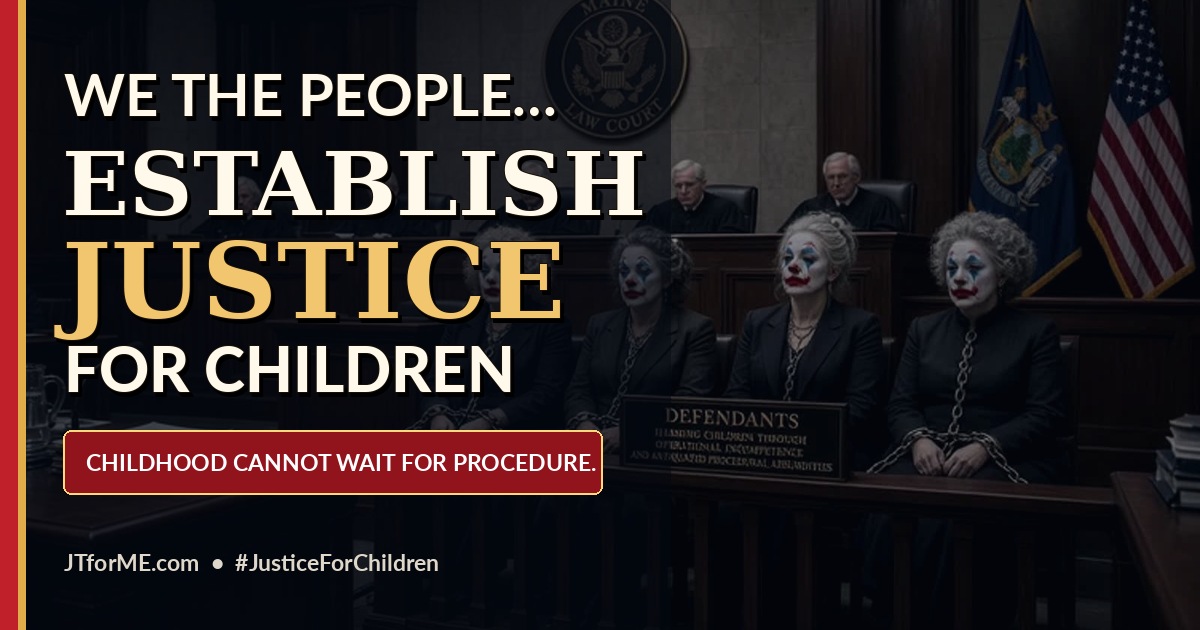
Childhood is perishable.
Time in a child’s life does not pause while adults exchange filings, debate jurisdiction, or wait for the next available date.
A public campaign · Lawful · Peaceful · Evidence-based
The Constitution names justice as a purpose of government. That promise is unfinished anywhere a child can lose years to delay, procedural drift, inaccessible records, or orders that exist on paper but fail in life.
Children are not docket numbers. Childhood is not renewable.
Three truths the system cannot proceduralize away
A court can close a docket. It cannot return a birthday. An agency can issue a final letter. It cannot restore ordinary daily life. An appellate opinion can declare an error harmless. It cannot make the lost year harmless to the child who lived it.
Time in a child’s life does not pause while adults exchange filings, debate jurisdiction, or wait for the next available date.
When officials know that time itself is causing harm, choosing not to act is not neutral administration. It is an outcome.
A perfect explanation of procedure is worthless when no enforceable provision reaches the child before the damage is done.
The public standard
These are not abstract preferences. They are basic operational requirements for a public system that claims to protect children and families.
Prompt hearings, rulings, and written reasons when parent-child relationships, safety, healthcare, education, or therapeutic access are at risk.
Automatic escalation when delay threatens to defeat the purpose of the requested relief or turn a live child-impact dispute into an empty historical question.
Usable audio, transcripts, exhibits, and appellate records regardless of wealth. Meaningful review cannot depend on who can purchase the evidence of what occurred.
Clear logistics, defined responsibilities, compliance clocks, and meaningful enforcement—not broad language that leaves one adult free to convert a right into a practical veto.
Independent investigation when credible evidence identifies prolonged interference, escalating conflict, adult blame narratives, or foreseeable developmental harm.
Plain rejection reasons, reliable correction paths, preserved filing dates, transparent performance reporting, and refunds when a filing is rejected or never reaches the docket.
Measurable reporting on delay, implementation, rejected filings, record access, child-impact outcomes, and whether ordered relief produced real-world compliance.
The campaign pledge
“I will not accept a system that treats childhood as renewable, delay as neutral, or procedural closure as justice. I support lawful, peaceful, evidence-based reform that makes the protection of children a measurable public duty.”
Copy it. Post it. Send it to the people who write the laws, administer the courts, fund the systems, and decide what Maine’s newsrooms consider worthy of public attention.
Use the campaign
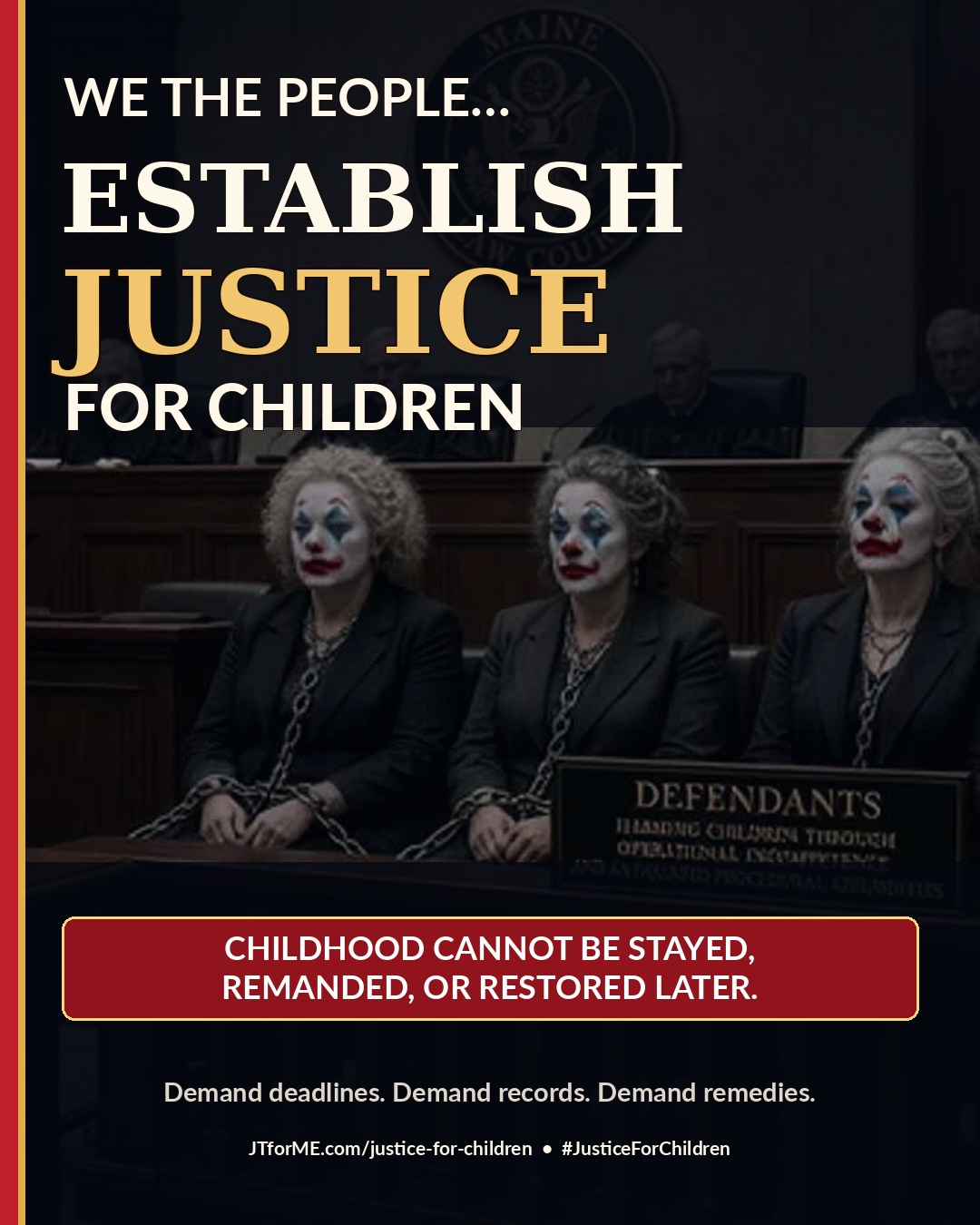
The campaign kit contains the corrected 15-second video, social card, vertical poster, full statement, and social sharing copy. Use it with the source page attached so the public can examine the demands in context.
Public advocacy only. No private case intake. Preserve children’s privacy and attach public sources when making factual claims.
The constitutional promise
That sentence is not ceremonial decoration. It is a job description for government—and a standard the people are entitled to enforce through criticism, petition, legislation, oversight, elections, and lawful reform.
Justice for Children · Public notice
When public institutions knowingly excuse foreseeable harm to children, We the People do not owe them silence, ceremony, or automatic deference. We have a duty to alter and reform them.
Justin A. Tahai’s published opinion is deliberately severe: officials who knowingly proceduralize preventable harm to children are morally no better than adults who prey on children. That is a moral comparison and political opinion—not an allegation of sexual misconduct.
“In the early stages of becoming a man, I learned to wield the figurative sword. For my son, I learned to wield the pen. For my family, should they ever need it of me, I would wield both.”
July 2025 letter to all courts. The sword is expressly figurative and means lawful constitutional action—not violence.