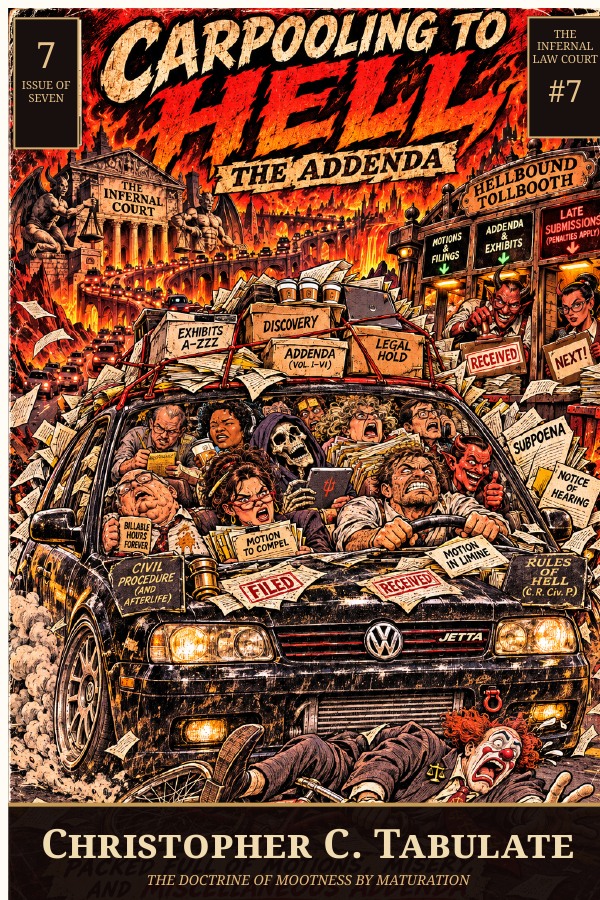
Complete issue text
In re the Extinguishment of Childhood Through the Ordinary Passage of Time, with Costs Taxed to the Party Who Noticed
Christopher C. Tabulate was a careful man, given to columns and subcolumns, appendices and indices, and the comforting assumption that any human catastrophe could be rendered administratively manageable by assigning it a stable item number.
When he approached the Seventh Door, a clerk presented him with a receipt bearing precisely six decimal places. The receipt confirmed that his request for ordinary family contact had been received, indexed, archived, and successfully categorized as PENDING A DETERMINATION OF WHETHER FURTHER DETERMINATION IS REQUIRED.
"Excellent," said Tabulate. "At last, a properly controlled record."
Beyond the glass, an imaginary child was standing at the entrance to a park on a summer morning, holding a kite with seven brightly colored ribbons. The child had asked to share the afternoon. The invitation was voluntary; the fictional child was safe and remained free to leave at any moment. The only impediment was the adult's procedural access to the moment.
A wall clock read AGE: SIX.
"A delightful prospect," Tabulate murmured. "I shall address it in the ordinary course."
He filed a motion requesting a date. The clerk stamped it, scheduled a status conference, and assigned a case management number. The number had sixteen digits, eleven letters, four hyphens, and one decorative semicolon which, if omitted, rendered the entire application void.
The clock advanced to AGE: EIGHT.
"That moved rather quickly," Tabulate said.
"Two years is a modest interval when normalized across an institution's historical docket," Miss Quill replied.
He sought expedition. The Court denied it without waiting for a response. Tabulate requested reconsideration. The denial of reconsideration was entered immediately, thereby establishing that the Court was capable of extraordinary speed when declining to accelerate a matter.
The clock advanced to AGE: ELEVEN.
The imaginary child had traded the kite for a stack of library books. There was a note on the gate: CAN YOU COME TO THE SCIENCE FAIR?
"This is still manageable," Tabulate insisted. "The essential right has been preserved."
Billmore appeared, pedaling a bicycle fitted with a tiny conveyor belt that fed unopened motions into a shredder. The shredded paper emerged as confetti in the shape of judicial laurels.
"Magnificent news," the clown attorney announced. "The case's administrative maturity has improved by thirty percent. Pending motions are no longer measured by age but by density, which allows substantial backlog to be celebrated as an impressive concentration of institutional activity."
Tabulate filed a motion for immediate calendaring. It was assigned a priority code meaning highly important once all ordinary matters have been completed. Because ordinary matters could never be completed while new ordinary matters continued to arrive, the case was placed in a category known as INDEFINITELY PRIORITIZED.
The clock advanced to AGE: FOURTEEN.
Through the door appeared an imaginary basketball court. A tall teenager bounced a ball, looked toward the gate, then returned to the game. Tabulate could see that the opportunity had changed. A kite would no longer interest this imagined person. The books had been exchanged for other interests. Time did not merely subtract birthdays; it altered the form of the relationship that might have grown between them.
"I need a hearing now," Tabulate said.
"Your application remains pending."
"If it remains pending, it will become pointless."
"That possibility has been noted for preservation purposes."
"Don't you understand? I won't get this time back."
Miss Quill lifted her eyes from the ledger.
"Sir, this Tribunal operates under a doctrine of nonretroactive temporal conservation. Time which has passed shall not be presumed available for redistribution. It therefore follows that your inability to recover it is not itself a reason to hurry."
"That is insane."
"Objection: inflammatory vocabulary."
The clock advanced to AGE: SEVENTEEN.
Tabulate submitted a comprehensive index of lost opportunities. The spreadsheet listed birthdays, ordinary Saturdays, school events, first attempts at driving, a competition, a graduation rehearsal, quiet meals, and the small unremarked conversations through which two people acquire the habit of knowing one another. It contained precisely 1,103 line items. Billmore admired the spreadsheet and charged for reviewing the column widths.
"The index is thorough," the clown said. "Its only defect is that it does not alter the governing presumption that the proceedings have been entirely proper."
Tabulate went to the clerk's window and presented the table.
"I can demonstrate the dates."
"Excellent. Date evidence is particularly suitable for retrospective explanation."
"I can demonstrate the requests."
"Also excellent."
"I can demonstrate that the requests weren't decided in time."
"A compelling administrative observation."
"Then what more do you need?"
"Proof that the delay affected an outcome which remains available to be affected."
Tabulate stopped breathing for a moment. The sentence was a perfect loop: relief was denied until the opportunity expired, then the expiration was invoked to explain why relief was no longer available.
He had once admired elegant loops. He now understood how easily they became nooses around an issue while leaving the institution's hands entirely clean.
The clock advanced to AGE: EIGHTEEN.
A graduation cap appeared on the fictional young person's head. There was a diploma, a crowd, a warm evening. The child had become an adult in the allegory, still safe, independent, and entitled to make every personal choice. The door did not open. Instead, an electronic chime announced:
CONTROVERSY DISMISSED AS MOOT BY MATURATION.
"What?" Tabulate whispered.
"The subject has attained the age at which the particular form of relief originally requested can no longer be imposed," Miss Quill explained. "The Court therefore finds no live controversy warranting further consideration."
"But I filed when there was one!"
"Yes."
"And I begged you to decide it!"
"Repeatedly."
"And the institution waited!"
"In the ordinary course."
"Then the institution can't congratulate itself because the case became impossible to remedy!"
Miss Quill consulted her manual. She looked at the clock, then at the file, then at the note reading PETITIONER SEEKS APPROPRIATE RELIEF.
"There appears to be no box for that proposition," she admitted.
Tabulate turned to Satan.
"Undo it," he said.
"I cannot," the Devil answered. "Nor can any court, however splendid its robes. The question is what your institution ought to do before that point."
Tabulate sank onto the gallery bench. His impeccable table had measured the loss perfectly and prevented none of it.
For a long time, nobody spoke. Even Billmore ceased counting the seconds, though he continued billing them internally.
At last Tabulate rose, walked to the seventh bookmark, and wrote:
When a child's developmental time makes a requested remedy uniquely time-sensitive, courts should address practicable urgent relief while the controversy is live. A later finding of mootness may accurately describe the loss of jurisdiction or the unavailability of a specific remedy; it should not be treated as an answer to the separate question whether avoidable delay contributed to the loss of that remedy.
Satan read the sentence twice.
"You have not asked me to restore the imaginary childhood."
"I know you can't."
"You have not asked for a personal exception."
"No."
"Then perhaps," the Devil said, "you have finally filed a motion that concerns somebody besides its author."
All seven clock hands stopped moving. The seven doors stood in a row, each displaying one vanished ordinary opportunity. No imagined child was in danger; none had been physically held. Each had safely continued into a life beyond the court's control. The harm demonstrated to the adults was the absence of shared time, a thing the record could name but never manufacture.
The driver stepped from the Jetta and glanced at the clock.
"How many words did it take?" he asked.
Tabulate stared at the seven completed pages in the ledger.
"Far too many," he said.
"And what's the answer?"
Tabulate spoke plainly.
"Decide what can be decided while it can still matter."
A door opened, not to yesterday but to the courtroom beyond. It was time for all seven to hear a final judgment.
INTERLOCUTORY ORDER NO. VII
THE COURT FINDS that a mootness determination may be legally necessary when a requested remedy can no longer be granted, but that mootness is not a congratulatory certificate bestowed upon those who helped time overtake a live controversy. Petitioner's demand to restore the years is DENIED for the most unfortunate and least fictional of reasons: no tribunal can do so. His proposed rule concerning time-sensitive adjudication is PRESERVED FOR IMMEDIATE FINAL CONSIDERATION.
The word immediate is used here in its ordinary, practical sense, an innovation the clerk has reluctantly approved.