Skip to content
JTforMEFrom public purpose to practical reform
Menu
Urgent help & crisis support

The complete revised public blueprint

Justice, Rebuilt.
All 46 pages.

Read every page below, open its selectable text, or download the original PDF with all bookmarks and links intact.

Browse the full page list
  1. Page 1 — Justice, Rebuilt.
  2. Page 2 — Title and public purpose
  3. Page 3 — Start here
  4. Page 4 — Find the argument. Follow the plan.
  5. Page 5 — 01 / Purpose, safeguards and authority
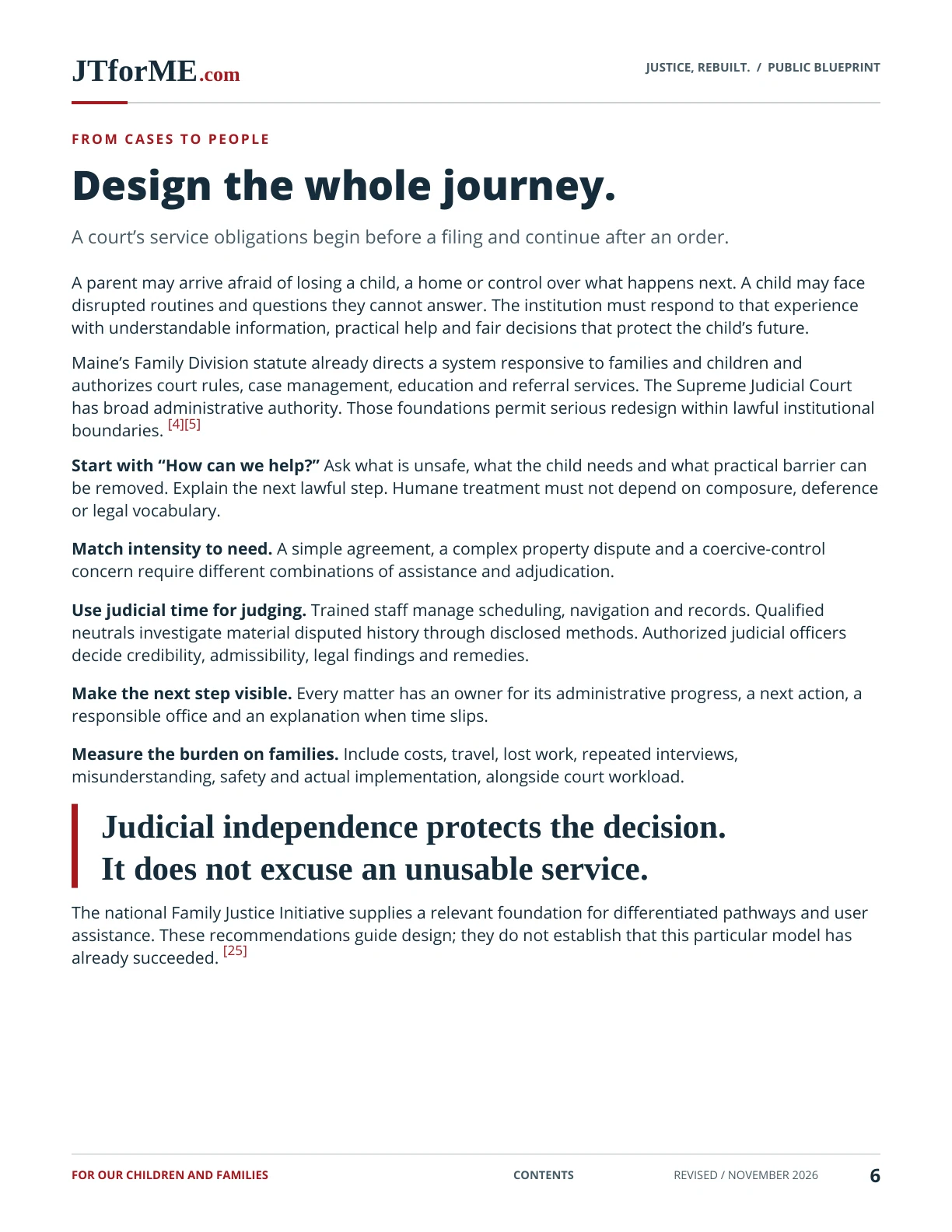
  6. Page 6 — Design the whole journey.
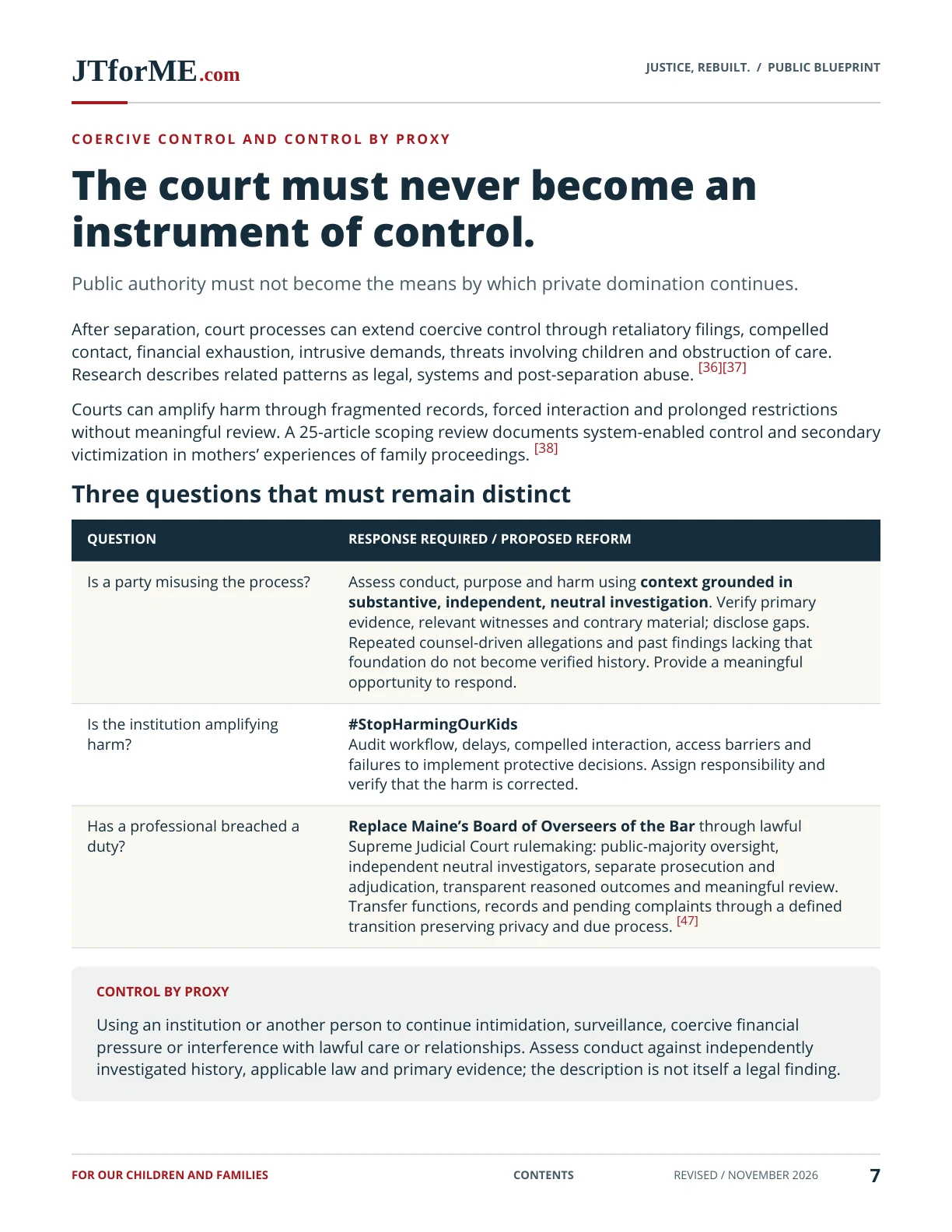
  7. Page 7 — The court must never become an instrument of control.
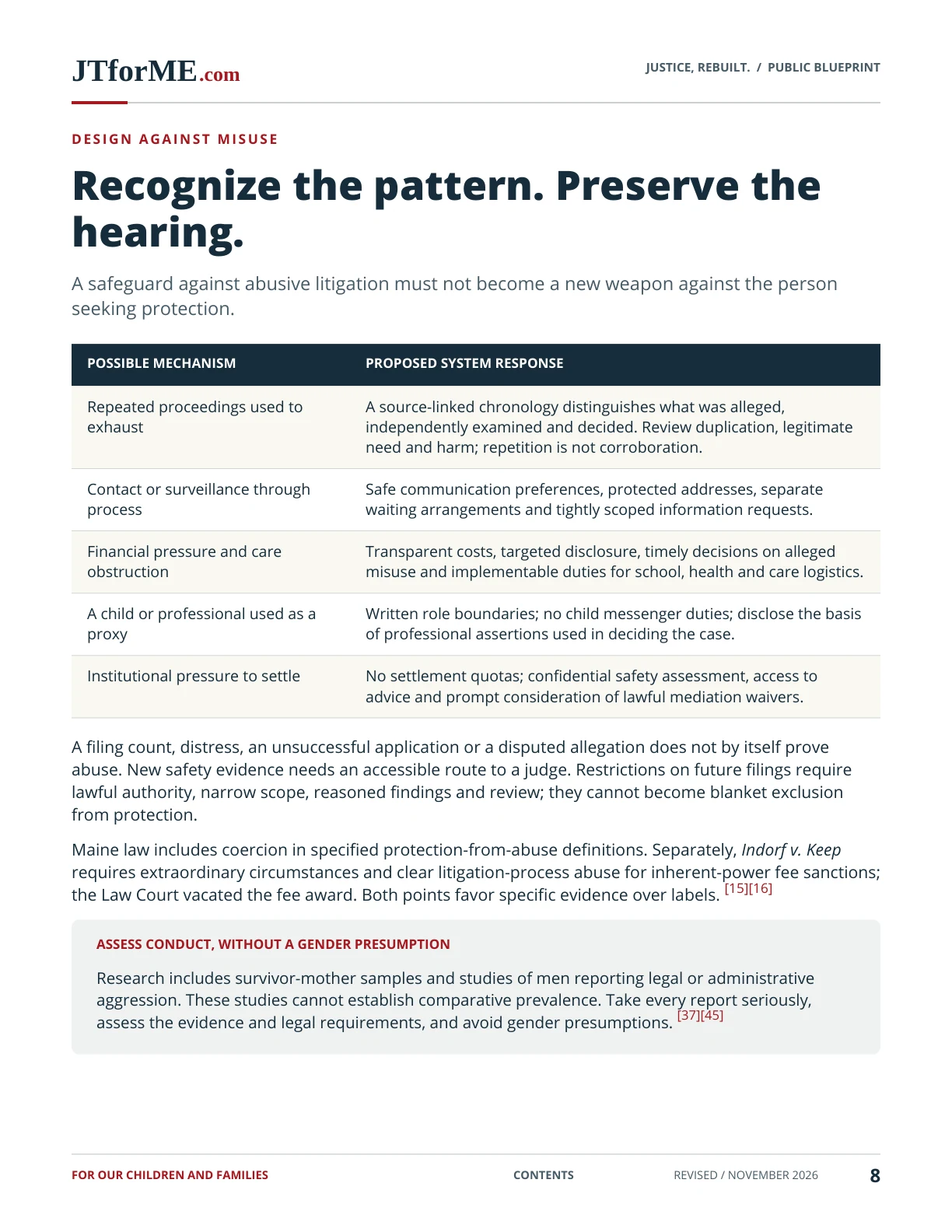
  8. Page 8 — Recognize the pattern. Preserve the hearing.
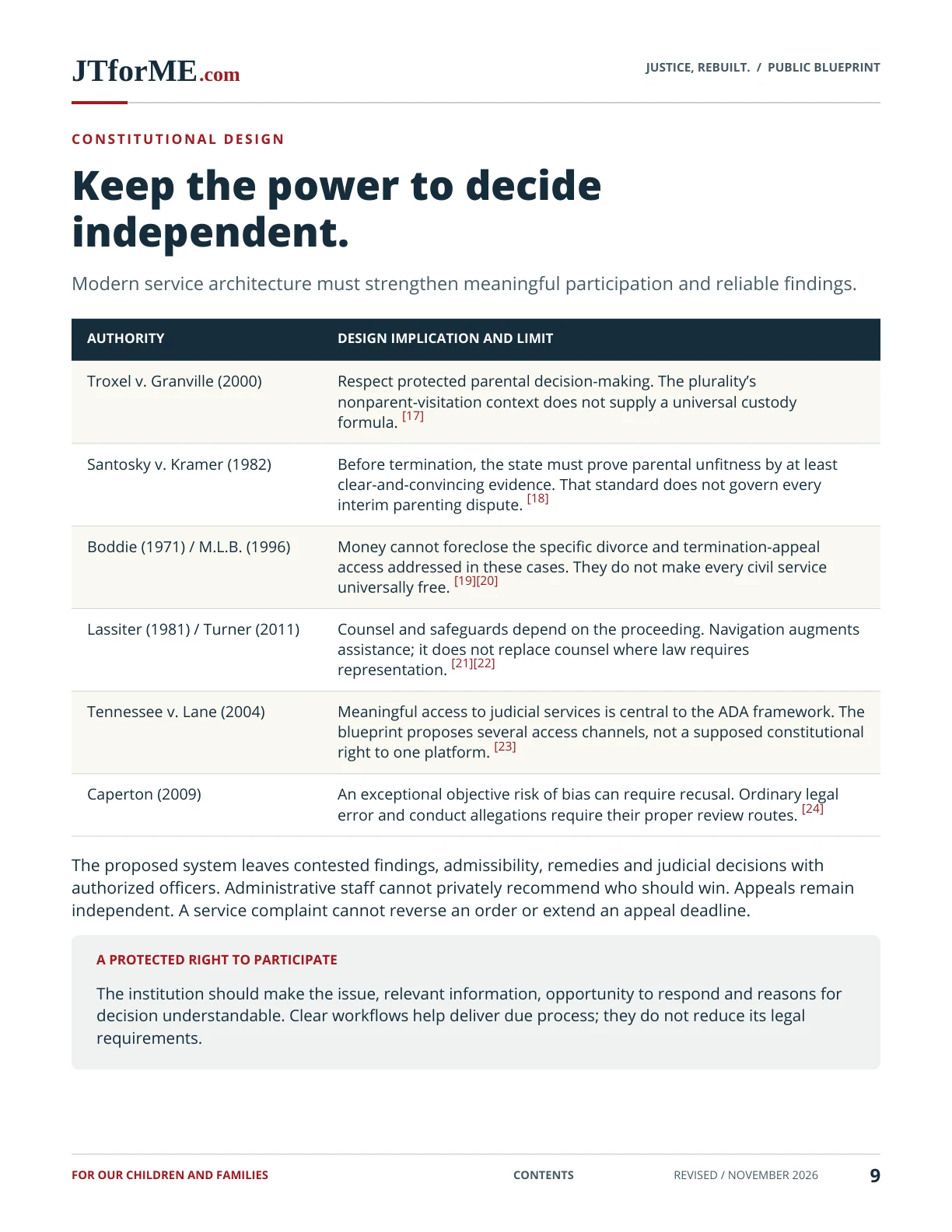
  9. Page 9 — Keep the power to decide independent.
  10. Page 10 — Put each decision in the right hands.
  11. Page 11 — 02 / The public experience
  12. Page 12 — A visible next step at every stage.
  13. Page 13 — Make the front door understandable.
  14. Page 14 — Match service to risk and complexity.
  15. Page 15 — Screen before creating settlement pressure.
  16. Page 16 — Hear the child. Do not make the child carry the case.
  17. Page 17 — History must be investigated.
  18. Page 18 — A fair hearing that people can understand.
  19. Page 19 — A decision is not delivery.
  20. Page 20 — A coordinated team with explicit boundaries.
  21. Page 21 — 03 / Evidence and learning
  22. Page 22 — A modern interface is only the beginning.
  23. Page 23 — Evidence that changes the design.
  24. Page 24 — “How can we help?”
  25. Page 25 — Make help reachable.
  26. Page 26 — Support can change outcomes.
  27. Page 27 — Investigate harm. Measure help.
  28. Page 28 — 04 / Delivery and accountability
  29. Page 29 — Independent judging. Accountable service.
  30. Page 30 — Automate the burden. Keep judgment accountable.
  31. Page 31 — Fund the service. Show the arithmetic.
  32. Page 32 — Measure what families actually receive.
  33. Page 33 — Start now. Replace carefully.
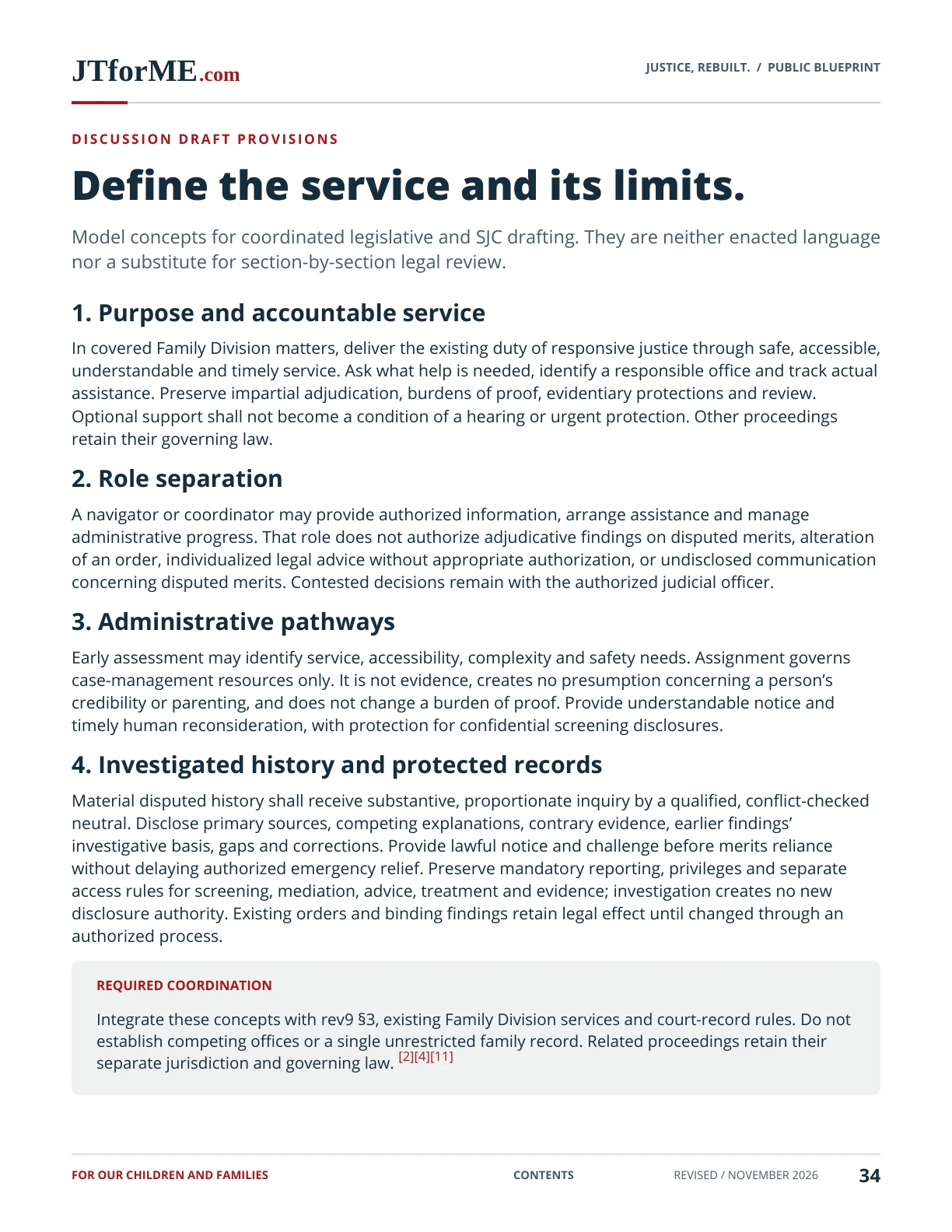
  34. Page 34 — Define the service and its limits.
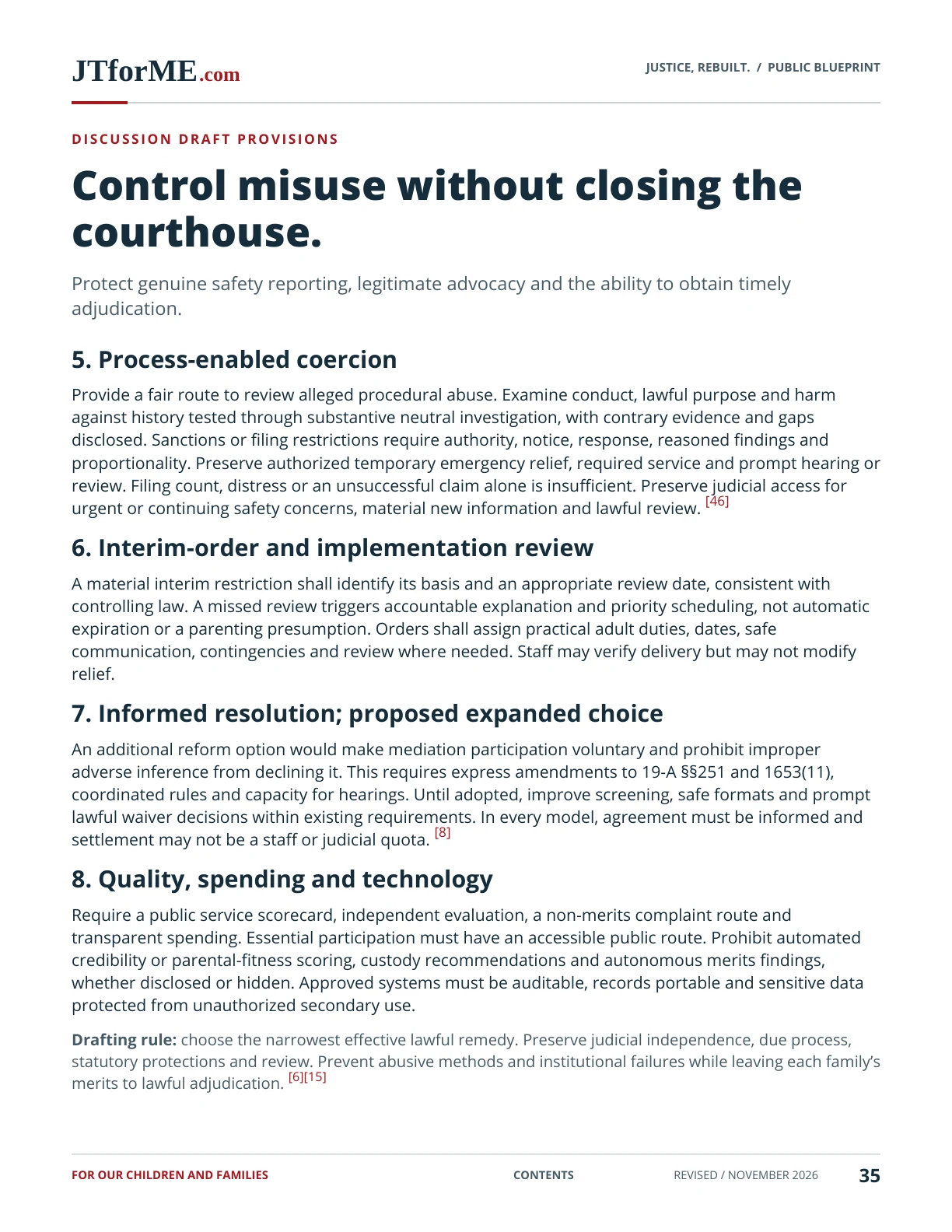
  35. Page 35 — Control misuse without closing the courthouse.
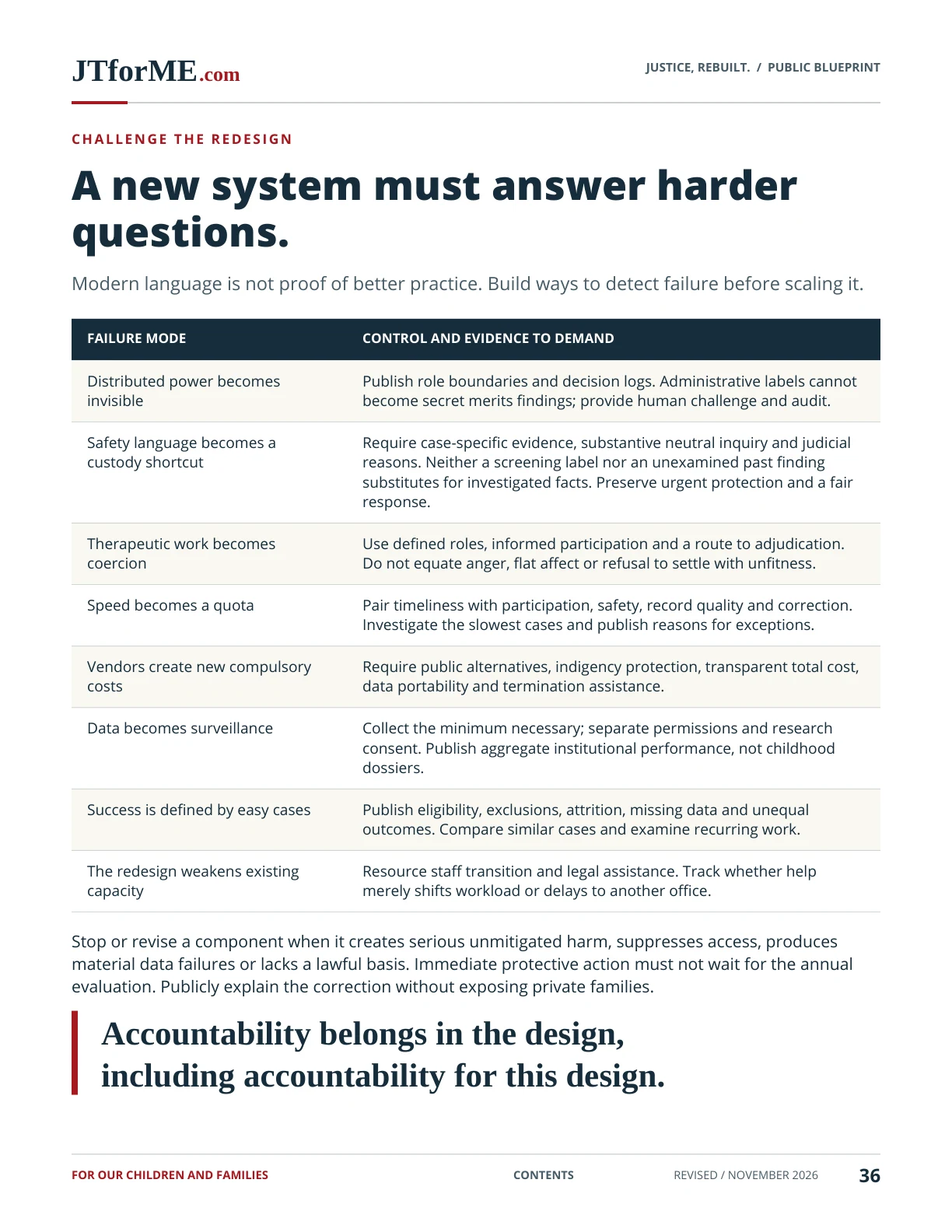
  36. Page 36 — A new system must answer harder questions.
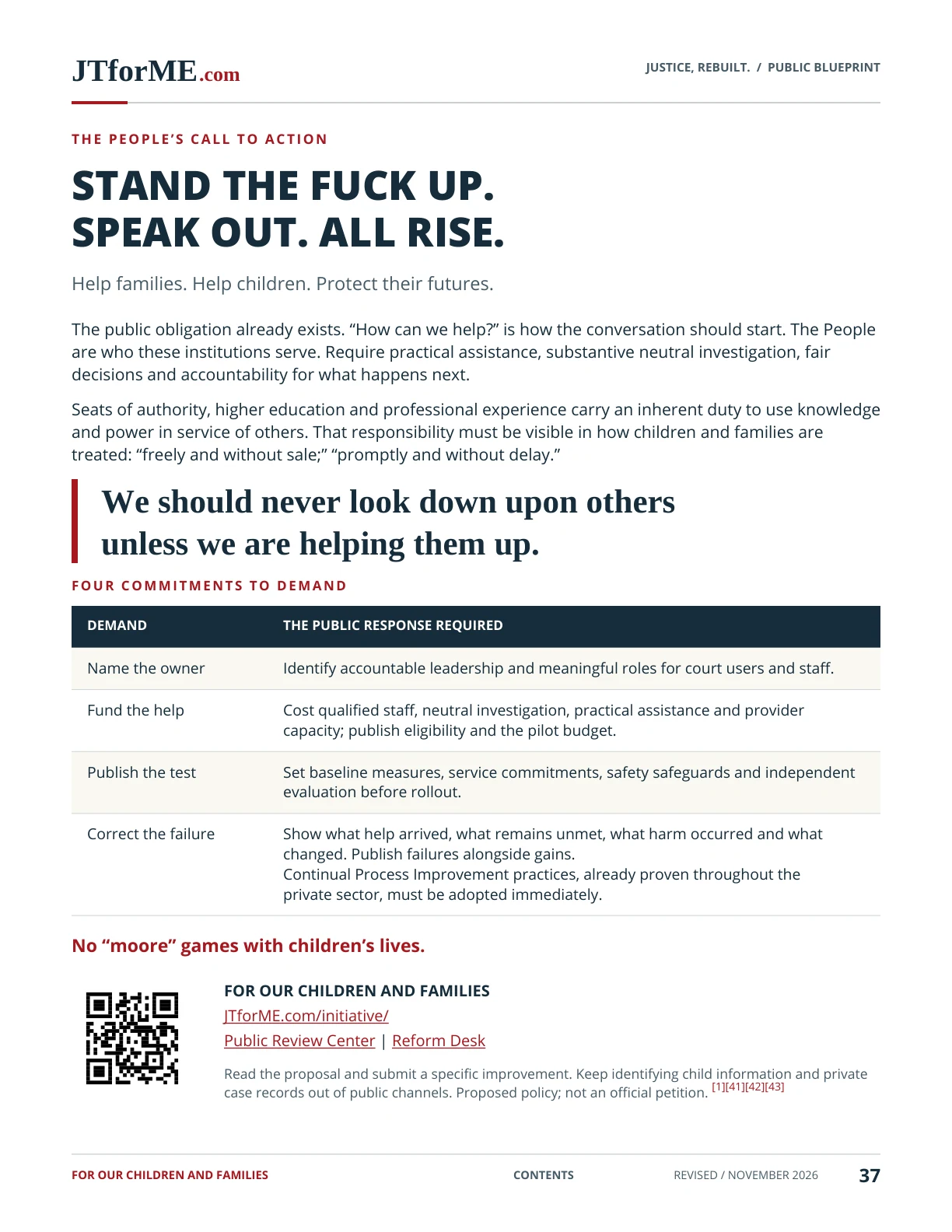
  37. Page 37 — 05 / Public action
  38. Page 38 — 06 / Sources and research notes
  39. Page 39 — Sources 07 onward
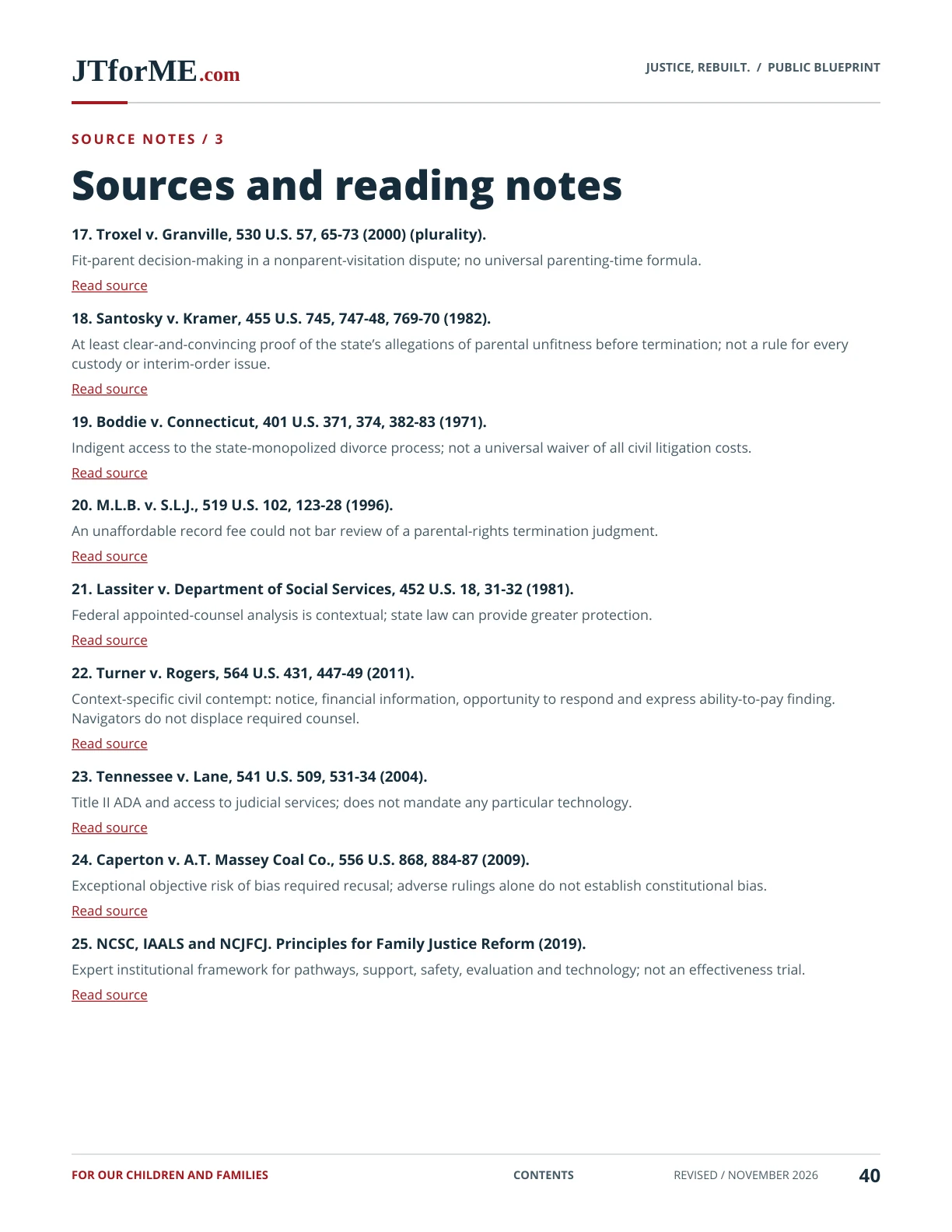
  40. Page 40 — Sources 17 onward
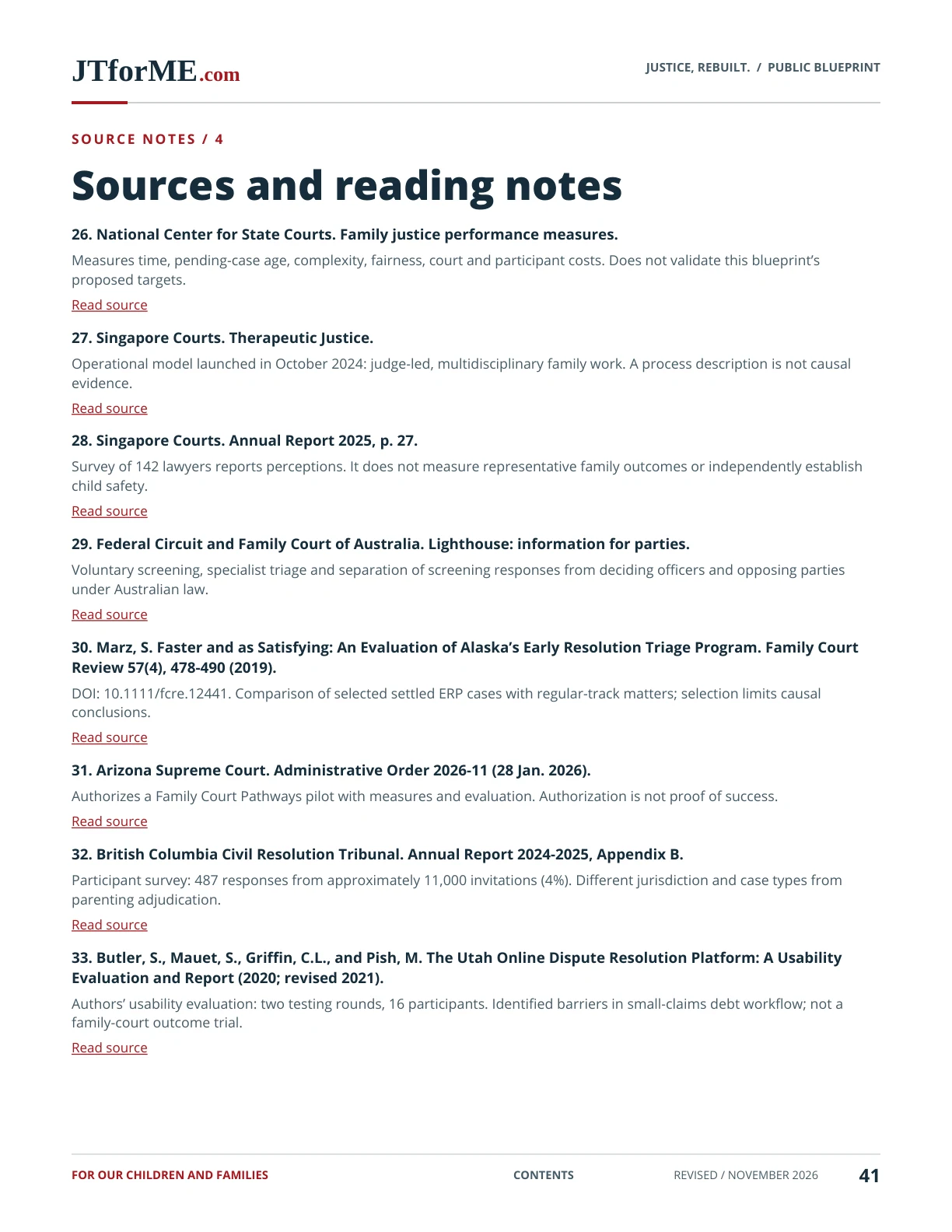
  41. Page 41 — Sources 26 onward
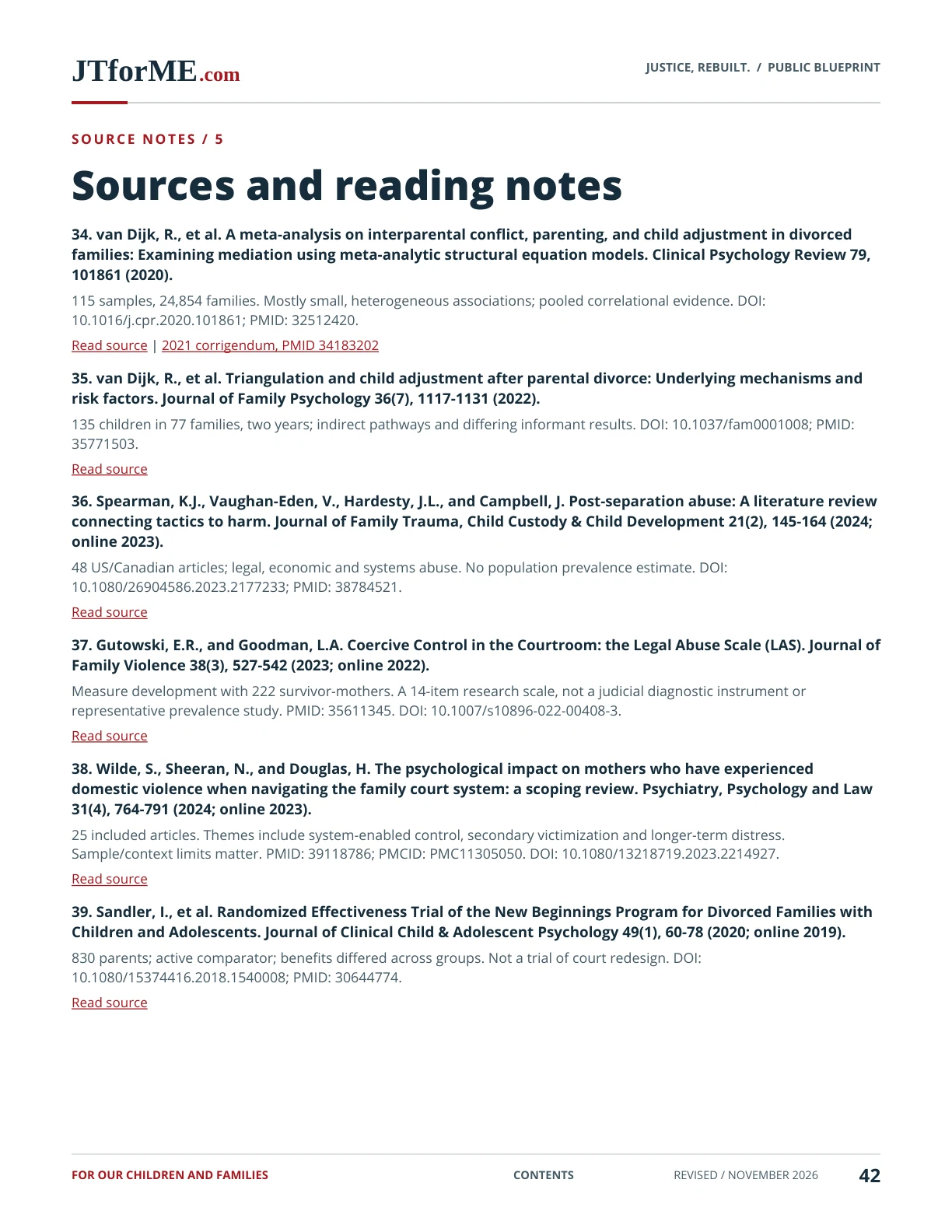
  42. Page 42 — Sources 34 onward
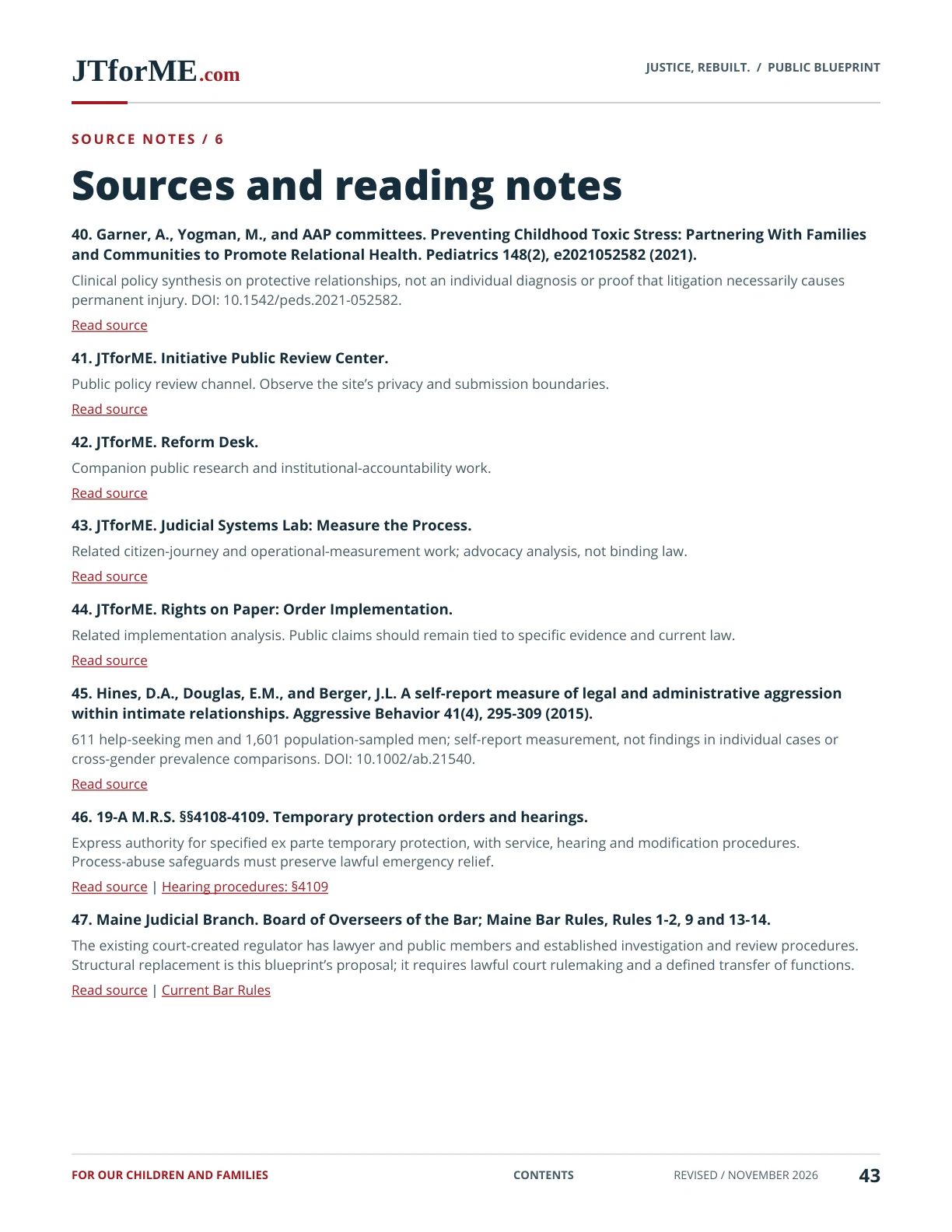
  43. Page 43 — Sources 40 onward
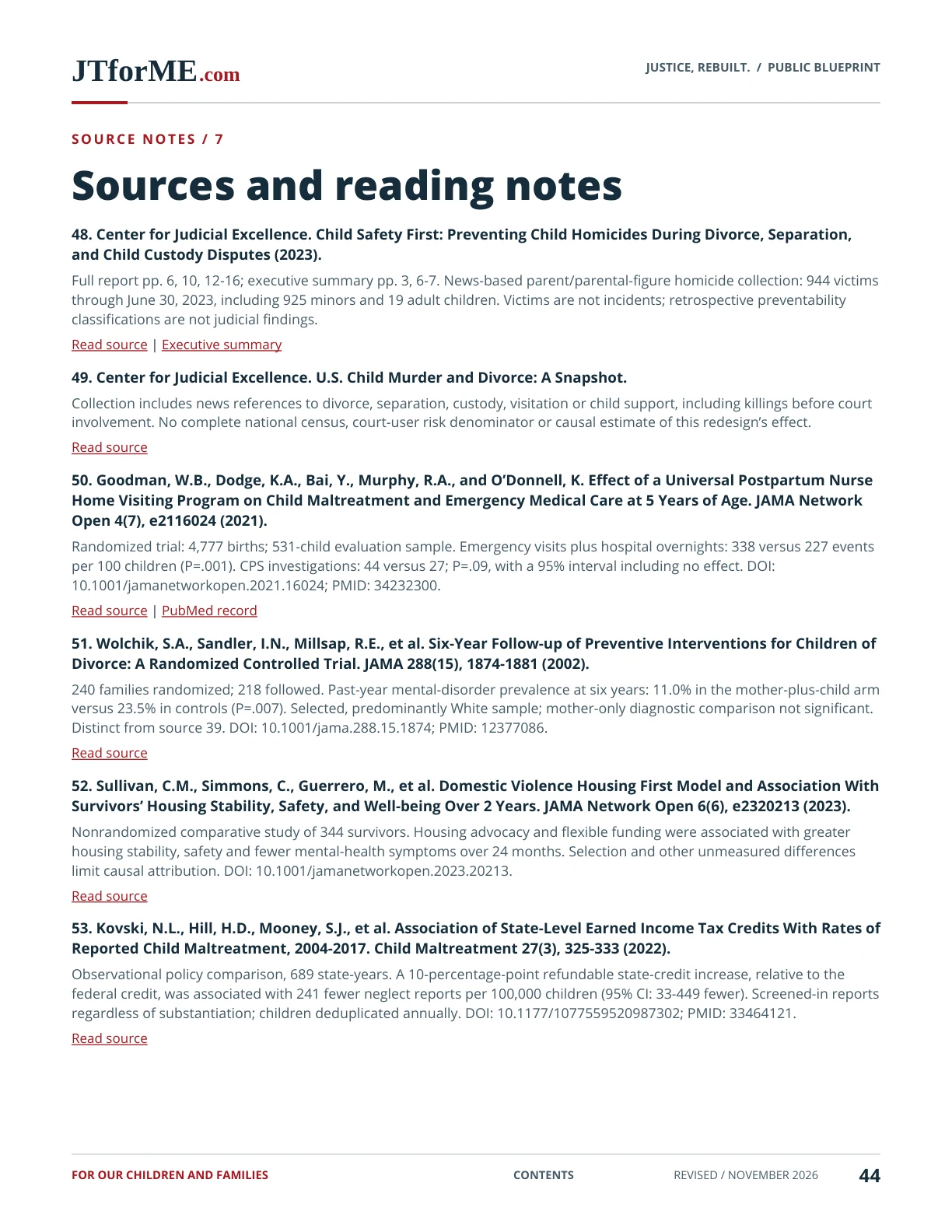
  44. Page 44 — Sources 48 onward
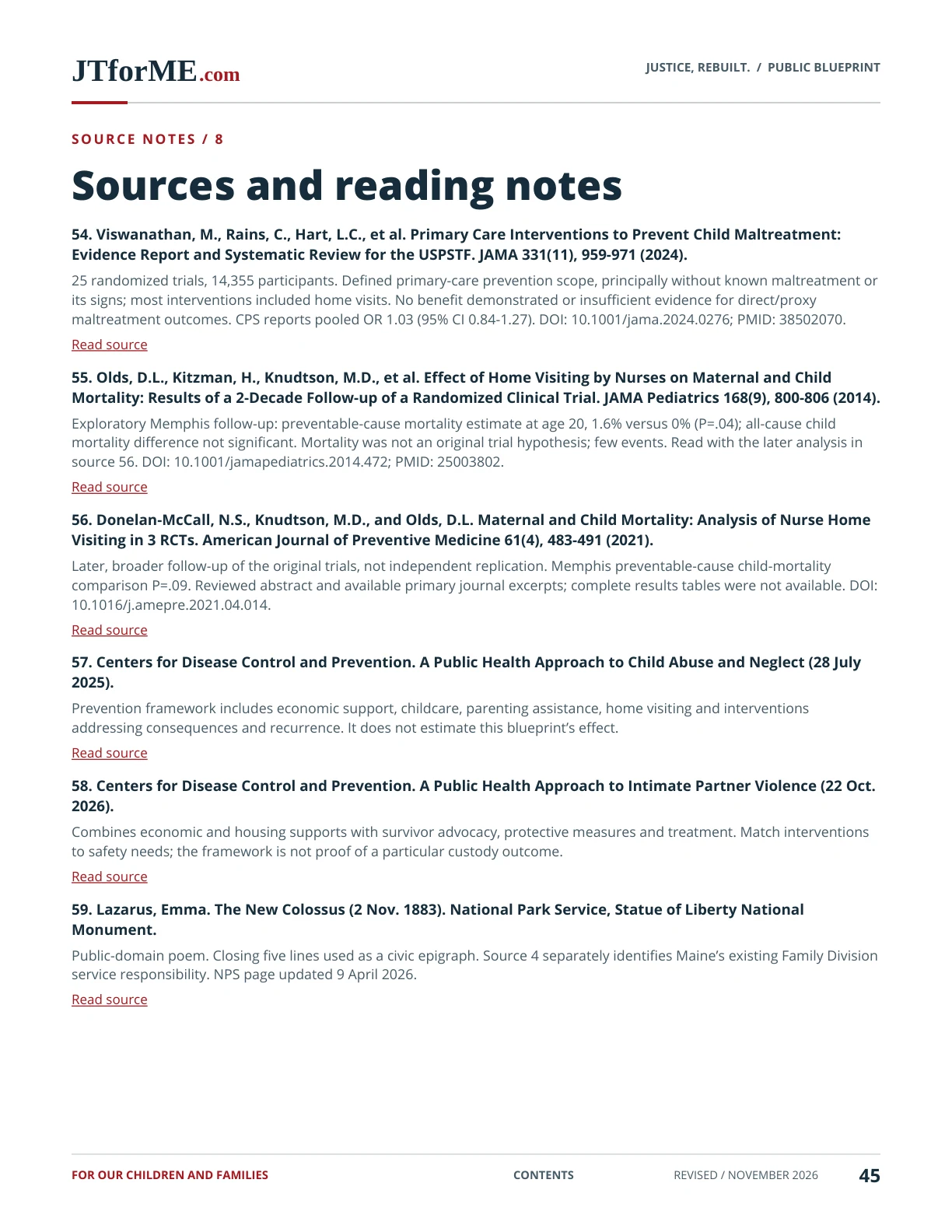
  45. Page 45 — Sources 54 onward
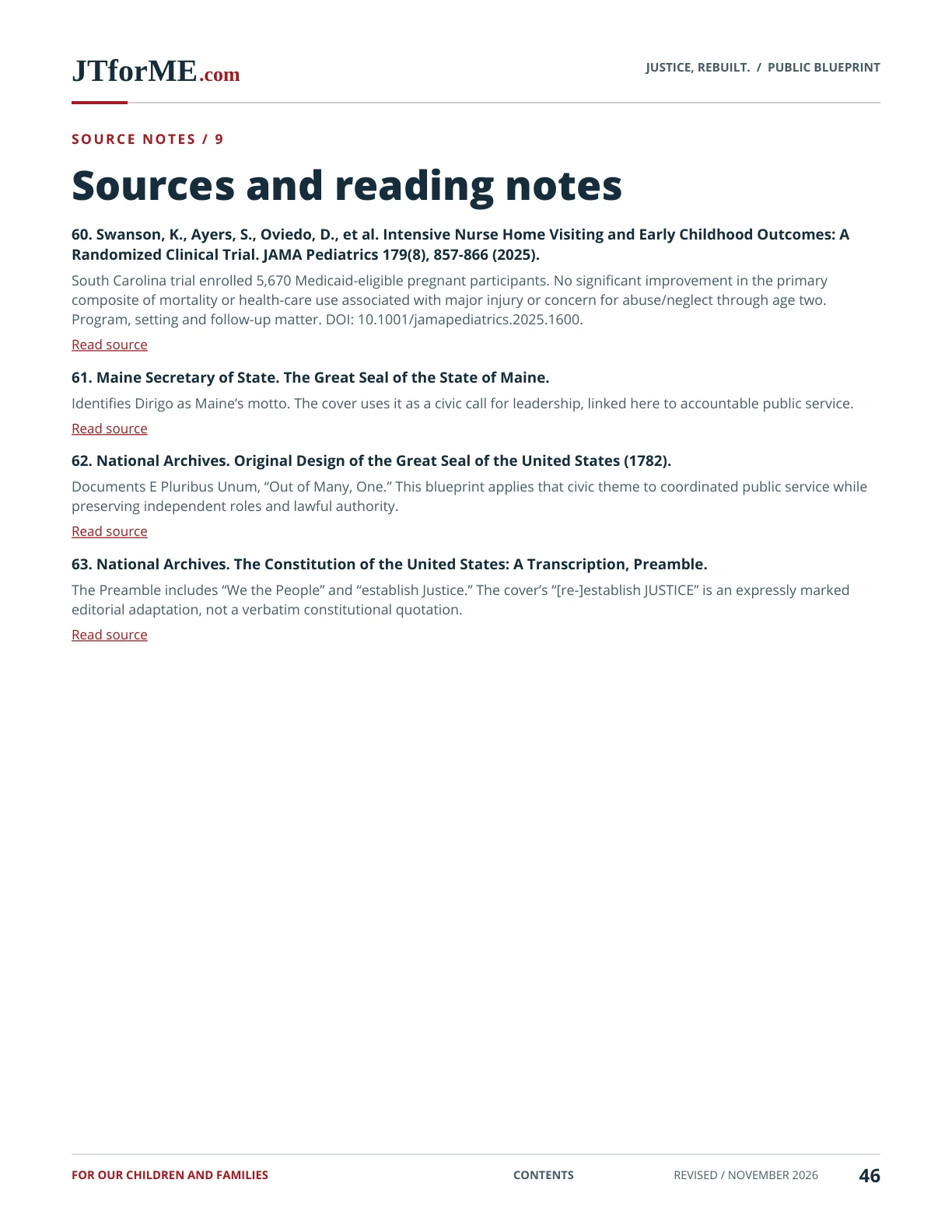
  46. Page 46 — Sources 60 onward
Blueprint page 1: Justice, Rebuilt.. Full page text follows.
Read selectable text — page 1

Text extracted from the revised PDF. The original page governs layout, tables and citation placement.

JTforME.com
PUBLIC BLUEPRINT / REVISED EDITION
“Give me your tired, your poor,
Your huddled masses yearning to breathe free,
The wretched refuse of your teeming shore.
Send these, the homeless, tempest-tost to me,
I lift my lamp beside the golden door!”
Emma Lazarus, The New Colossus (1883) [59]
Dirigo … 
[61]
E Pluribus Unum … 
[62]
We the People … 
[63]
U.S. Constitution, Preamble - adapted
[re-]establish
JUSTICE.
Blueprint page 2: Title and public purpose. Full page text follows.
Read selectable text — page 2

Text extracted from the revised PDF. The original page governs layout, tables and citation placement.

JTforME.com
PUBLIC BLUEPRINT / REVISED EDITION
JUSTICE,
REBUILT.
The public obligation already exists.
“How can we help?” is how the conversation should start.
Help families. Help children. Protect their futures.
Redesign the judiciary around the people it serves.
Start with Maine’s children and families.
A companion to For Our Children and Families
JTforME.com/initiative/
NOVEMBER 2026 / RESEARCH, POLICY AND IMPLEMENTATION
Proposed reforms. Existing law and court orders continue to govern.
FOR OUR CHILDREN AND FAMILIES
CONTENTS
REVISED / NOVEMBER 2026
2
Blueprint page 3: Start here. Full page text follows.
Read selectable text — page 3

Text extracted from the revised PDF. The original page governs layout, tables and citation placement.

JTforME.com
JUSTICE, REBUILT.  /  PUBLIC BLUEPRINT
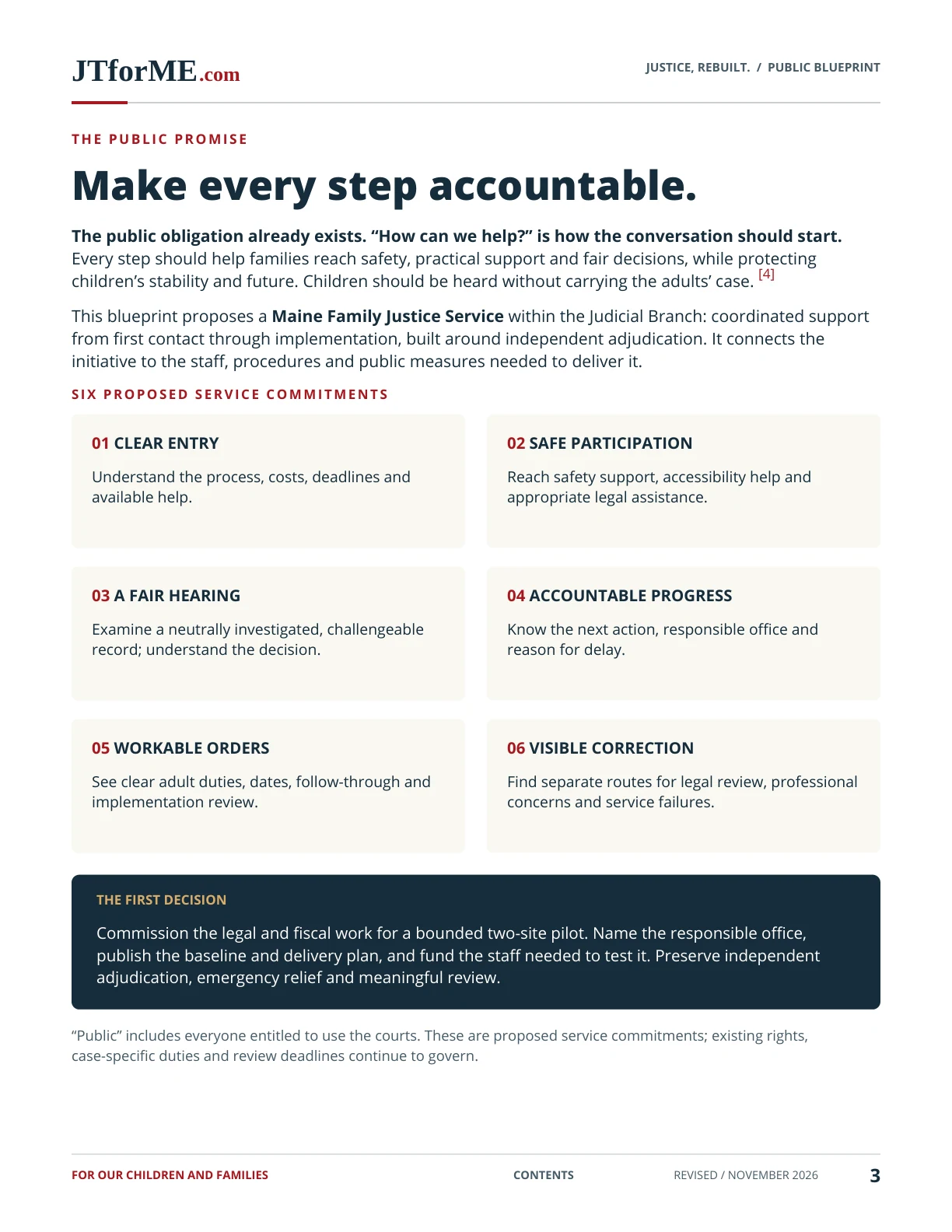
THE PUBLIC PROMISE
Make every step accountable.
The public obligation already exists. “How can we help?” is how the conversation should start.
Every step should help families reach safety, practical support and fair decisions, while protecting
children’s stability and future. Children should be heard without carrying the adults’ case. [4]
This blueprint proposes a Maine Family Justice Service within the Judicial Branch: coordinated support
from first contact through implementation, built around independent adjudication. It connects the
initiative to the staff, procedures and public measures needed to deliver it.
SIX PROPOSED SERVICE COMMITMENTS
01 CLEAR ENTRY
Understand the process, costs, deadlines and
available help.
02 SAFE PARTICIPATION
Reach safety support, accessibility help and
appropriate legal assistance.
03 A FAIR HEARING
Examine a neutrally investigated, challengeable
record; understand the decision.
04 ACCOUNTABLE PROGRESS
Know the next action, responsible office and
reason for delay.
05 WORKABLE ORDERS
See clear adult duties, dates, follow-through and
implementation review.
06 VISIBLE CORRECTION
Find separate routes for legal review, professional
concerns and service failures.
THE FIRST DECISION
Commission the legal and fiscal work for a bounded two-site pilot. Name the responsible office,
publish the baseline and delivery plan, and fund the staff needed to test it. Preserve independent
adjudication, emergency relief and meaningful review.
“Public” includes everyone entitled to use the courts. These are proposed service commitments; existing rights,
case-specific duties and review deadlines continue to govern.
FOR OUR CHILDREN AND FAMILIES
CONTENTS
REVISED / NOVEMBER 2026
3
Blueprint page 4: Find the argument. Follow the plan.. Full page text follows.
Read selectable text — page 4

Text extracted from the revised PDF. The original page governs layout, tables and citation placement.

JTforME.com
JUSTICE, REBUILT.  /  PUBLIC BLUEPRINT
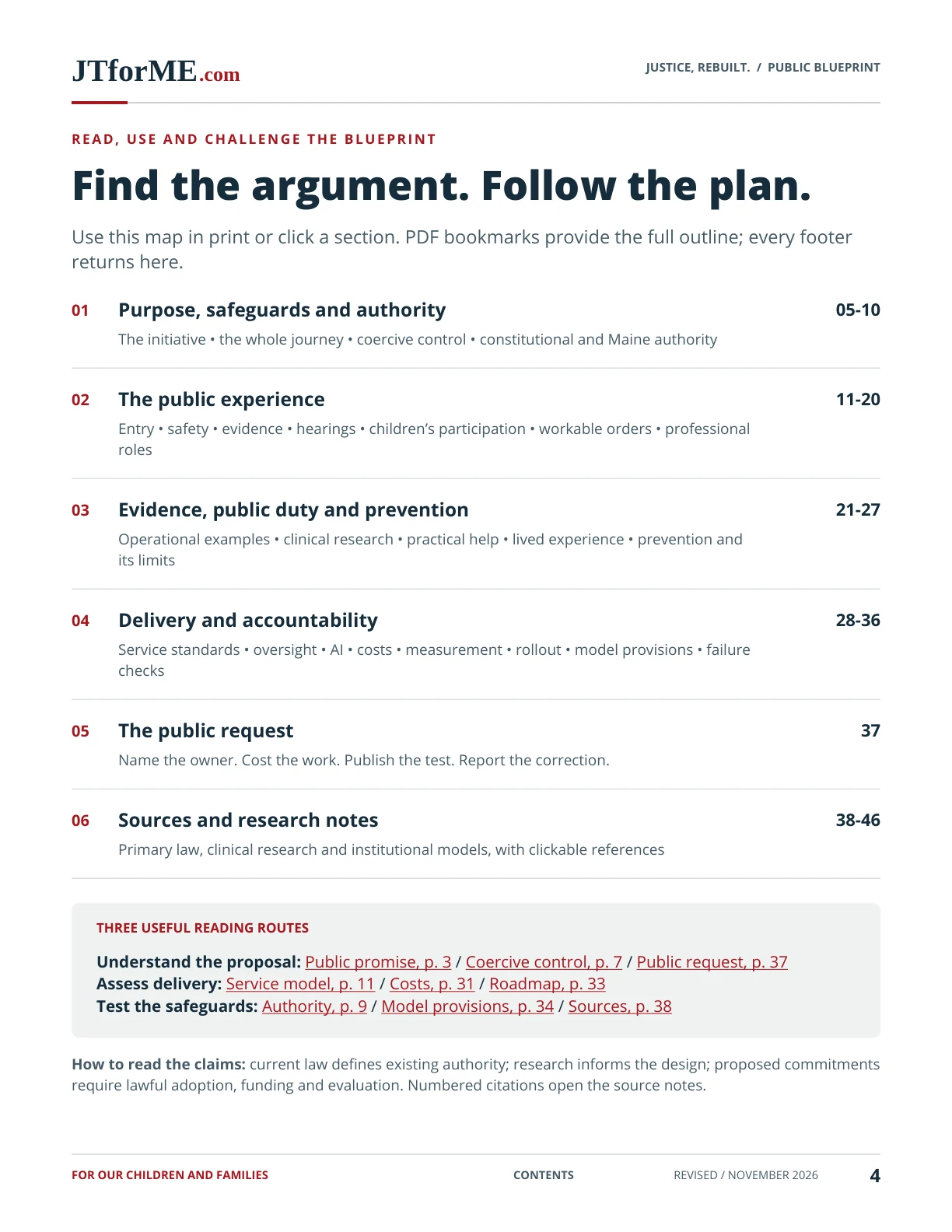
READ, USE AND CHALLENGE THE BLUEPRINT
Find the argument. Follow the plan.
Use this map in print or click a section. PDF bookmarks provide the full outline; every footer
returns here.
01
Purpose, safeguards and authority
The initiative • the whole journey • coercive control • constitutional and Maine authority
05-10
02
The public experience
Entry • safety • evidence • hearings • children’s participation • workable orders • professional
roles
11-20
03
Evidence, public duty and prevention
Operational examples • clinical research • practical help • lived experience • prevention and
its limits
21-27
04
Delivery and accountability
Service standards • oversight • AI • costs • measurement • rollout • model provisions • failure
checks
28-36
05
The public request
Name the owner. Cost the work. Publish the test. Report the correction.
37
06
Sources and research notes
Primary law, clinical research and institutional models, with clickable references
38-46
THREE USEFUL READING ROUTES
Understand the proposal: Public promise, p. 3 / Coercive control, p. 7 / Public request, p. 37
Assess delivery: Service model, p. 11 / Costs, p. 31 / Roadmap, p. 33
Test the safeguards: Authority, p. 9 / Model provisions, p. 34 / Sources, p. 38
How to read the claims: current law defines existing authority; research informs the design; proposed commitments
require lawful adoption, funding and evaluation. Numbered citations open the source notes.
FOR OUR CHILDREN AND FAMILIES
CONTENTS
REVISED / NOVEMBER 2026
4
Blueprint page 5: 01 / Purpose, safeguards and authority. Full page text follows.
Read selectable text — page 5

Text extracted from the revised PDF. The original page governs layout, tables and citation placement.

JTforME.com
JUSTICE, REBUILT.  /  PUBLIC BLUEPRINT
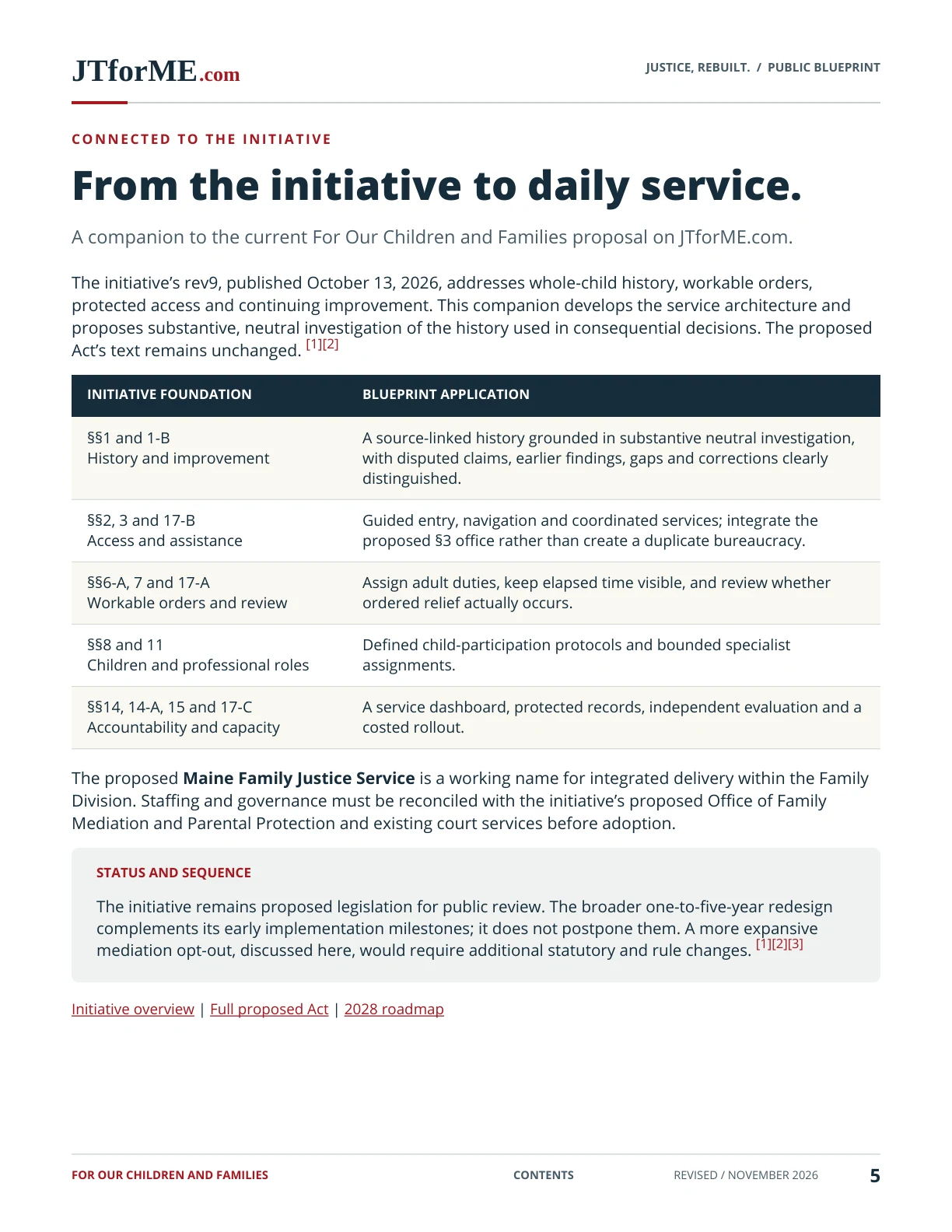
CONNECTED TO THE INITIATIVE
From the initiative to daily service.
A companion to the current For Our Children and Families proposal on JTforME.com.
The initiative’s rev9, published October 13, 2026, addresses whole-child history, workable orders,
protected access and continuing improvement. This companion develops the service architecture and
proposes substantive, neutral investigation of the history used in consequential decisions. The proposed
Act’s text remains unchanged. [1][2]
INITIATIVE FOUNDATION
BLUEPRINT APPLICATION
§§1 and 1-B
History and improvement
A source-linked history grounded in substantive neutral investigation,
with disputed claims, earlier findings, gaps and corrections clearly
distinguished.
§§2, 3 and 17-B
Access and assistance
Guided entry, navigation and coordinated services; integrate the
proposed §3 office rather than create a duplicate bureaucracy.
§§6-A, 7 and 17-A
Workable orders and review
Assign adult duties, keep elapsed time visible, and review whether
ordered relief actually occurs.
§§8 and 11
Children and professional roles
Defined child-participation protocols and bounded specialist
assignments.
§§14, 14-A, 15 and 17-C
Accountability and capacity
A service dashboard, protected records, independent evaluation and a
costed rollout.
The proposed Maine Family Justice Service is a working name for integrated delivery within the Family
Division. Staffing and governance must be reconciled with the initiative’s proposed Office of Family
Mediation and Parental Protection and existing court services before adoption.
STATUS AND SEQUENCE
The initiative remains proposed legislation for public review. The broader one-to-five-year redesign
complements its early implementation milestones; it does not postpone them. A more expansive
mediation opt-out, discussed here, would require additional statutory and rule changes. [1][2][3]
Initiative overview | Full proposed Act | 2028 roadmap
FOR OUR CHILDREN AND FAMILIES
CONTENTS
REVISED / NOVEMBER 2026
5
Blueprint page 6: Design the whole journey.. Full page text follows.
Read selectable text — page 6

Text extracted from the revised PDF. The original page governs layout, tables and citation placement.

JTforME.com
JUSTICE, REBUILT.  /  PUBLIC BLUEPRINT
FROM CASES TO PEOPLE
Design the whole journey.
A court’s service obligations begin before a filing and continue after an order.
A parent may arrive afraid of losing a child, a home or control over what happens next. A child may face
disrupted routines and questions they cannot answer. The institution must respond to that experience
with understandable information, practical help and fair decisions that protect the child’s future.
Maine’s Family Division statute already directs a system responsive to families and children and
authorizes court rules, case management, education and referral services. The Supreme Judicial Court
has broad administrative authority. Those foundations permit serious redesign within lawful institutional
boundaries. [4][5]
Start with “How can we help?” Ask what is unsafe, what the child needs and what practical barrier can
be removed. Explain the next lawful step. Humane treatment must not depend on composure, deference
or legal vocabulary.
Match intensity to need. A simple agreement, a complex property dispute and a coercive-control
concern require different combinations of assistance and adjudication.
Use judicial time for judging. Trained staff manage scheduling, navigation and records. Qualified
neutrals investigate material disputed history through disclosed methods. Authorized judicial officers
decide credibility, admissibility, legal findings and remedies.
Make the next step visible. Every matter has an owner for its administrative progress, a next action, a
responsible office and an explanation when time slips.
Measure the burden on families. Include costs, travel, lost work, repeated interviews,
misunderstanding, safety and actual implementation, alongside court workload.
Judicial independence protects the decision.
It does not excuse an unusable service.
The national Family Justice Initiative supplies a relevant foundation for differentiated pathways and user
assistance. These recommendations guide design; they do not establish that this particular model has
already succeeded. [25]
FOR OUR CHILDREN AND FAMILIES
CONTENTS
REVISED / NOVEMBER 2026
6
Blueprint page 7: The court must never become an instrument of control.. Full page text follows.
Read selectable text — page 7

Text extracted from the revised PDF. The original page governs layout, tables and citation placement.

JTforME.com
JUSTICE, REBUILT.  /  PUBLIC BLUEPRINT
COERCIVE CONTROL AND CONTROL BY PROXY
The court must never become an
instrument of control.
Public authority must not become the means by which private domination continues.
After separation, court processes can extend coercive control through retaliatory filings, compelled
contact, financial exhaustion, intrusive demands, threats involving children and obstruction of care.
Research describes related patterns as legal, systems and post-separation abuse. [36][37]
Courts can amplify harm through fragmented records, forced interaction and prolonged restrictions
without meaningful review. A 25-article scoping review documents system-enabled control and secondary
victimization in mothers’ experiences of family proceedings. [38]
Three questions that must remain distinct
QUESTION
RESPONSE REQUIRED / PROPOSED REFORM
Is a party misusing the process?
Assess conduct, purpose and harm using context grounded in
substantive, independent, neutral investigation. Verify primary
evidence, relevant witnesses and contrary material; disclose gaps.
Repeated counsel-driven allegations and past findings lacking that
foundation do not become verified history. Provide a meaningful
opportunity to respond.
Is the institution amplifying
harm?
#StopHarmingOurKids
Audit workflow, delays, compelled interaction, access barriers and
failures to implement protective decisions. Assign responsibility and
verify that the harm is corrected.
Has a professional breached a
duty?
Replace Maine’s Board of Overseers of the Bar through lawful
Supreme Judicial Court rulemaking: public-majority oversight,
independent neutral investigators, separate prosecution and
adjudication, transparent reasoned outcomes and meaningful review.
Transfer functions, records and pending complaints through a defined
transition preserving privacy and due process. [47]
CONTROL BY PROXY
Using an institution or another person to continue intimidation, surveillance, coercive financial
pressure or interference with lawful care or relationships. Assess conduct against independently
investigated history, applicable law and primary evidence; the description is not itself a legal finding.
FOR OUR CHILDREN AND FAMILIES
CONTENTS
REVISED / NOVEMBER 2026
7
Blueprint page 8: Recognize the pattern. Preserve the hearing.. Full page text follows.
Read selectable text — page 8

Text extracted from the revised PDF. The original page governs layout, tables and citation placement.

JTforME.com
JUSTICE, REBUILT.  /  PUBLIC BLUEPRINT
DESIGN AGAINST MISUSE
Recognize the pattern. Preserve the
hearing.
A safeguard against abusive litigation must not become a new weapon against the person
seeking protection.
POSSIBLE MECHANISM
PROPOSED SYSTEM RESPONSE
Repeated proceedings used to
exhaust
A source-linked chronology distinguishes what was alleged,
independently examined and decided. Review duplication, legitimate
need and harm; repetition is not corroboration.
Contact or surveillance through
process
Safe communication preferences, protected addresses, separate
waiting arrangements and tightly scoped information requests.
Financial pressure and care
obstruction
Transparent costs, targeted disclosure, timely decisions on alleged
misuse and implementable duties for school, health and care logistics.
A child or professional used as a
proxy
Written role boundaries; no child messenger duties; disclose the basis
of professional assertions used in deciding the case.
Institutional pressure to settle
No settlement quotas; confidential safety assessment, access to
advice and prompt consideration of lawful mediation waivers.
A filing count, distress, an unsuccessful application or a disputed allegation does not by itself prove
abuse. New safety evidence needs an accessible route to a judge. Restrictions on future filings require
lawful authority, narrow scope, reasoned findings and review; they cannot become blanket exclusion
from protection.
Maine law includes coercion in specified protection-from-abuse definitions. Separately, Indorf v. Keep
requires extraordinary circumstances and clear litigation-process abuse for inherent-power fee sanctions;
the Law Court vacated the fee award. Both points favor specific evidence over labels. [15][16]
ASSESS CONDUCT, WITHOUT A GENDER PRESUMPTION
Research includes survivor-mother samples and studies of men reporting legal or administrative
aggression. These studies cannot establish comparative prevalence. Take every report seriously,
assess the evidence and legal requirements, and avoid gender presumptions. [37][45]
FOR OUR CHILDREN AND FAMILIES
CONTENTS
REVISED / NOVEMBER 2026
8
Blueprint page 9: Keep the power to decide independent.. Full page text follows.
Read selectable text — page 9

Text extracted from the revised PDF. The original page governs layout, tables and citation placement.

JTforME.com
JUSTICE, REBUILT.  /  PUBLIC BLUEPRINT
CONSTITUTIONAL DESIGN
Keep the power to decide
independent.
Modern service architecture must strengthen meaningful participation and reliable findings.
AUTHORITY
DESIGN IMPLICATION AND LIMIT
Troxel v. Granville (2000)
Respect protected parental decision-making. The plurality’s
nonparent-visitation context does not supply a universal custody
formula. [17]
Santosky v. Kramer (1982)
Before termination, the state must prove parental unfitness by at least
clear-and-convincing evidence. That standard does not govern every
interim parenting dispute. [18]
Boddie (1971) / M.L.B. (1996)
Money cannot foreclose the specific divorce and termination-appeal
access addressed in these cases. They do not make every civil service
universally free. [19][20]
Lassiter (1981) / Turner (2011)
Counsel and safeguards depend on the proceeding. Navigation augments
assistance; it does not replace counsel where law requires
representation. [21][22]
Tennessee v. Lane (2004)
Meaningful access to judicial services is central to the ADA framework. The
blueprint proposes several access channels, not a supposed constitutional
right to one platform. [23]
Caperton (2009)
An exceptional objective risk of bias can require recusal. Ordinary legal
error and conduct allegations require their proper review routes. [24]
The proposed system leaves contested findings, admissibility, remedies and judicial decisions with
authorized officers. Administrative staff cannot privately recommend who should win. Appeals remain
independent. A service complaint cannot reverse an order or extend an appeal deadline.
A PROTECTED RIGHT TO PARTICIPATE
The institution should make the issue, relevant information, opportunity to respond and reasons for
decision understandable. Clear workflows help deliver due process; they do not reduce its legal
requirements.
FOR OUR CHILDREN AND FAMILIES
CONTENTS
REVISED / NOVEMBER 2026
9
Blueprint page 10: Put each decision in the right hands.. Full page text follows.
Read selectable text — page 10

Text extracted from the revised PDF. The original page governs layout, tables and citation placement.

JTforME.com
JUSTICE, REBUILT.  /  PUBLIC BLUEPRINT
MAINE AUTHORITY MAP
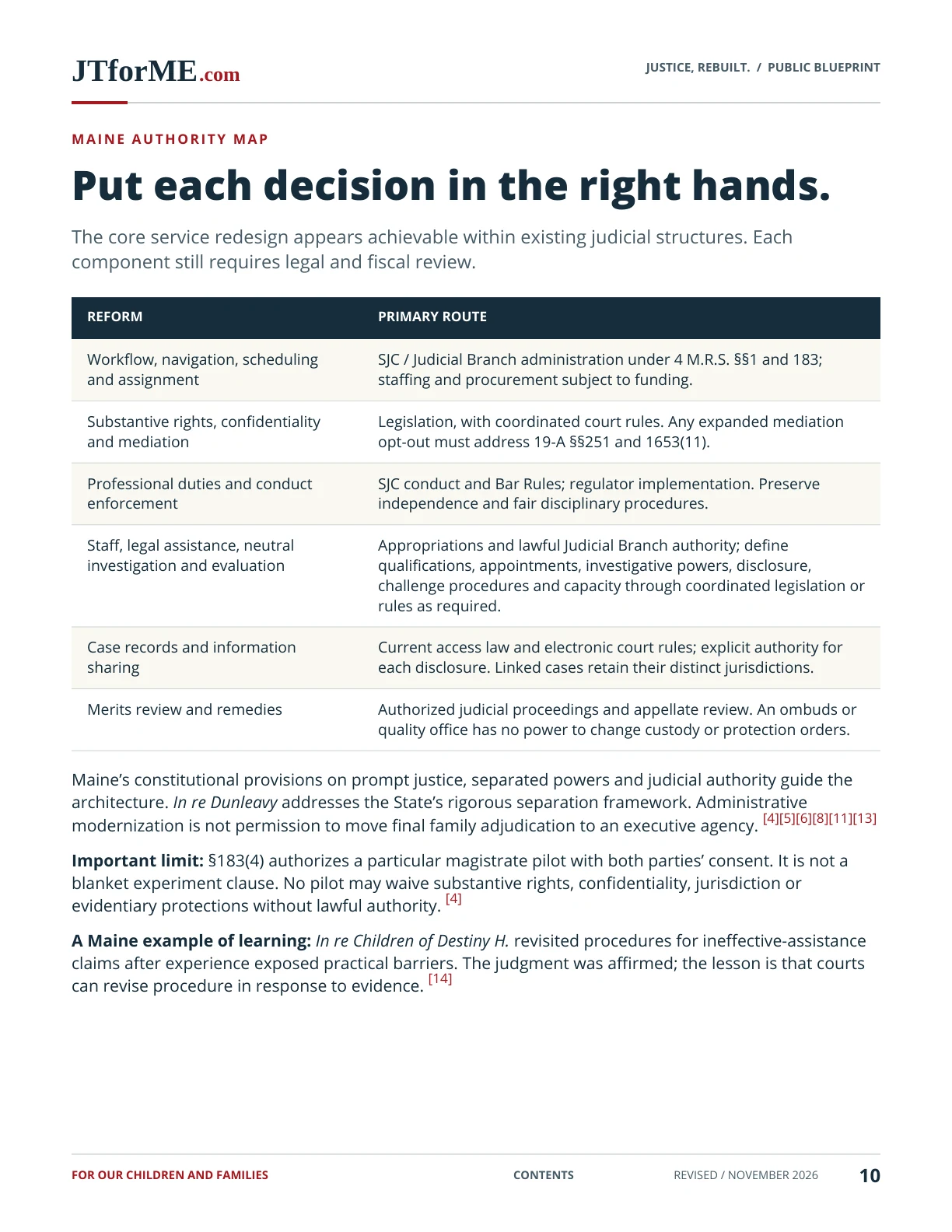
Put each decision in the right hands.
The core service redesign appears achievable within existing judicial structures. Each
component still requires legal and fiscal review.
REFORM
PRIMARY ROUTE
Workflow, navigation, scheduling
and assignment
SJC / Judicial Branch administration under 4 M.R.S. §§1 and 183;
staffing and procurement subject to funding.
Substantive rights, confidentiality
and mediation
Legislation, with coordinated court rules. Any expanded mediation
opt-out must address 19-A §§251 and 1653(11).
Professional duties and conduct
enforcement
SJC conduct and Bar Rules; regulator implementation. Preserve
independence and fair disciplinary procedures.
Staff, legal assistance, neutral
investigation and evaluation
Appropriations and lawful Judicial Branch authority; define
qualifications, appointments, investigative powers, disclosure,
challenge procedures and capacity through coordinated legislation or
rules as required.
Case records and information
sharing
Current access law and electronic court rules; explicit authority for
each disclosure. Linked cases retain their distinct jurisdictions.
Merits review and remedies
Authorized judicial proceedings and appellate review. An ombuds or
quality office has no power to change custody or protection orders.
Maine’s constitutional provisions on prompt justice, separated powers and judicial authority guide the
architecture. In re Dunleavy addresses the State’s rigorous separation framework. Administrative
modernization is not permission to move final family adjudication to an executive agency. [4][5][6][8][11][13]
Important limit: §183(4) authorizes a particular magistrate pilot with both parties’ consent. It is not a
blanket experiment clause. No pilot may waive substantive rights, confidentiality, jurisdiction or
evidentiary protections without lawful authority. [4]
A Maine example of learning: In re Children of Destiny H. revisited procedures for ineffective-assistance
claims after experience exposed practical barriers. The judgment was affirmed; the lesson is that courts
can revise procedure in response to evidence. [14]
FOR OUR CHILDREN AND FAMILIES
CONTENTS
REVISED / NOVEMBER 2026
10
Blueprint page 11: 02 / The public experience. Full page text follows.
Read selectable text — page 11

Text extracted from the revised PDF. The original page governs layout, tables and citation placement.

JTforME.com
JUSTICE, REBUILT.  /  PUBLIC BLUEPRINT
THE REPLACEMENT ARCHITECTURE
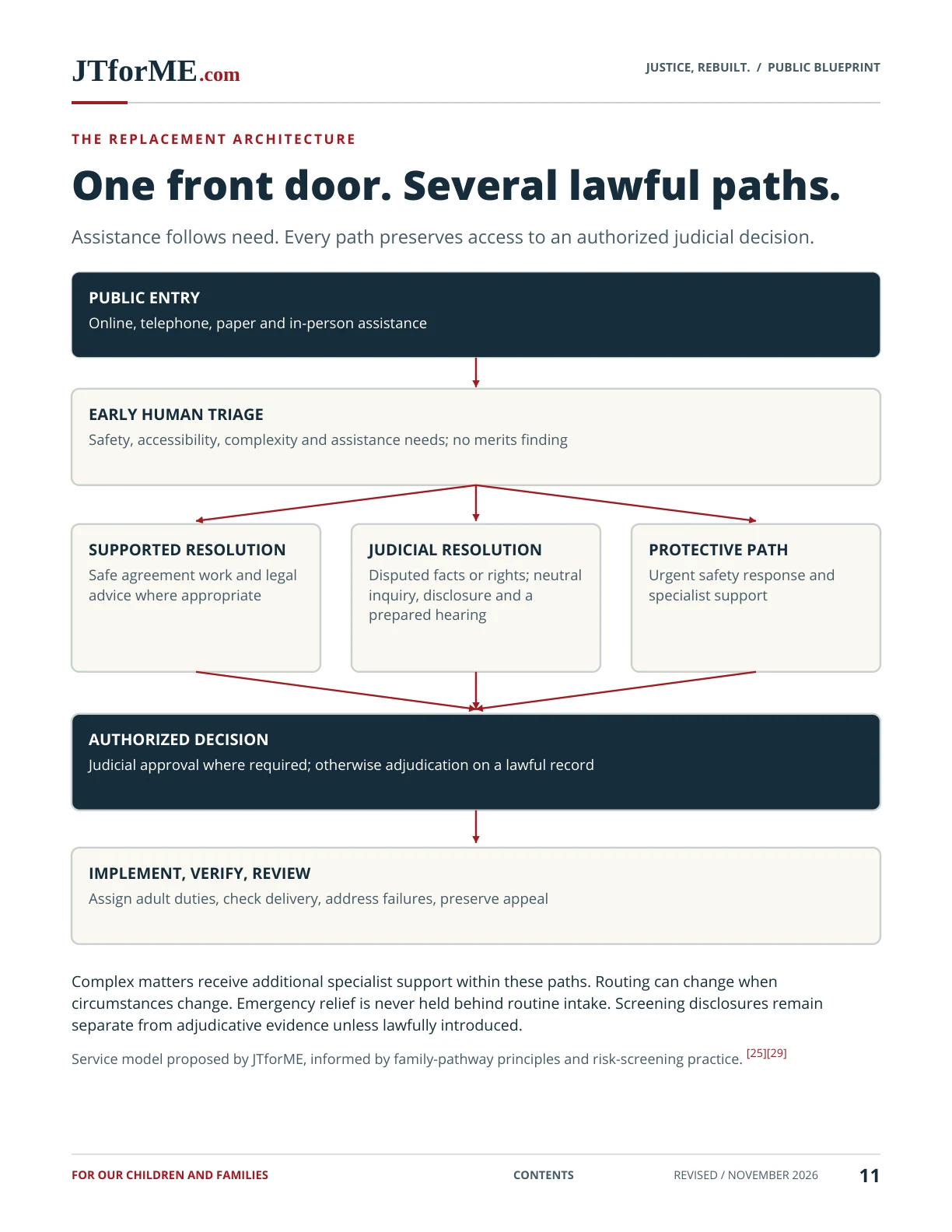
One front door. Several lawful paths.
Assistance follows need. Every path preserves access to an authorized judicial decision.
PUBLIC ENTRY
Online, telephone, paper and in-person assistance
EARLY HUMAN TRIAGE
Safety, accessibility, complexity and assistance needs; no merits finding
SUPPORTED RESOLUTION
Safe agreement work and legal
advice where appropriate
JUDICIAL RESOLUTION
Disputed facts or rights; neutral
inquiry, disclosure and a
prepared hearing
PROTECTIVE PATH
Urgent safety response and
specialist support
AUTHORIZED DECISION
Judicial approval where required; otherwise adjudication on a lawful record
IMPLEMENT, VERIFY, REVIEW
Assign adult duties, check delivery, address failures, preserve appeal
Complex matters receive additional specialist support within these paths. Routing can change when
circumstances change. Emergency relief is never held behind routine intake. Screening disclosures remain
separate from adjudicative evidence unless lawfully introduced.
Service model proposed by JTforME, informed by family-pathway principles and risk-screening practice. [25][29]
FOR OUR CHILDREN AND FAMILIES
CONTENTS
REVISED / NOVEMBER 2026
11
Blueprint page 12: A visible next step at every stage.. Full page text follows.
Read selectable text — page 12

Text extracted from the revised PDF. The original page governs layout, tables and citation placement.

JTforME.com
JUSTICE, REBUILT.  /  PUBLIC BLUEPRINT
THE FAMILY JOURNEY
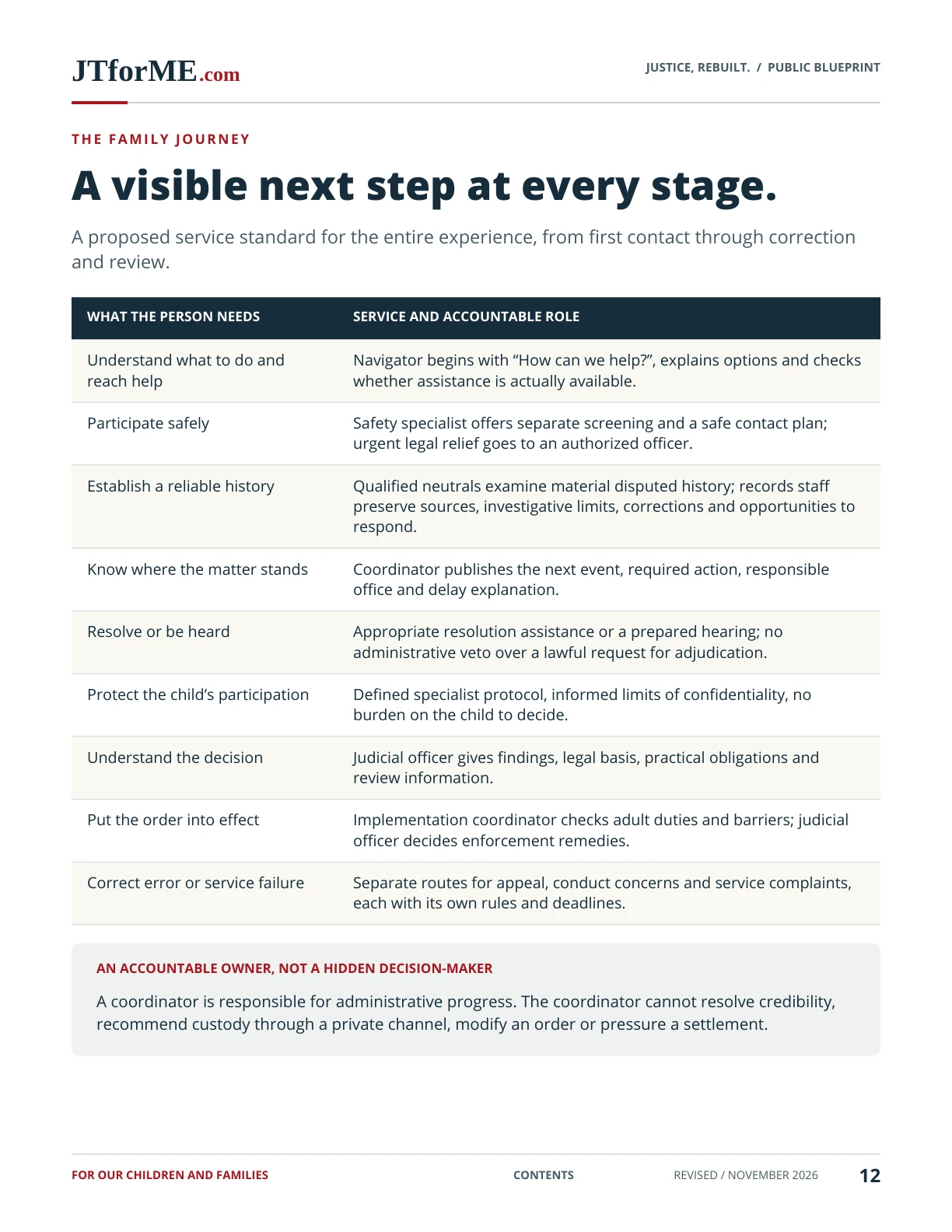
A visible next step at every stage.
A proposed service standard for the entire experience, from first contact through correction
and review.
WHAT THE PERSON NEEDS
SERVICE AND ACCOUNTABLE ROLE
Understand what to do and
reach help
Navigator begins with “How can we help?”, explains options and checks
whether assistance is actually available.
Participate safely
Safety specialist offers separate screening and a safe contact plan;
urgent legal relief goes to an authorized officer.
Establish a reliable history
Qualified neutrals examine material disputed history; records staff
preserve sources, investigative limits, corrections and opportunities to
respond.
Know where the matter stands
Coordinator publishes the next event, required action, responsible
office and delay explanation.
Resolve or be heard
Appropriate resolution assistance or a prepared hearing; no
administrative veto over a lawful request for adjudication.
Protect the child’s participation
Defined specialist protocol, informed limits of confidentiality, no
burden on the child to decide.
Understand the decision
Judicial officer gives findings, legal basis, practical obligations and
review information.
Put the order into effect
Implementation coordinator checks adult duties and barriers; judicial
officer decides enforcement remedies.
Correct error or service failure
Separate routes for appeal, conduct concerns and service complaints,
each with its own rules and deadlines.
AN ACCOUNTABLE OWNER, NOT A HIDDEN DECISION-MAKER
A coordinator is responsible for administrative progress. The coordinator cannot resolve credibility,
recommend custody through a private channel, modify an order or pressure a settlement.
FOR OUR CHILDREN AND FAMILIES
CONTENTS
REVISED / NOVEMBER 2026
12
Blueprint page 13: Make the front door understandable.. Full page text follows.
Read selectable text — page 13

Text extracted from the revised PDF. The original page governs layout, tables and citation placement.

JTforME.com
JUSTICE, REBUILT.  /  PUBLIC BLUEPRINT
ENTRY AND ACCESS
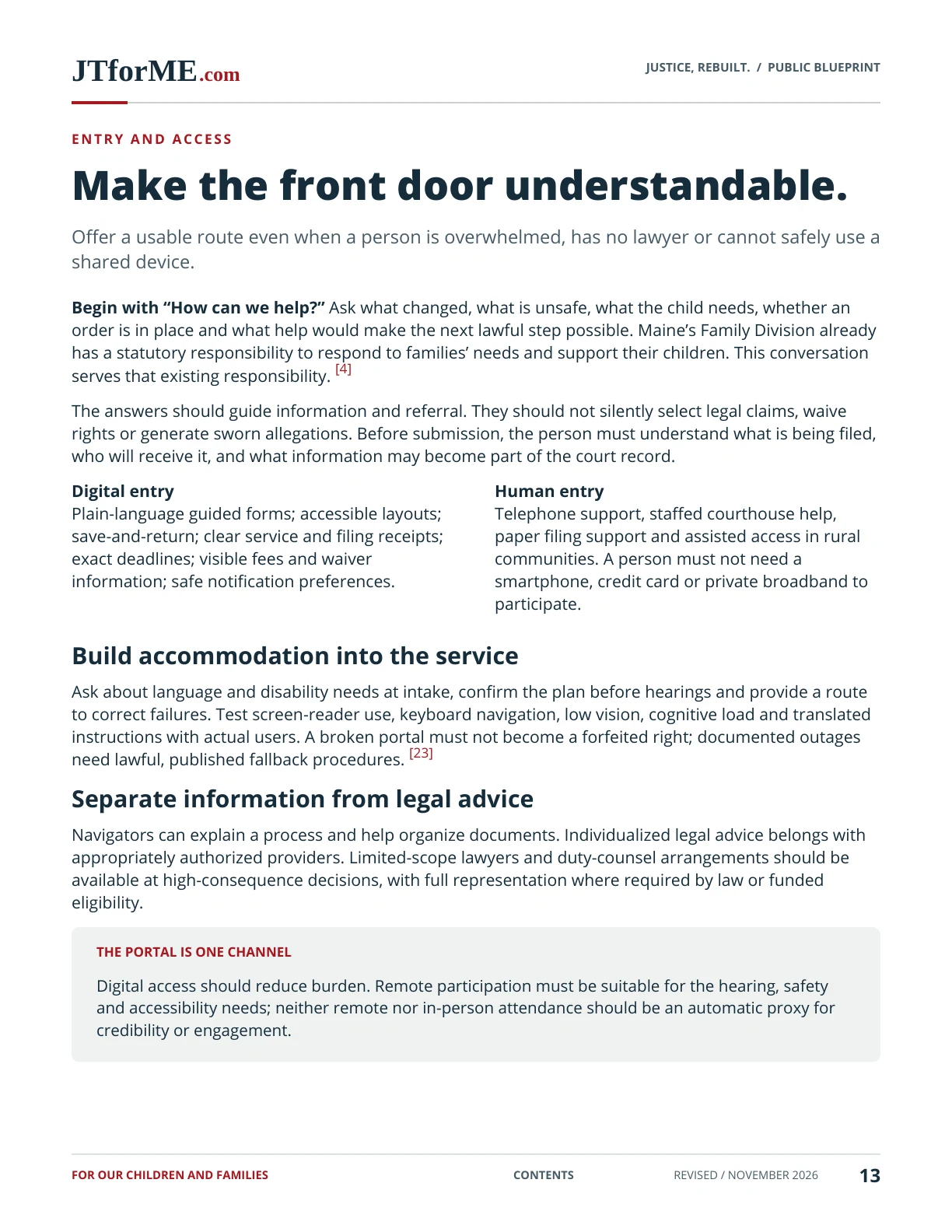
Make the front door understandable.
Offer a usable route even when a person is overwhelmed, has no lawyer or cannot safely use a
shared device.
Begin with “How can we help?” Ask what changed, what is unsafe, what the child needs, whether an
order is in place and what help would make the next lawful step possible. Maine’s Family Division already
has a statutory responsibility to respond to families’ needs and support their children. This conversation
serves that existing responsibility. [4]
The answers should guide information and referral. They should not silently select legal claims, waive
rights or generate sworn allegations. Before submission, the person must understand what is being filed,
who will receive it, and what information may become part of the court record.
Digital entry
Plain-language guided forms; accessible layouts;
save-and-return; clear service and filing receipts;
exact deadlines; visible fees and waiver
information; safe notification preferences.
Human entry
Telephone support, staffed courthouse help,
paper filing support and assisted access in rural
communities. A person must not need a
smartphone, credit card or private broadband to
participate.
Build accommodation into the service
Ask about language and disability needs at intake, confirm the plan before hearings and provide a route
to correct failures. Test screen-reader use, keyboard navigation, low vision, cognitive load and translated
instructions with actual users. A broken portal must not become a forfeited right; documented outages
need lawful, published fallback procedures. [23]
Separate information from legal advice
Navigators can explain a process and help organize documents. Individualized legal advice belongs with
appropriately authorized providers. Limited-scope lawyers and duty-counsel arrangements should be
available at high-consequence decisions, with full representation where required by law or funded
eligibility.
THE PORTAL IS ONE CHANNEL
Digital access should reduce burden. Remote participation must be suitable for the hearing, safety
and accessibility needs; neither remote nor in-person attendance should be an automatic proxy for
credibility or engagement.
FOR OUR CHILDREN AND FAMILIES
CONTENTS
REVISED / NOVEMBER 2026
13
Blueprint page 14: Match service to risk and complexity.. Full page text follows.
Read selectable text — page 14

Text extracted from the revised PDF. The original page governs layout, tables and citation placement.

JTforME.com
JUSTICE, REBUILT.  /  PUBLIC BLUEPRINT
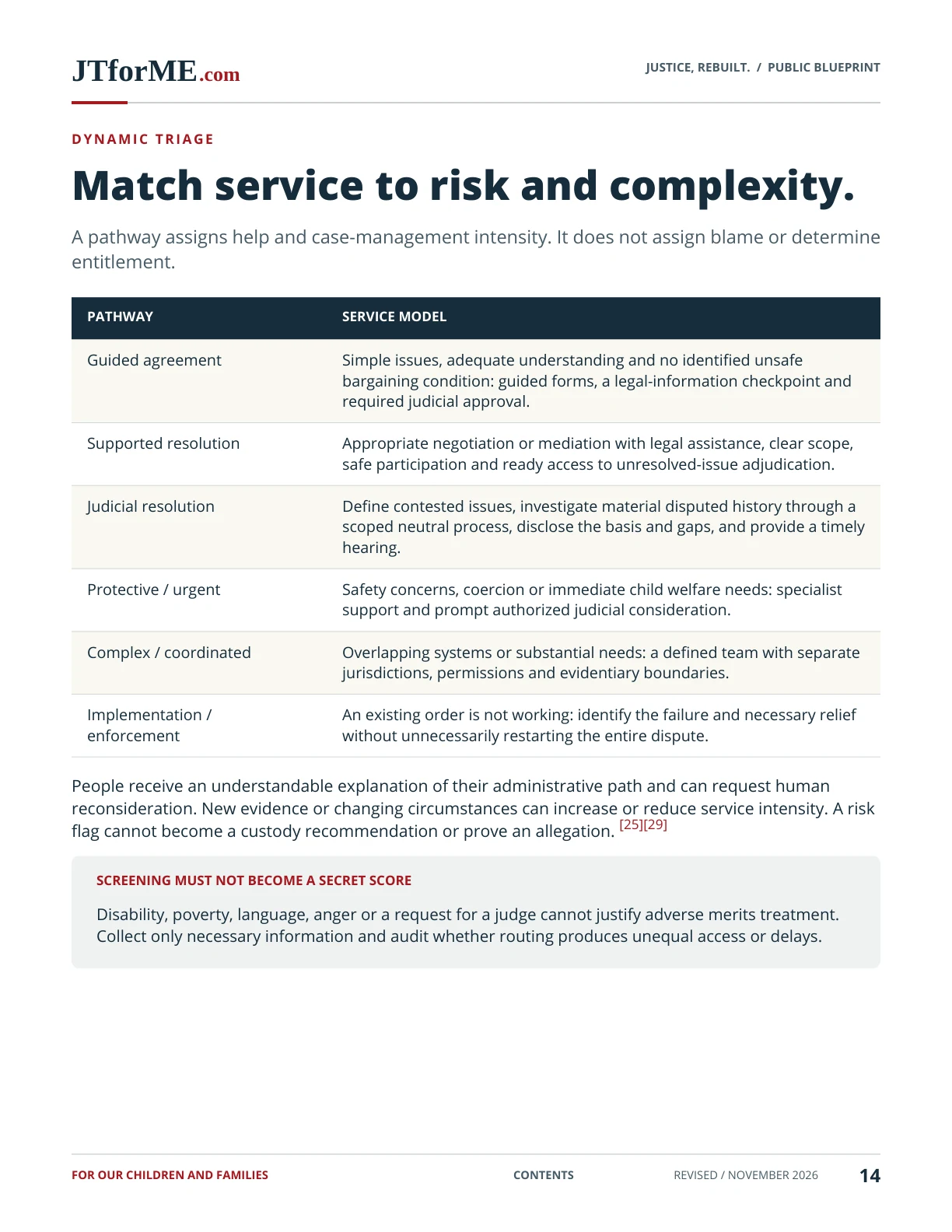
DYNAMIC TRIAGE
Match service to risk and complexity.
A pathway assigns help and case-management intensity. It does not assign blame or determine
entitlement.
PATHWAY
SERVICE MODEL
Guided agreement
Simple issues, adequate understanding and no identified unsafe
bargaining condition: guided forms, a legal-information checkpoint and
required judicial approval.
Supported resolution
Appropriate negotiation or mediation with legal assistance, clear scope,
safe participation and ready access to unresolved-issue adjudication.
Judicial resolution
Define contested issues, investigate material disputed history through a
scoped neutral process, disclose the basis and gaps, and provide a timely
hearing.
Protective / urgent
Safety concerns, coercion or immediate child welfare needs: specialist
support and prompt authorized judicial consideration.
Complex / coordinated
Overlapping systems or substantial needs: a defined team with separate
jurisdictions, permissions and evidentiary boundaries.
Implementation /
enforcement
An existing order is not working: identify the failure and necessary relief
without unnecessarily restarting the entire dispute.
People receive an understandable explanation of their administrative path and can request human
reconsideration. New evidence or changing circumstances can increase or reduce service intensity. A risk
flag cannot become a custody recommendation or prove an allegation. [25][29]
SCREENING MUST NOT BECOME A SECRET SCORE
Disability, poverty, language, anger or a request for a judge cannot justify adverse merits treatment.
Collect only necessary information and audit whether routing produces unequal access or delays.
FOR OUR CHILDREN AND FAMILIES
CONTENTS
REVISED / NOVEMBER 2026
14
Blueprint page 15: Screen before creating settlement pressure.. Full page text follows.
Read selectable text — page 15

Text extracted from the revised PDF. The original page governs layout, tables and citation placement.

JTforME.com
JUSTICE, REBUILT.  /  PUBLIC BLUEPRINT
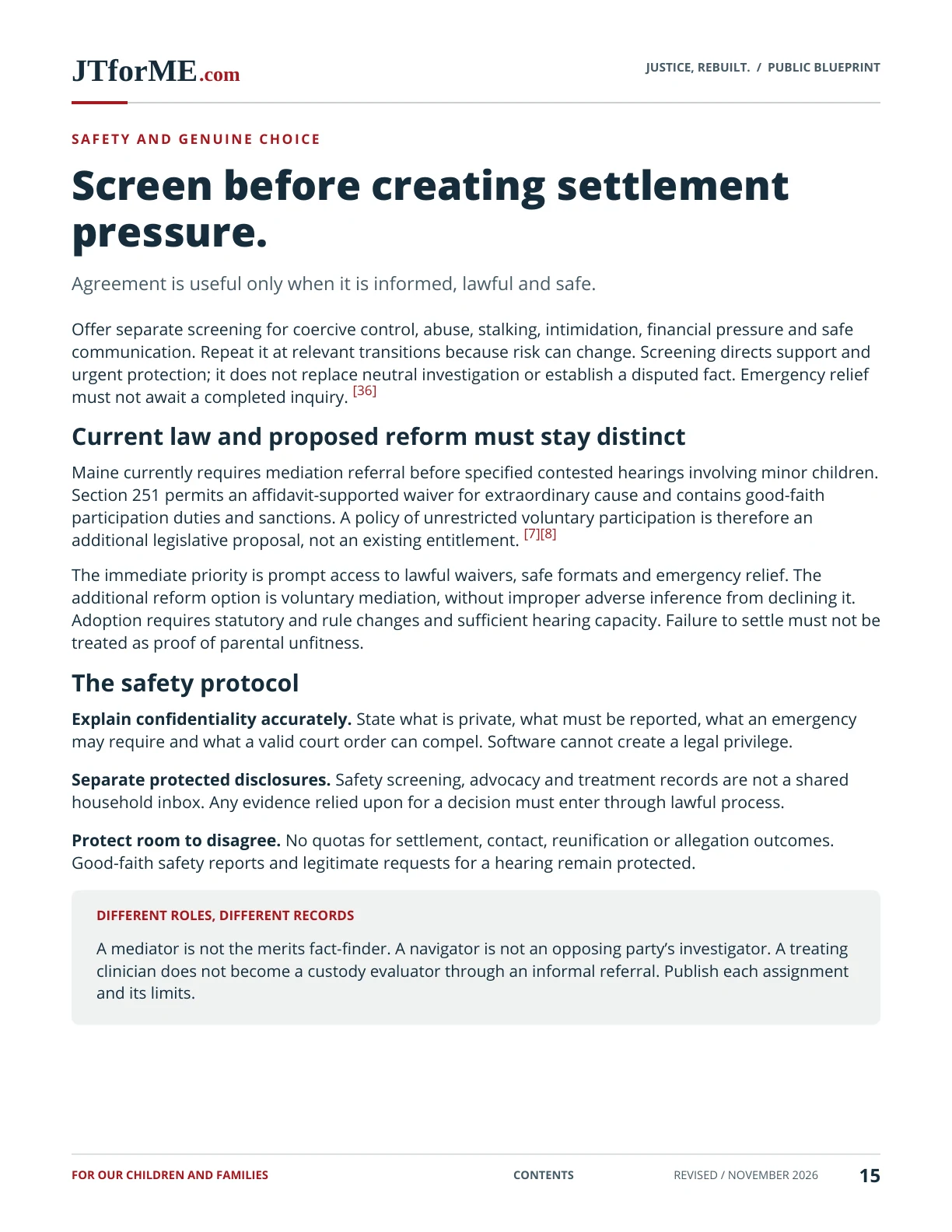
SAFETY AND GENUINE CHOICE
Screen before creating settlement
pressure.
Agreement is useful only when it is informed, lawful and safe.
Offer separate screening for coercive control, abuse, stalking, intimidation, financial pressure and safe
communication. Repeat it at relevant transitions because risk can change. Screening directs support and
urgent protection; it does not replace neutral investigation or establish a disputed fact. Emergency relief
must not await a completed inquiry. [36]
Current law and proposed reform must stay distinct
Maine currently requires mediation referral before specified contested hearings involving minor children.
Section 251 permits an affidavit-supported waiver for extraordinary cause and contains good-faith
participation duties and sanctions. A policy of unrestricted voluntary participation is therefore an
additional legislative proposal, not an existing entitlement. [7][8]
The immediate priority is prompt access to lawful waivers, safe formats and emergency relief. The
additional reform option is voluntary mediation, without improper adverse inference from declining it.
Adoption requires statutory and rule changes and sufficient hearing capacity. Failure to settle must not be
treated as proof of parental unfitness.
The safety protocol
Explain confidentiality accurately. State what is private, what must be reported, what an emergency
may require and what a valid court order can compel. Software cannot create a legal privilege.
Separate protected disclosures. Safety screening, advocacy and treatment records are not a shared
household inbox. Any evidence relied upon for a decision must enter through lawful process.
Protect room to disagree. No quotas for settlement, contact, reunification or allegation outcomes.
Good-faith safety reports and legitimate requests for a hearing remain protected.
DIFFERENT ROLES, DIFFERENT RECORDS
A mediator is not the merits fact-finder. A navigator is not an opposing party’s investigator. A treating
clinician does not become a custody evaluator through an informal referral. Publish each assignment
and its limits.
FOR OUR CHILDREN AND FAMILIES
CONTENTS
REVISED / NOVEMBER 2026
15
Blueprint page 16: Hear the child. Do not make the child carry the case.. Full page text follows.
Read selectable text — page 16

Text extracted from the revised PDF. The original page governs layout, tables and citation placement.

JTforME.com
JUSTICE, REBUILT.  /  PUBLIC BLUEPRINT
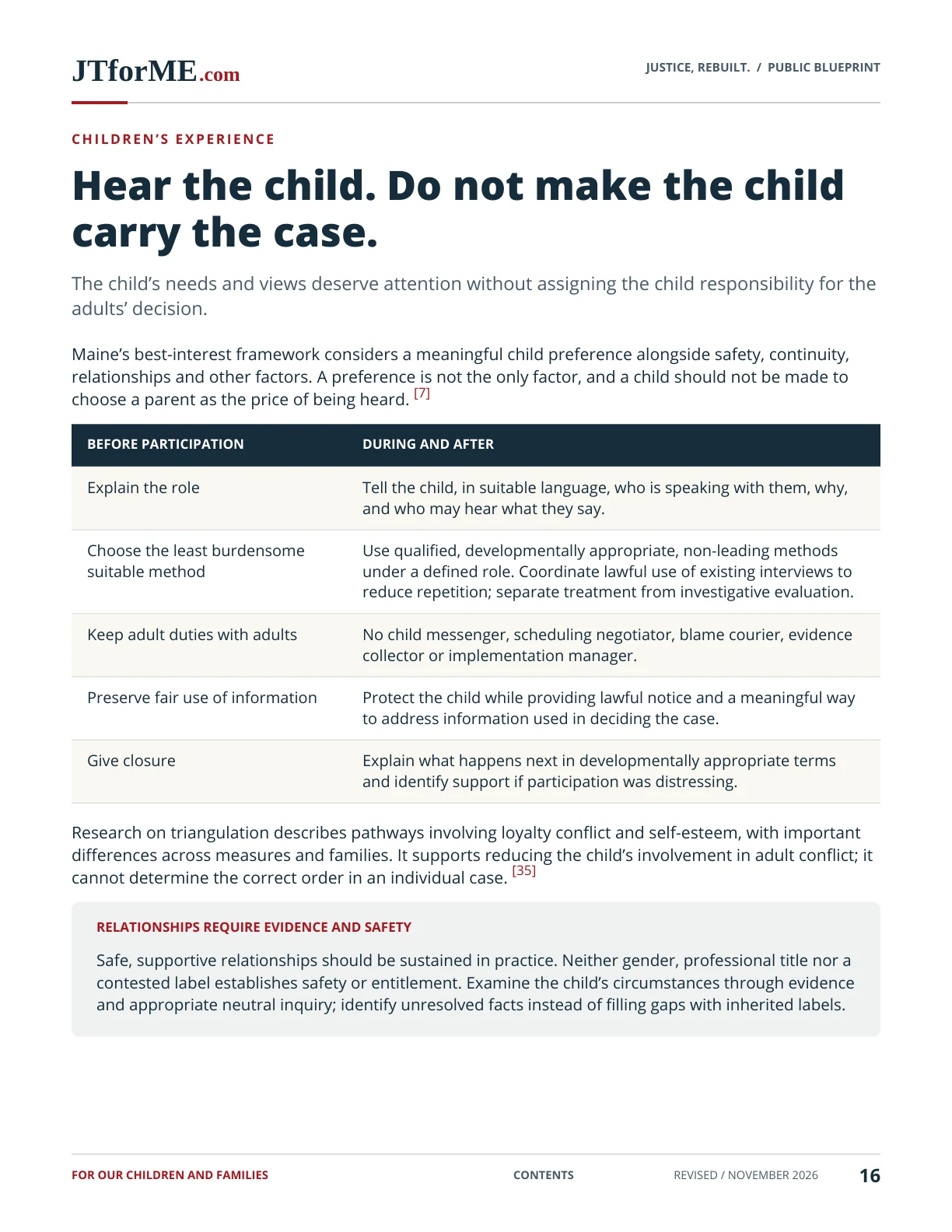
CHILDREN’S EXPERIENCE
Hear the child. Do not make the child
carry the case.
The child’s needs and views deserve attention without assigning the child responsibility for the
adults’ decision.
Maine’s best-interest framework considers a meaningful child preference alongside safety, continuity,
relationships and other factors. A preference is not the only factor, and a child should not be made to
choose a parent as the price of being heard. [7]
BEFORE PARTICIPATION
DURING AND AFTER
Explain the role
Tell the child, in suitable language, who is speaking with them, why,
and who may hear what they say.
Choose the least burdensome
suitable method
Use qualified, developmentally appropriate, non-leading methods
under a defined role. Coordinate lawful use of existing interviews to
reduce repetition; separate treatment from investigative evaluation.
Keep adult duties with adults
No child messenger, scheduling negotiator, blame courier, evidence
collector or implementation manager.
Preserve fair use of information
Protect the child while providing lawful notice and a meaningful way
to address information used in deciding the case.
Give closure
Explain what happens next in developmentally appropriate terms
and identify support if participation was distressing.
Research on triangulation describes pathways involving loyalty conflict and self-esteem, with important
differences across measures and families. It supports reducing the child’s involvement in adult conflict; it
cannot determine the correct order in an individual case. [35]
RELATIONSHIPS REQUIRE EVIDENCE AND SAFETY
Safe, supportive relationships should be sustained in practice. Neither gender, professional title nor a
contested label establishes safety or entitlement. Examine the child’s circumstances through evidence
and appropriate neutral inquiry; identify unresolved facts instead of filling gaps with inherited labels.
FOR OUR CHILDREN AND FAMILIES
CONTENTS
REVISED / NOVEMBER 2026
16
Blueprint page 17: History must be investigated.. Full page text follows.
Read selectable text — page 17

Text extracted from the revised PDF. The original page governs layout, tables and citation placement.

JTforME.com
JUSTICE, REBUILT.  /  PUBLIC BLUEPRINT
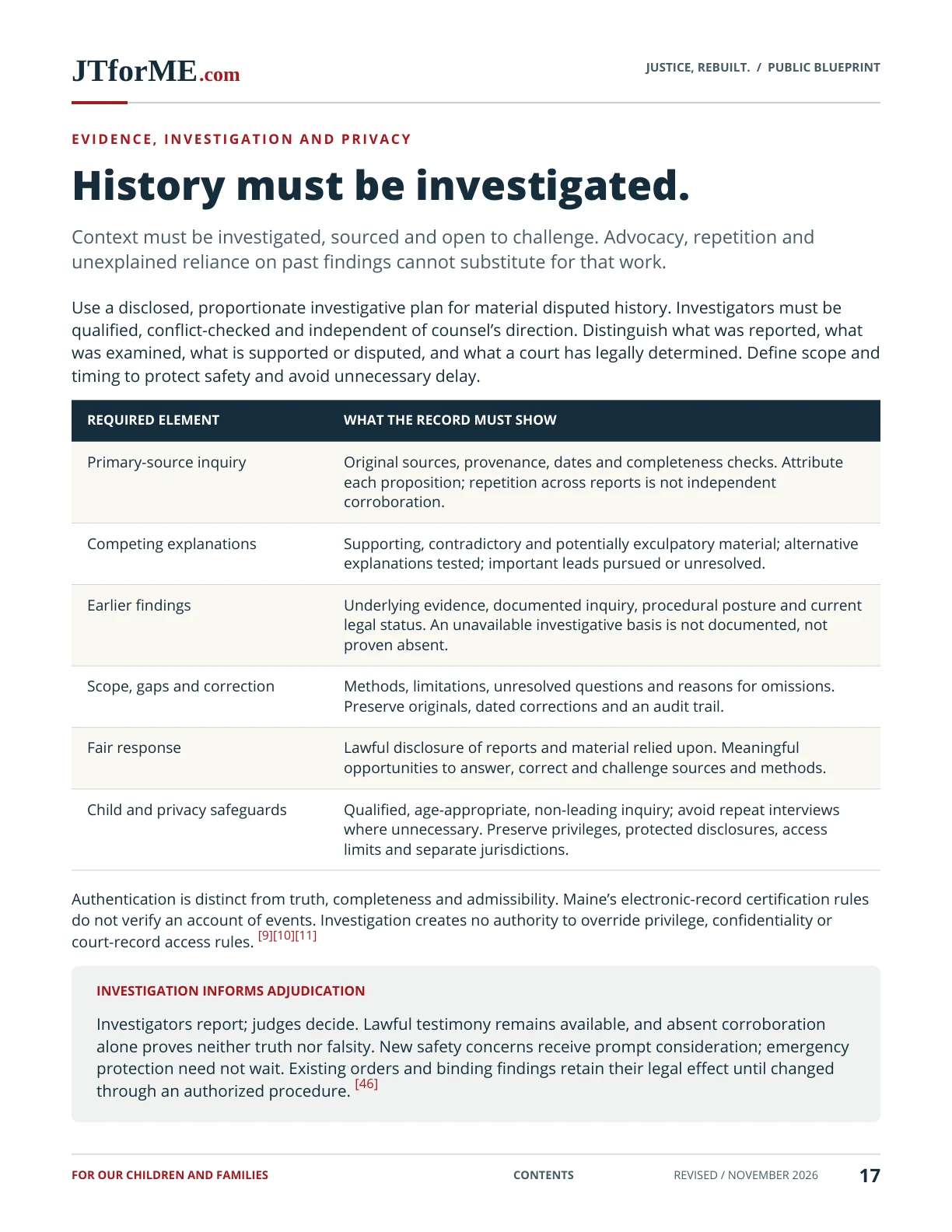
EVIDENCE, INVESTIGATION AND PRIVACY
History must be investigated.
Context must be investigated, sourced and open to challenge. Advocacy, repetition and
unexplained reliance on past findings cannot substitute for that work.
Use a disclosed, proportionate investigative plan for material disputed history. Investigators must be
qualified, conflict-checked and independent of counsel’s direction. Distinguish what was reported, what
was examined, what is supported or disputed, and what a court has legally determined. Define scope and
timing to protect safety and avoid unnecessary delay.
REQUIRED ELEMENT
WHAT THE RECORD MUST SHOW
Primary-source inquiry
Original sources, provenance, dates and completeness checks. Attribute
each proposition; repetition across reports is not independent
corroboration.
Competing explanations
Supporting, contradictory and potentially exculpatory material; alternative
explanations tested; important leads pursued or unresolved.
Earlier findings
Underlying evidence, documented inquiry, procedural posture and current
legal status. An unavailable investigative basis is not documented, not
proven absent.
Scope, gaps and correction
Methods, limitations, unresolved questions and reasons for omissions.
Preserve originals, dated corrections and an audit trail.
Fair response
Lawful disclosure of reports and material relied upon. Meaningful
opportunities to answer, correct and challenge sources and methods.
Child and privacy safeguards
Qualified, age-appropriate, non-leading inquiry; avoid repeat interviews
where unnecessary. Preserve privileges, protected disclosures, access
limits and separate jurisdictions.
Authentication is distinct from truth, completeness and admissibility. Maine’s electronic-record certification rules
do not verify an account of events. Investigation creates no authority to override privilege, confidentiality or
court-record access rules. [9][10][11]
INVESTIGATION INFORMS ADJUDICATION
Investigators report; judges decide. Lawful testimony remains available, and absent corroboration
alone proves neither truth nor falsity. New safety concerns receive prompt consideration; emergency
protection need not wait. Existing orders and binding findings retain their legal effect until changed
through an authorized procedure. [46]
FOR OUR CHILDREN AND FAMILIES
CONTENTS
REVISED / NOVEMBER 2026
17
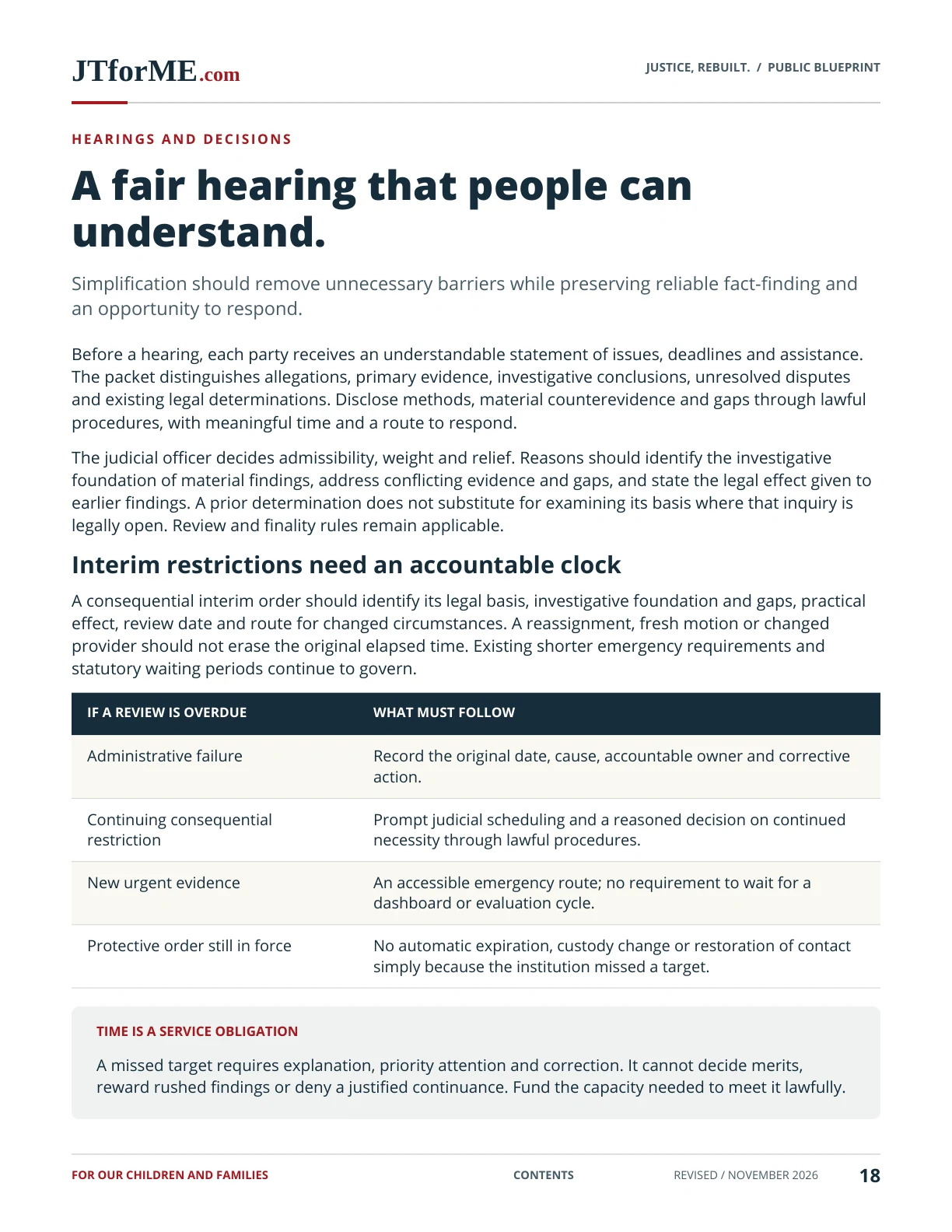
Blueprint page 18: A fair hearing that people can understand.. Full page text follows.
Read selectable text — page 18

Text extracted from the revised PDF. The original page governs layout, tables and citation placement.

JTforME.com
JUSTICE, REBUILT.  /  PUBLIC BLUEPRINT
HEARINGS AND DECISIONS
A fair hearing that people can
understand.
Simplification should remove unnecessary barriers while preserving reliable fact-finding and
an opportunity to respond.
Before a hearing, each party receives an understandable statement of issues, deadlines and assistance.
The packet distinguishes allegations, primary evidence, investigative conclusions, unresolved disputes
and existing legal determinations. Disclose methods, material counterevidence and gaps through lawful
procedures, with meaningful time and a route to respond.
The judicial officer decides admissibility, weight and relief. Reasons should identify the investigative
foundation of material findings, address conflicting evidence and gaps, and state the legal effect given to
earlier findings. A prior determination does not substitute for examining its basis where that inquiry is
legally open. Review and finality rules remain applicable.
Interim restrictions need an accountable clock
A consequential interim order should identify its legal basis, investigative foundation and gaps, practical
effect, review date and route for changed circumstances. A reassignment, fresh motion or changed
provider should not erase the original elapsed time. Existing shorter emergency requirements and
statutory waiting periods continue to govern.
IF A REVIEW IS OVERDUE
WHAT MUST FOLLOW
Administrative failure
Record the original date, cause, accountable owner and corrective
action.
Continuing consequential
restriction
Prompt judicial scheduling and a reasoned decision on continued
necessity through lawful procedures.
New urgent evidence
An accessible emergency route; no requirement to wait for a
dashboard or evaluation cycle.
Protective order still in force
No automatic expiration, custody change or restoration of contact
simply because the institution missed a target.
TIME IS A SERVICE OBLIGATION
A missed target requires explanation, priority attention and correction. It cannot decide merits,
reward rushed findings or deny a justified continuance. Fund the capacity needed to meet it lawfully.
FOR OUR CHILDREN AND FAMILIES
CONTENTS
REVISED / NOVEMBER 2026
18
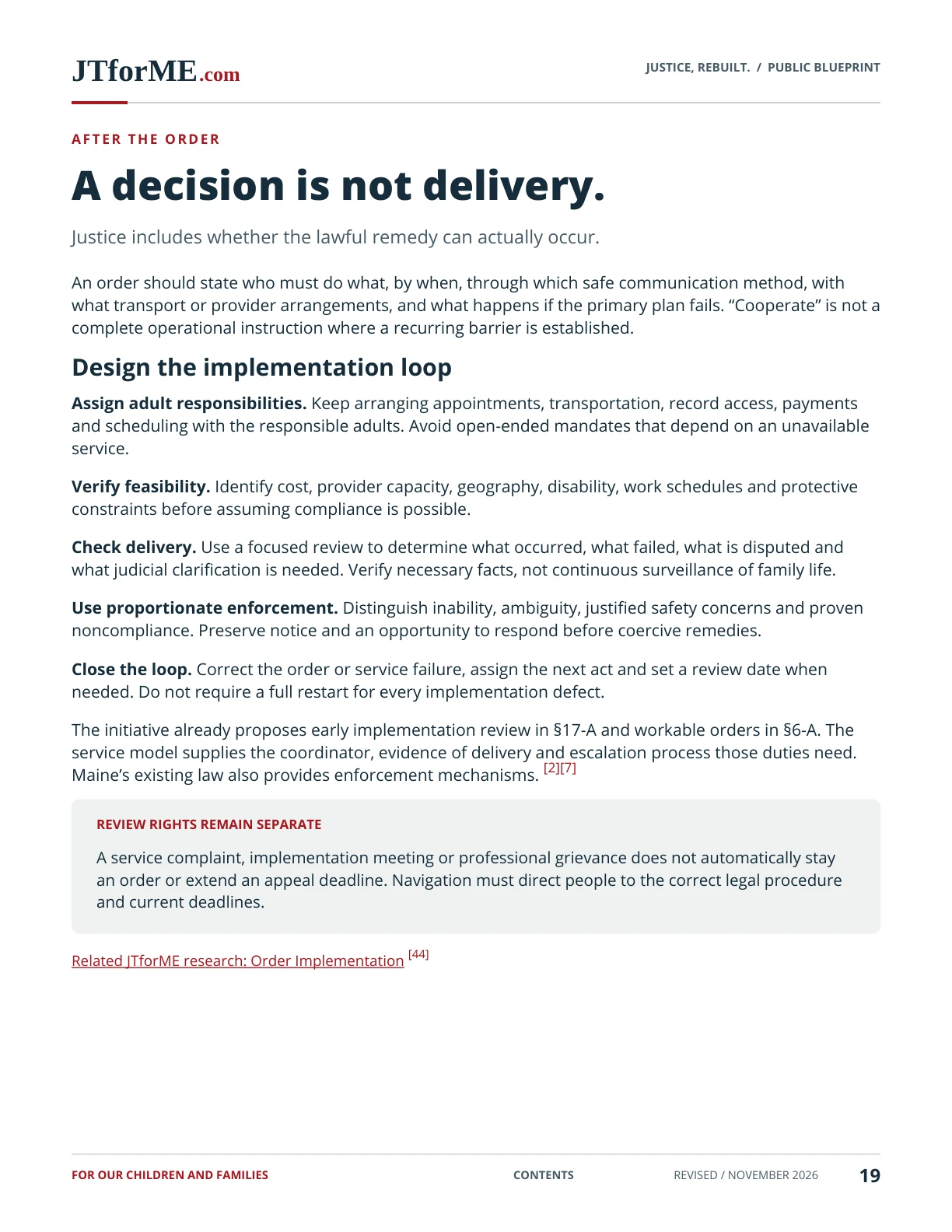
Blueprint page 19: A decision is not delivery.. Full page text follows.
Read selectable text — page 19

Text extracted from the revised PDF. The original page governs layout, tables and citation placement.

JTforME.com
JUSTICE, REBUILT.  /  PUBLIC BLUEPRINT
AFTER THE ORDER
A decision is not delivery.
Justice includes whether the lawful remedy can actually occur.
An order should state who must do what, by when, through which safe communication method, with
what transport or provider arrangements, and what happens if the primary plan fails. “Cooperate” is not a
complete operational instruction where a recurring barrier is established.
Design the implementation loop
Assign adult responsibilities. Keep arranging appointments, transportation, record access, payments
and scheduling with the responsible adults. Avoid open-ended mandates that depend on an unavailable
service.
Verify feasibility. Identify cost, provider capacity, geography, disability, work schedules and protective
constraints before assuming compliance is possible.
Check delivery. Use a focused review to determine what occurred, what failed, what is disputed and
what judicial clarification is needed. Verify necessary facts, not continuous surveillance of family life.
Use proportionate enforcement. Distinguish inability, ambiguity, justified safety concerns and proven
noncompliance. Preserve notice and an opportunity to respond before coercive remedies.
Close the loop. Correct the order or service failure, assign the next act and set a review date when
needed. Do not require a full restart for every implementation defect.
The initiative already proposes early implementation review in §17-A and workable orders in §6-A. The
service model supplies the coordinator, evidence of delivery and escalation process those duties need.
Maine’s existing law also provides enforcement mechanisms. [2][7]
REVIEW RIGHTS REMAIN SEPARATE
A service complaint, implementation meeting or professional grievance does not automatically stay
an order or extend an appeal deadline. Navigation must direct people to the correct legal procedure
and current deadlines.
Related JTforME research: Order Implementation [44]
FOR OUR CHILDREN AND FAMILIES
CONTENTS
REVISED / NOVEMBER 2026
19
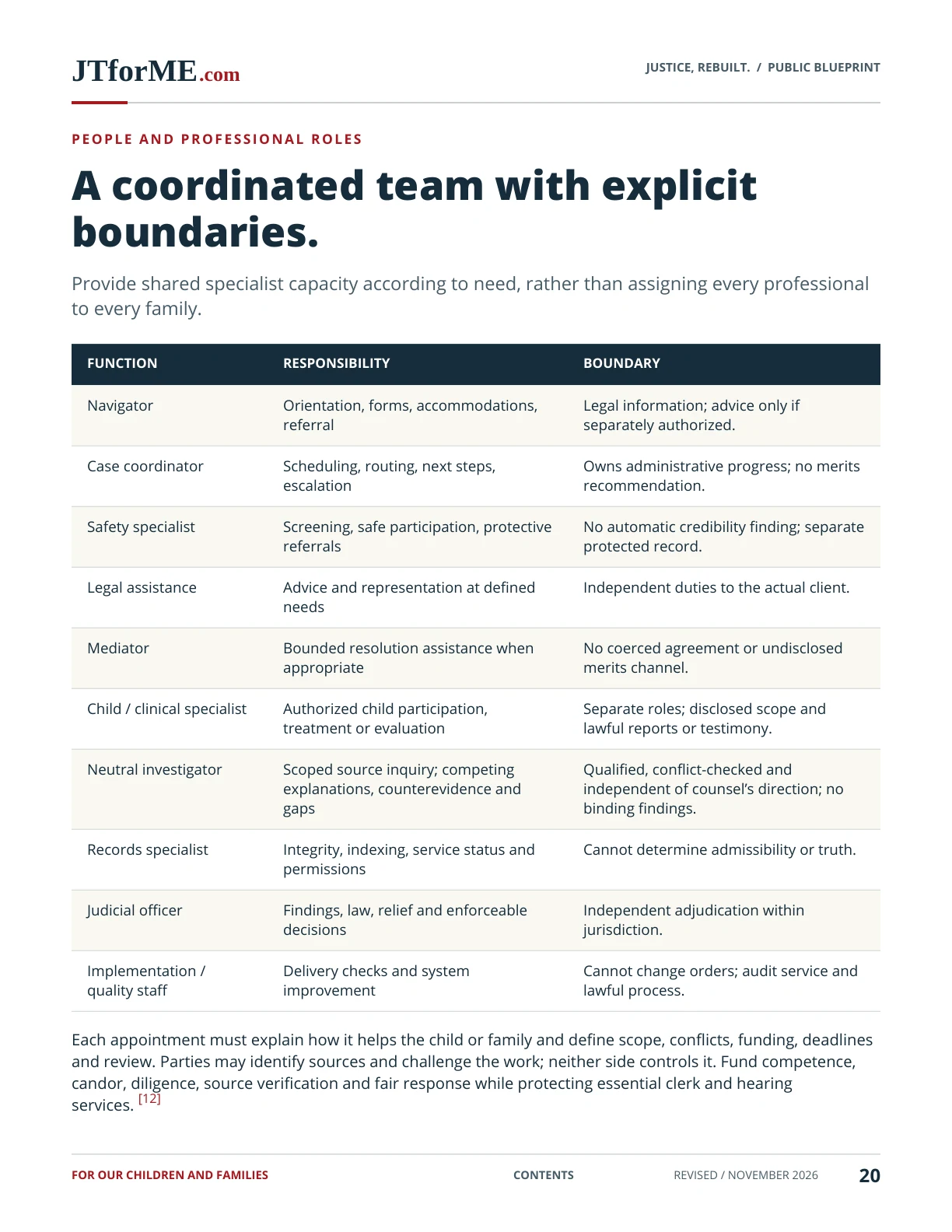
Blueprint page 20: A coordinated team with explicit boundaries.. Full page text follows.
Read selectable text — page 20

Text extracted from the revised PDF. The original page governs layout, tables and citation placement.

JTforME.com
JUSTICE, REBUILT.  /  PUBLIC BLUEPRINT
PEOPLE AND PROFESSIONAL ROLES
A coordinated team with explicit
boundaries.
Provide shared specialist capacity according to need, rather than assigning every professional
to every family.
FUNCTION
RESPONSIBILITY
BOUNDARY
Navigator
Orientation, forms, accommodations,
referral
Legal information; advice only if
separately authorized.
Case coordinator
Scheduling, routing, next steps,
escalation
Owns administrative progress; no merits
recommendation.
Safety specialist
Screening, safe participation, protective
referrals
No automatic credibility finding; separate
protected record.
Legal assistance
Advice and representation at defined
needs
Independent duties to the actual client.
Mediator
Bounded resolution assistance when
appropriate
No coerced agreement or undisclosed
merits channel.
Child / clinical specialist
Authorized child participation,
treatment or evaluation
Separate roles; disclosed scope and
lawful reports or testimony.
Neutral investigator
Scoped source inquiry; competing
explanations, counterevidence and
gaps
Qualified, conflict-checked and
independent of counsel’s direction; no
binding findings.
Records specialist
Integrity, indexing, service status and
permissions
Cannot determine admissibility or truth.
Judicial officer
Findings, law, relief and enforceable
decisions
Independent adjudication within
jurisdiction.
Implementation /
quality staff
Delivery checks and system
improvement
Cannot change orders; audit service and
lawful process.
Each appointment must explain how it helps the child or family and define scope, conflicts, funding, deadlines
and review. Parties may identify sources and challenge the work; neither side controls it. Fund competence,
candor, diligence, source verification and fair response while protecting essential clerk and hearing
services. [12]
FOR OUR CHILDREN AND FAMILIES
CONTENTS
REVISED / NOVEMBER 2026
20
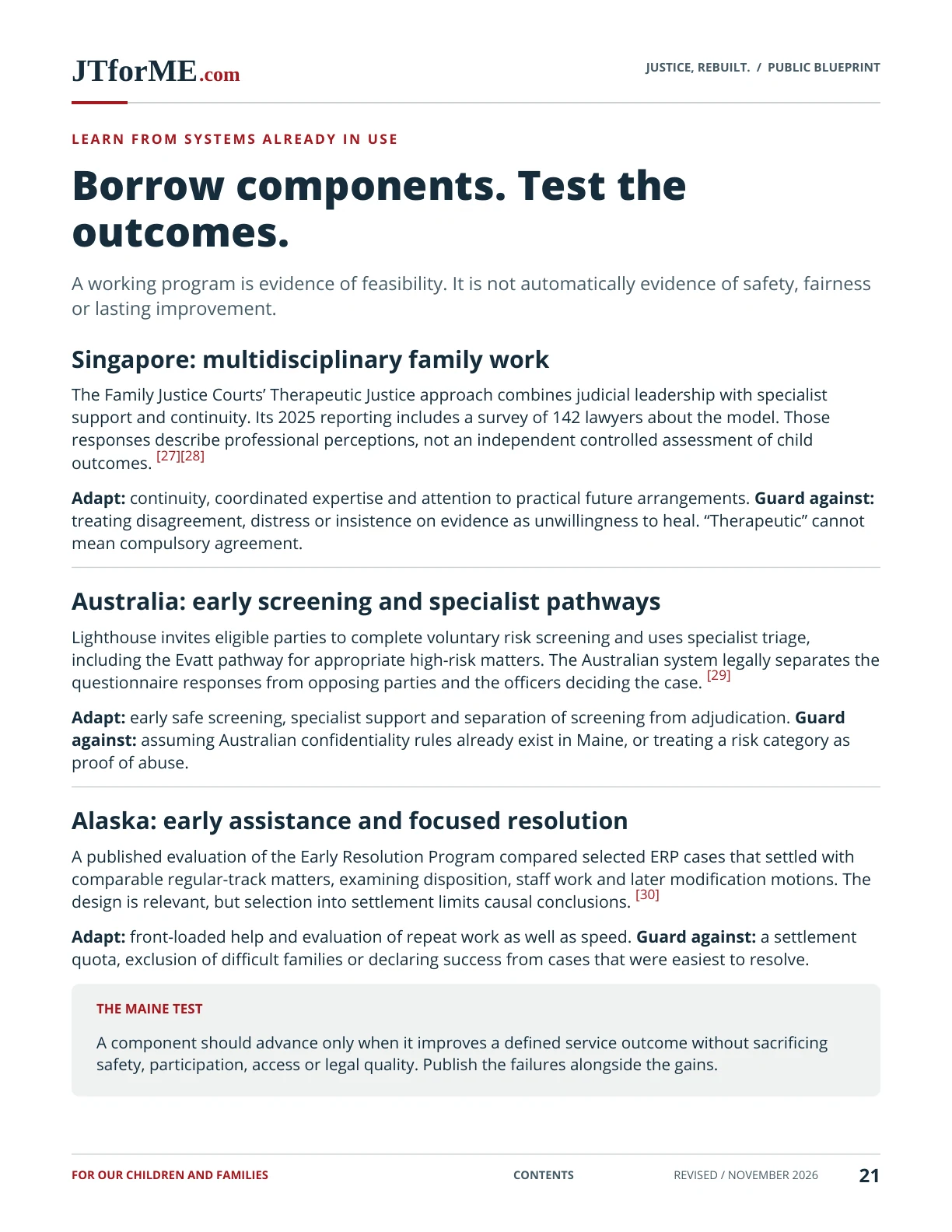
Blueprint page 21: 03 / Evidence and learning. Full page text follows.
Read selectable text — page 21

Text extracted from the revised PDF. The original page governs layout, tables and citation placement.

JTforME.com
JUSTICE, REBUILT.  /  PUBLIC BLUEPRINT
LEARN FROM SYSTEMS ALREADY IN USE
Borrow components. Test the
outcomes.
A working program is evidence of feasibility. It is not automatically evidence of safety, fairness
or lasting improvement.
Singapore: multidisciplinary family work
The Family Justice Courts’ Therapeutic Justice approach combines judicial leadership with specialist
support and continuity. Its 2025 reporting includes a survey of 142 lawyers about the model. Those
responses describe professional perceptions, not an independent controlled assessment of child
outcomes. [27][28]
Adapt: continuity, coordinated expertise and attention to practical future arrangements. Guard against:
treating disagreement, distress or insistence on evidence as unwillingness to heal. “Therapeutic” cannot
mean compulsory agreement.
Australia: early screening and specialist pathways
Lighthouse invites eligible parties to complete voluntary risk screening and uses specialist triage,
including the Evatt pathway for appropriate high-risk matters. The Australian system legally separates the
questionnaire responses from opposing parties and the officers deciding the case. [29]
Adapt: early safe screening, specialist support and separation of screening from adjudication. Guard
against: assuming Australian confidentiality rules already exist in Maine, or treating a risk category as
proof of abuse.
Alaska: early assistance and focused resolution
A published evaluation of the Early Resolution Program compared selected ERP cases that settled with
comparable regular-track matters, examining disposition, staff work and later modification motions. The
design is relevant, but selection into settlement limits causal conclusions. [30]
Adapt: front-loaded help and evaluation of repeat work as well as speed. Guard against: a settlement
quota, exclusion of difficult families or declaring success from cases that were easiest to resolve.
THE MAINE TEST
A component should advance only when it improves a defined service outcome without sacrificing
safety, participation, access or legal quality. Publish the failures alongside the gains.
FOR OUR CHILDREN AND FAMILIES
CONTENTS
REVISED / NOVEMBER 2026
21
Blueprint page 22: A modern interface is only the beginning.. Full page text follows.
Read selectable text — page 22

Text extracted from the revised PDF. The original page governs layout, tables and citation placement.

JTforME.com
JUSTICE, REBUILT.  /  PUBLIC BLUEPRINT
DIGITAL AND PROCEDURAL LESSONS
A modern interface is only the
beginning.
Usability research and small pilots are valuable precisely because they can reveal where a
redesign fails.
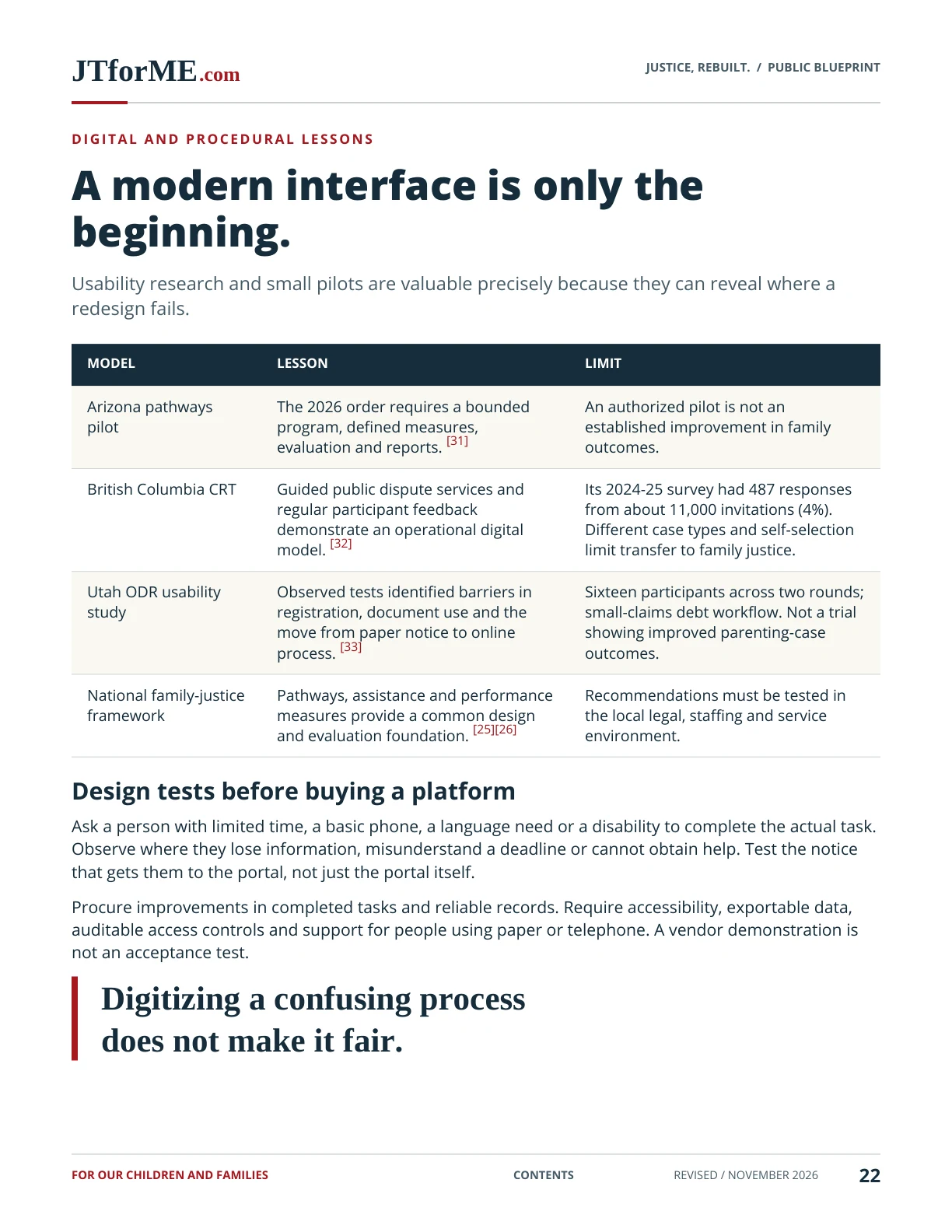
MODEL
LESSON
LIMIT
Arizona pathways
pilot
The 2026 order requires a bounded
program, defined measures,
evaluation and reports. [31]
An authorized pilot is not an
established improvement in family
outcomes.
British Columbia CRT
Guided public dispute services and
regular participant feedback
demonstrate an operational digital
model. [32]
Its 2024-25 survey had 487 responses
from about 11,000 invitations (4%).
Different case types and self-selection
limit transfer to family justice.
Utah ODR usability
study
Observed tests identified barriers in
registration, document use and the
move from paper notice to online
process. [33]
Sixteen participants across two rounds;
small-claims debt workflow. Not a trial
showing improved parenting-case
outcomes.
National family-justice
framework
Pathways, assistance and performance
measures provide a common design
and evaluation foundation. [25][26]
Recommendations must be tested in
the local legal, staffing and service
environment.
Design tests before buying a platform
Ask a person with limited time, a basic phone, a language need or a disability to complete the actual task.
Observe where they lose information, misunderstand a deadline or cannot obtain help. Test the notice
that gets them to the portal, not just the portal itself.
Procure improvements in completed tasks and reliable records. Require accessibility, exportable data,
auditable access controls and support for people using paper or telephone. A vendor demonstration is
not an acceptance test.
Digitizing a confusing process
does not make it fair.
FOR OUR CHILDREN AND FAMILIES
CONTENTS
REVISED / NOVEMBER 2026
22
Blueprint page 23: Evidence that changes the design.. Full page text follows.
Read selectable text — page 23

Text extracted from the revised PDF. The original page governs layout, tables and citation placement.

JTforME.com
JUSTICE, REBUILT.  /  PUBLIC BLUEPRINT
EVIDENCE AND ITS LIMITS
Evidence that changes the design.
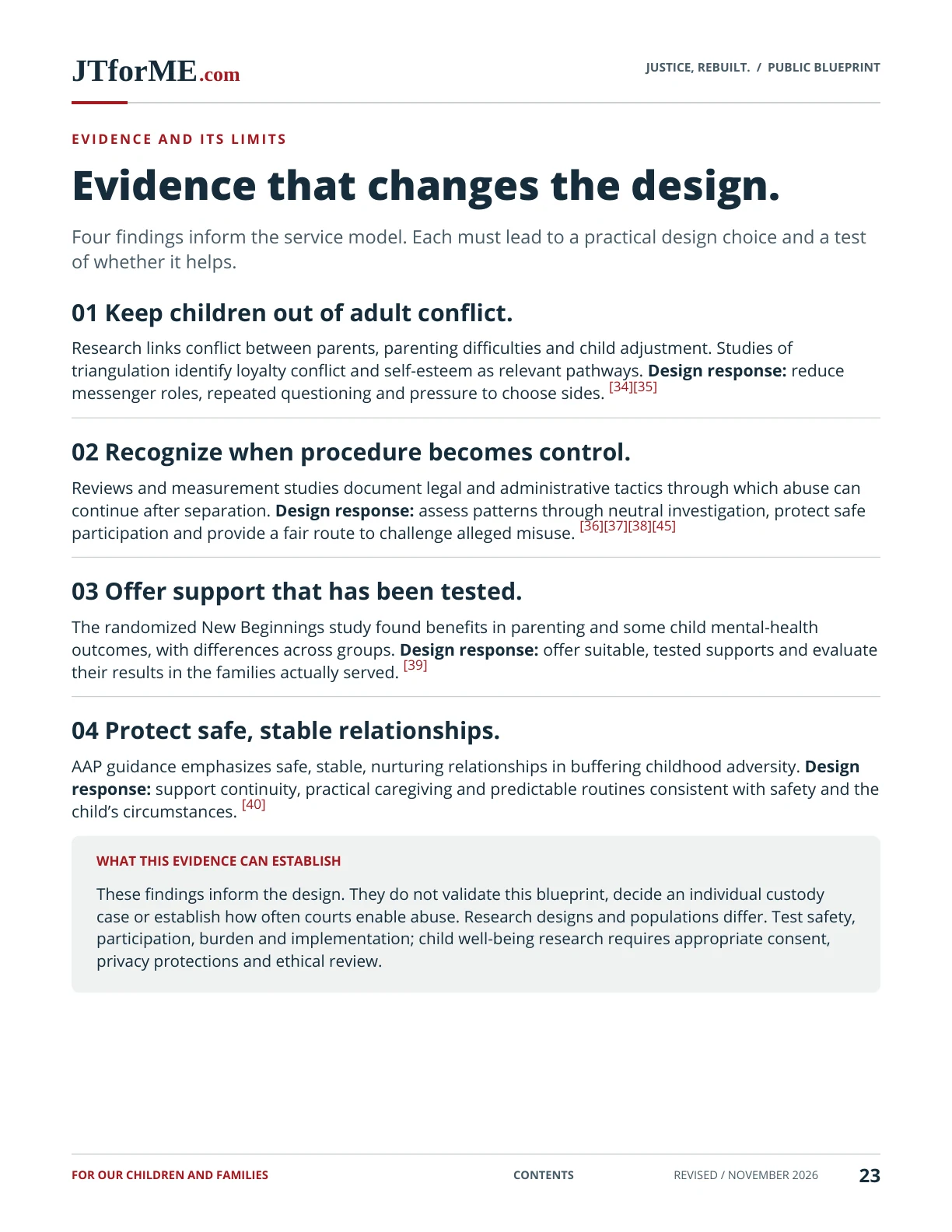
Four findings inform the service model. Each must lead to a practical design choice and a test
of whether it helps.
01 Keep children out of adult conflict.
Research links conflict between parents, parenting difficulties and child adjustment. Studies of
triangulation identify loyalty conflict and self-esteem as relevant pathways. Design response: reduce
messenger roles, repeated questioning and pressure to choose sides. [34][35]
02 Recognize when procedure becomes control.
Reviews and measurement studies document legal and administrative tactics through which abuse can
continue after separation. Design response: assess patterns through neutral investigation, protect safe
participation and provide a fair route to challenge alleged misuse. [36][37][38][45]
03 Offer support that has been tested.
The randomized New Beginnings study found benefits in parenting and some child mental-health
outcomes, with differences across groups. Design response: offer suitable, tested supports and evaluate
their results in the families actually served. [39]
04 Protect safe, stable relationships.
AAP guidance emphasizes safe, stable, nurturing relationships in buffering childhood adversity. Design
response: support continuity, practical caregiving and predictable routines consistent with safety and the
child’s circumstances. [40]
WHAT THIS EVIDENCE CAN ESTABLISH
These findings inform the design. They do not validate this blueprint, decide an individual custody
case or establish how often courts enable abuse. Research designs and populations differ. Test safety,
participation, burden and implementation; child well-being research requires appropriate consent,
privacy protections and ethical review.
FOR OUR CHILDREN AND FAMILIES
CONTENTS
REVISED / NOVEMBER 2026
23
Blueprint page 24: “How can we help?”. Full page text follows.
Read selectable text — page 24

Text extracted from the revised PDF. The original page governs layout, tables and citation placement.

JTforME.com
JUSTICE, REBUILT.  /  PUBLIC BLUEPRINT
PUBLIC DUTY AND THE FIRST CONVERSATION
“How can we help?”
The public obligation already exists. This is how the conversation should start.
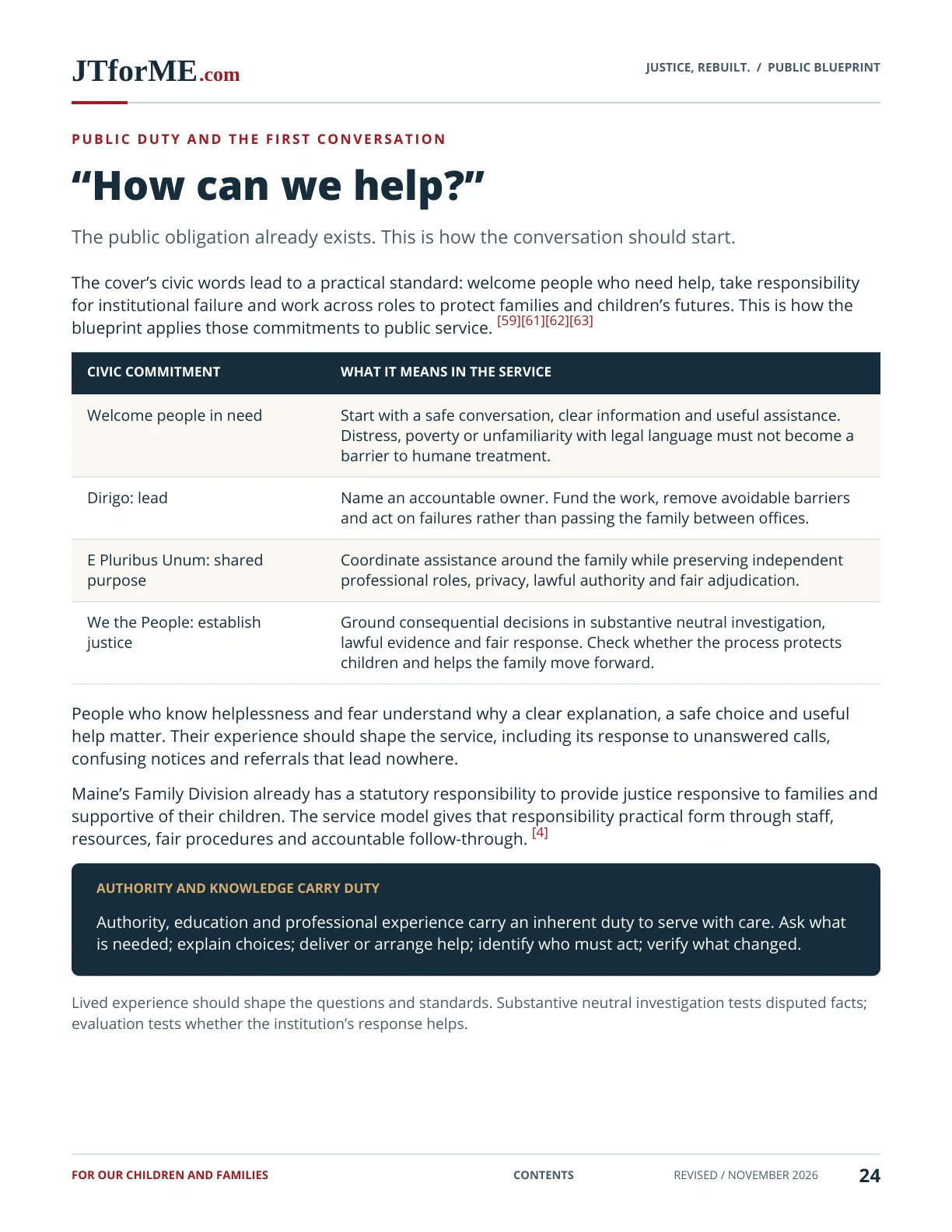
The cover’s civic words lead to a practical standard: welcome people who need help, take responsibility
for institutional failure and work across roles to protect families and children’s futures. This is how the
blueprint applies those commitments to public service. [59][61][62][63]
CIVIC COMMITMENT
WHAT IT MEANS IN THE SERVICE
Welcome people in need
Start with a safe conversation, clear information and useful assistance.
Distress, poverty or unfamiliarity with legal language must not become a
barrier to humane treatment.
Dirigo: lead
Name an accountable owner. Fund the work, remove avoidable barriers
and act on failures rather than passing the family between offices.
E Pluribus Unum: shared
purpose
Coordinate assistance around the family while preserving independent
professional roles, privacy, lawful authority and fair adjudication.
We the People: establish
justice
Ground consequential decisions in substantive neutral investigation,
lawful evidence and fair response. Check whether the process protects
children and helps the family move forward.
People who know helplessness and fear understand why a clear explanation, a safe choice and useful
help matter. Their experience should shape the service, including its response to unanswered calls,
confusing notices and referrals that lead nowhere.
Maine’s Family Division already has a statutory responsibility to provide justice responsive to families and
supportive of their children. The service model gives that responsibility practical form through staff,
resources, fair procedures and accountable follow-through. [4]
AUTHORITY AND KNOWLEDGE CARRY DUTY
Authority, education and professional experience carry an inherent duty to serve with care. Ask what
is needed; explain choices; deliver or arrange help; identify who must act; verify what changed.
Lived experience should shape the questions and standards. Substantive neutral investigation tests disputed facts;
evaluation tests whether the institution’s response helps.
FOR OUR CHILDREN AND FAMILIES
CONTENTS
REVISED / NOVEMBER 2026
24
Blueprint page 25: Make help reachable.. Full page text follows.
Read selectable text — page 25

Text extracted from the revised PDF. The original page governs layout, tables and citation placement.

JTforME.com
JUSTICE, REBUILT.  /  PUBLIC BLUEPRINT
PRACTICAL ASSISTANCE AND SAFE PARTICIPATION
Make help reachable.
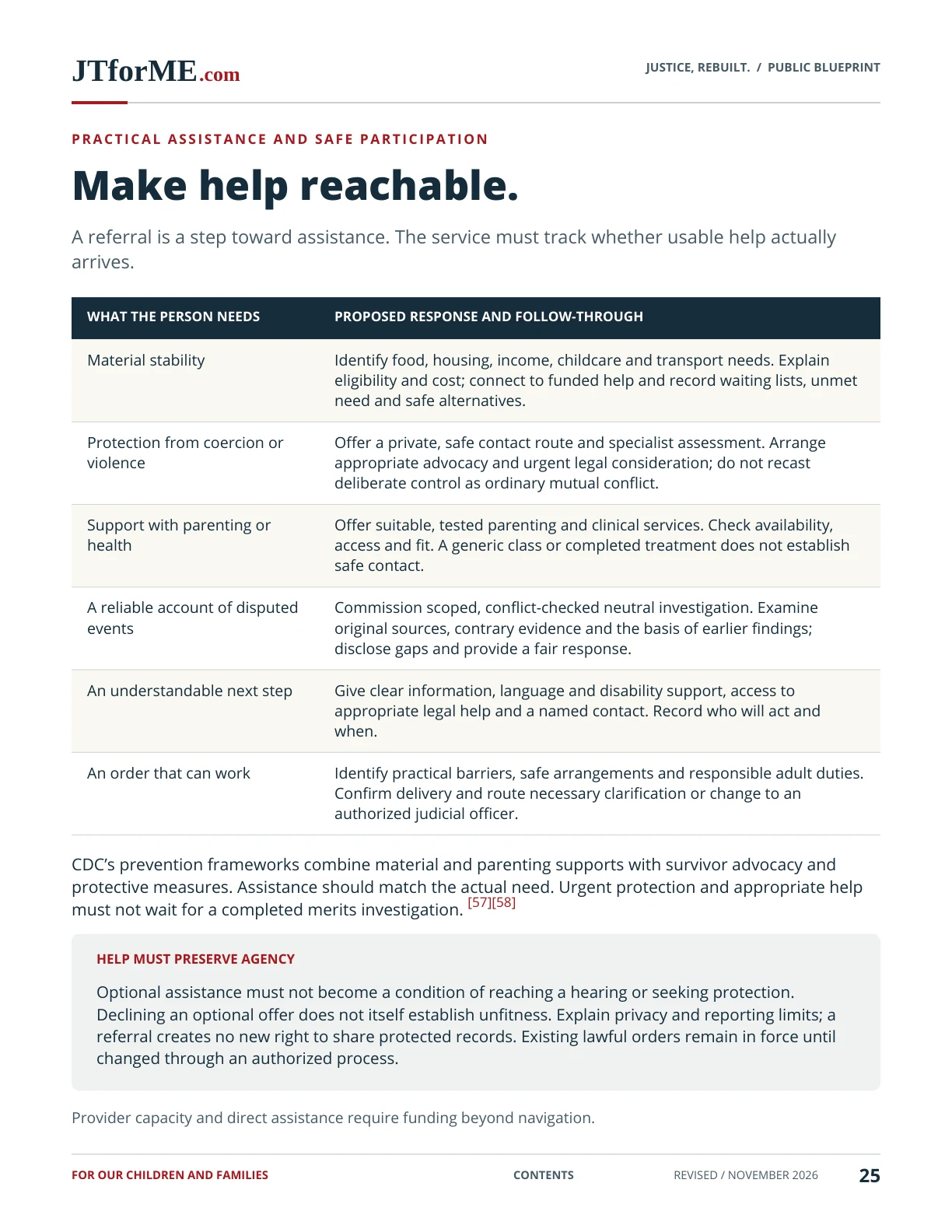
A referral is a step toward assistance. The service must track whether usable help actually
arrives.
WHAT THE PERSON NEEDS
PROPOSED RESPONSE AND FOLLOW-THROUGH
Material stability
Identify food, housing, income, childcare and transport needs. Explain
eligibility and cost; connect to funded help and record waiting lists, unmet
need and safe alternatives.
Protection from coercion or
violence
Offer a private, safe contact route and specialist assessment. Arrange
appropriate advocacy and urgent legal consideration; do not recast
deliberate control as ordinary mutual conflict.
Support with parenting or
health
Offer suitable, tested parenting and clinical services. Check availability,
access and fit. A generic class or completed treatment does not establish
safe contact.
A reliable account of disputed
events
Commission scoped, conflict-checked neutral investigation. Examine
original sources, contrary evidence and the basis of earlier findings;
disclose gaps and provide a fair response.
An understandable next step
Give clear information, language and disability support, access to
appropriate legal help and a named contact. Record who will act and
when.
An order that can work
Identify practical barriers, safe arrangements and responsible adult duties.
Confirm delivery and route necessary clarification or change to an
authorized judicial officer.
CDC’s prevention frameworks combine material and parenting supports with survivor advocacy and
protective measures. Assistance should match the actual need. Urgent protection and appropriate help
must not wait for a completed merits investigation. [57][58]
HELP MUST PRESERVE AGENCY
Optional assistance must not become a condition of reaching a hearing or seeking protection.
Declining an optional offer does not itself establish unfitness. Explain privacy and reporting limits; a
referral creates no new right to share protected records. Existing lawful orders remain in force until
changed through an authorized process.
Provider capacity and direct assistance require funding beyond navigation.
FOR OUR CHILDREN AND FAMILIES
CONTENTS
REVISED / NOVEMBER 2026
25
Blueprint page 26: Support can change outcomes.. Full page text follows.
Read selectable text — page 26

Text extracted from the revised PDF. The original page governs layout, tables and citation placement.

JTforME.com
JUSTICE, REBUILT.  /  PUBLIC BLUEPRINT
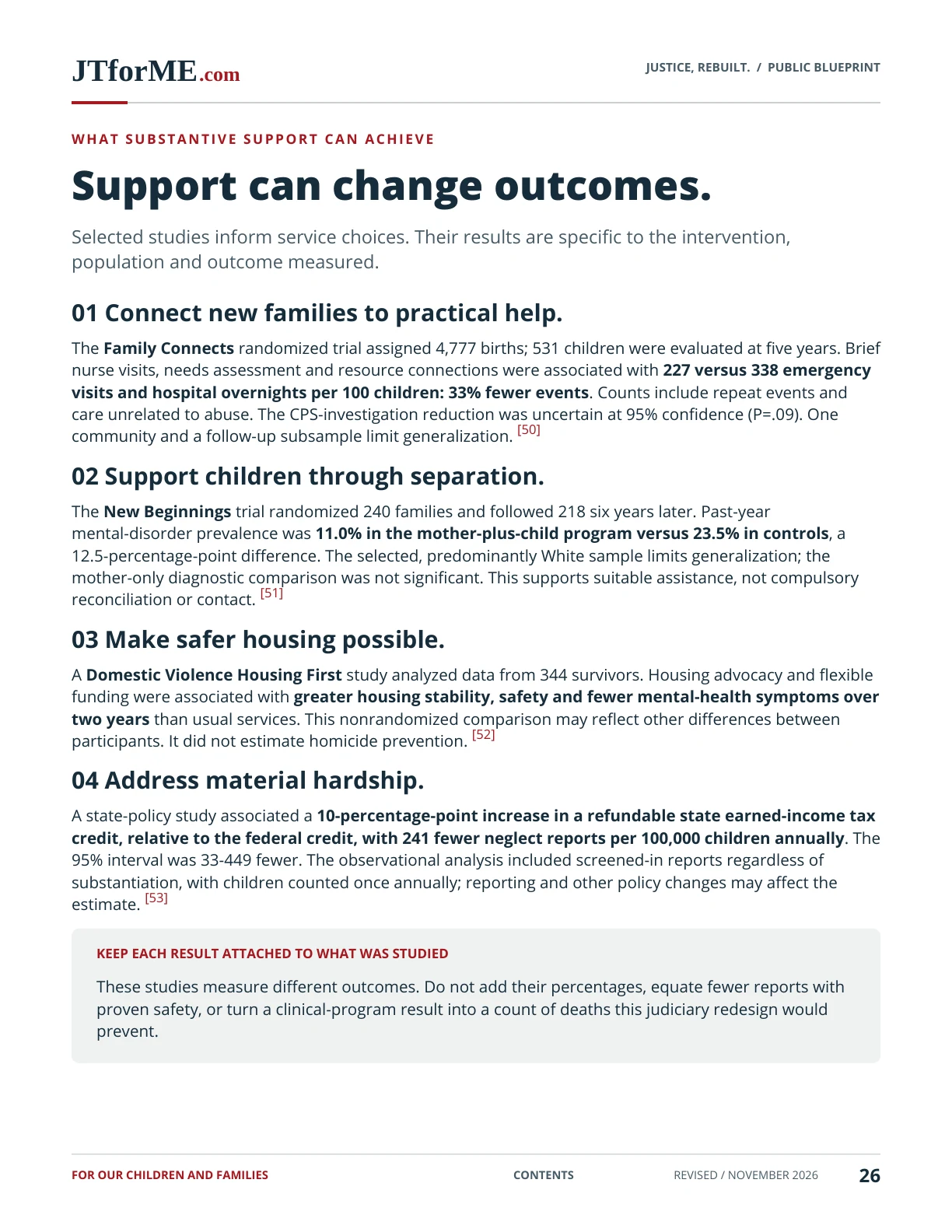
WHAT SUBSTANTIVE SUPPORT CAN ACHIEVE
Support can change outcomes.
Selected studies inform service choices. Their results are specific to the intervention,
population and outcome measured.
01 Connect new families to practical help.
The Family Connects randomized trial assigned 4,777 births; 531 children were evaluated at five years. Brief
nurse visits, needs assessment and resource connections were associated with 227 versus 338 emergency
visits and hospital overnights per 100 children: 33% fewer events. Counts include repeat events and
care unrelated to abuse. The CPS-investigation reduction was uncertain at 95% confidence (P=.09). One
community and a follow-up subsample limit generalization. [50]
02 Support children through separation.
The New Beginnings trial randomized 240 families and followed 218 six years later. Past-year
mental-disorder prevalence was 11.0% in the mother-plus-child program versus 23.5% in controls, a
12.5-percentage-point difference. The selected, predominantly White sample limits generalization; the
mother-only diagnostic comparison was not significant. This supports suitable assistance, not compulsory
reconciliation or contact. [51]
03 Make safer housing possible.
A Domestic Violence Housing First study analyzed data from 344 survivors. Housing advocacy and flexible
funding were associated with greater housing stability, safety and fewer mental-health symptoms over
two years than usual services. This nonrandomized comparison may reflect other differences between
participants. It did not estimate homicide prevention. [52]
04 Address material hardship.
A state-policy study associated a 10-percentage-point increase in a refundable state earned-income tax
credit, relative to the federal credit, with 241 fewer neglect reports per 100,000 children annually. The
95% interval was 33-449 fewer. The observational analysis included screened-in reports regardless of
substantiation, with children counted once annually; reporting and other policy changes may affect the
estimate. [53]
KEEP EACH RESULT ATTACHED TO WHAT WAS STUDIED
These studies measure different outcomes. Do not add their percentages, equate fewer reports with
proven safety, or turn a clinical-program result into a count of deaths this judiciary redesign would
prevent.
FOR OUR CHILDREN AND FAMILIES
CONTENTS
REVISED / NOVEMBER 2026
26
Blueprint page 27: Investigate harm. Measure help.. Full page text follows.
Read selectable text — page 27

Text extracted from the revised PDF. The original page governs layout, tables and citation placement.

JTforME.com
JUSTICE, REBUILT.  /  PUBLIC BLUEPRINT
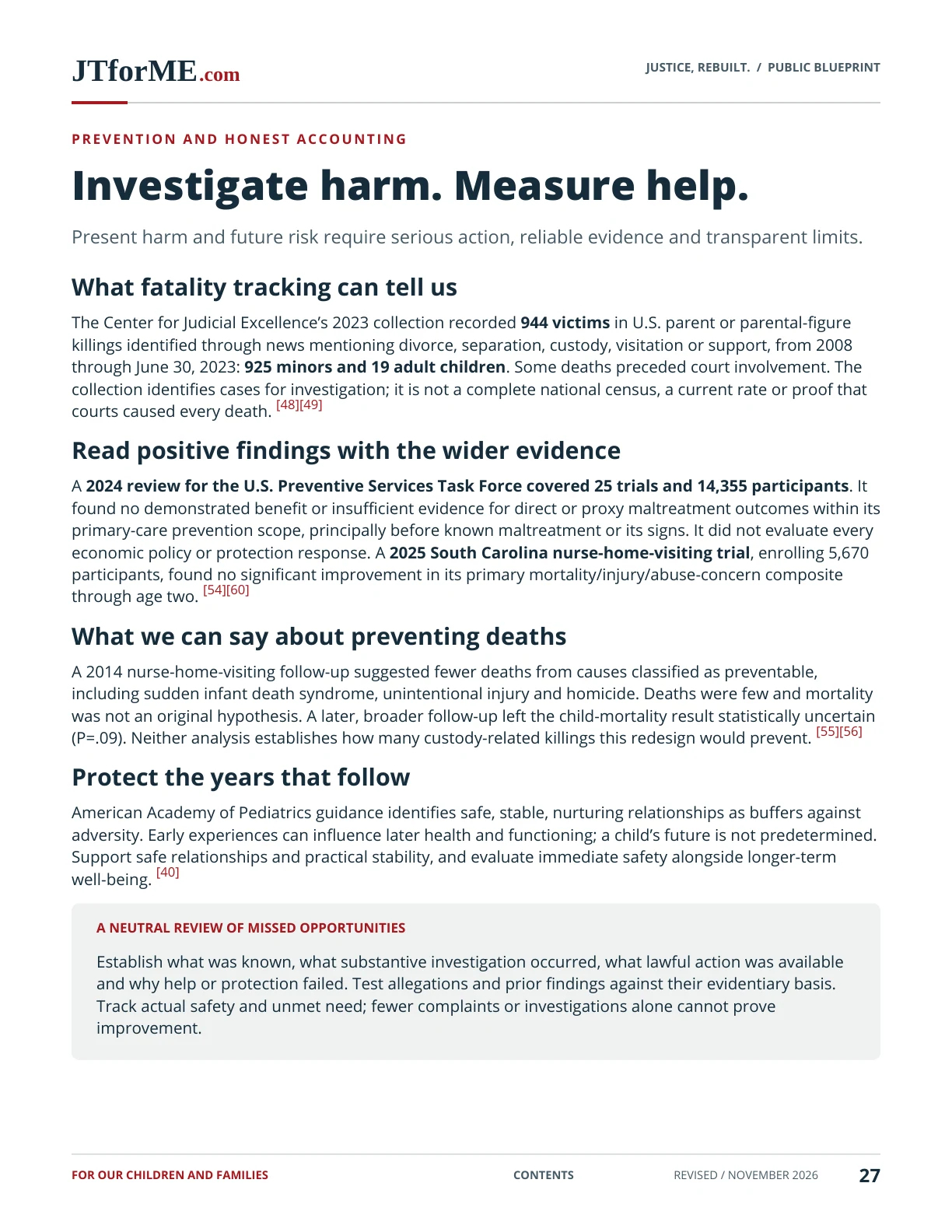
PREVENTION AND HONEST ACCOUNTING
Investigate harm. Measure help.
Present harm and future risk require serious action, reliable evidence and transparent limits.
What fatality tracking can tell us
The Center for Judicial Excellence’s 2023 collection recorded 944 victims in U.S. parent or parental-figure
killings identified through news mentioning divorce, separation, custody, visitation or support, from 2008
through June 30, 2023: 925 minors and 19 adult children. Some deaths preceded court involvement. The
collection identifies cases for investigation; it is not a complete national census, a current rate or proof that
courts caused every death. [48][49]
Read positive findings with the wider evidence
A 2024 review for the U.S. Preventive Services Task Force covered 25 trials and 14,355 participants. It
found no demonstrated benefit or insufficient evidence for direct or proxy maltreatment outcomes within its
primary-care prevention scope, principally before known maltreatment or its signs. It did not evaluate every
economic policy or protection response. A 2025 South Carolina nurse-home-visiting trial, enrolling 5,670
participants, found no significant improvement in its primary mortality/injury/abuse-concern composite
through age two. [54][60]
What we can say about preventing deaths
A 2014 nurse-home-visiting follow-up suggested fewer deaths from causes classified as preventable,
including sudden infant death syndrome, unintentional injury and homicide. Deaths were few and mortality
was not an original hypothesis. A later, broader follow-up left the child-mortality result statistically uncertain
(P=.09). Neither analysis establishes how many custody-related killings this redesign would prevent. [55][56]
Protect the years that follow
American Academy of Pediatrics guidance identifies safe, stable, nurturing relationships as buffers against
adversity. Early experiences can influence later health and functioning; a child’s future is not predetermined.
Support safe relationships and practical stability, and evaluate immediate safety alongside longer-term
well-being. [40]
A NEUTRAL REVIEW OF MISSED OPPORTUNITIES
Establish what was known, what substantive investigation occurred, what lawful action was available
and why help or protection failed. Test allegations and prior findings against their evidentiary basis.
Track actual safety and unmet need; fewer complaints or investigations alone cannot prove
improvement.
FOR OUR CHILDREN AND FAMILIES
CONTENTS
REVISED / NOVEMBER 2026
27
Blueprint page 28: 04 / Delivery and accountability. Full page text follows.
Read selectable text — page 28

Text extracted from the revised PDF. The original page governs layout, tables and citation placement.

JTforME.com
JUSTICE, REBUILT.  /  PUBLIC BLUEPRINT
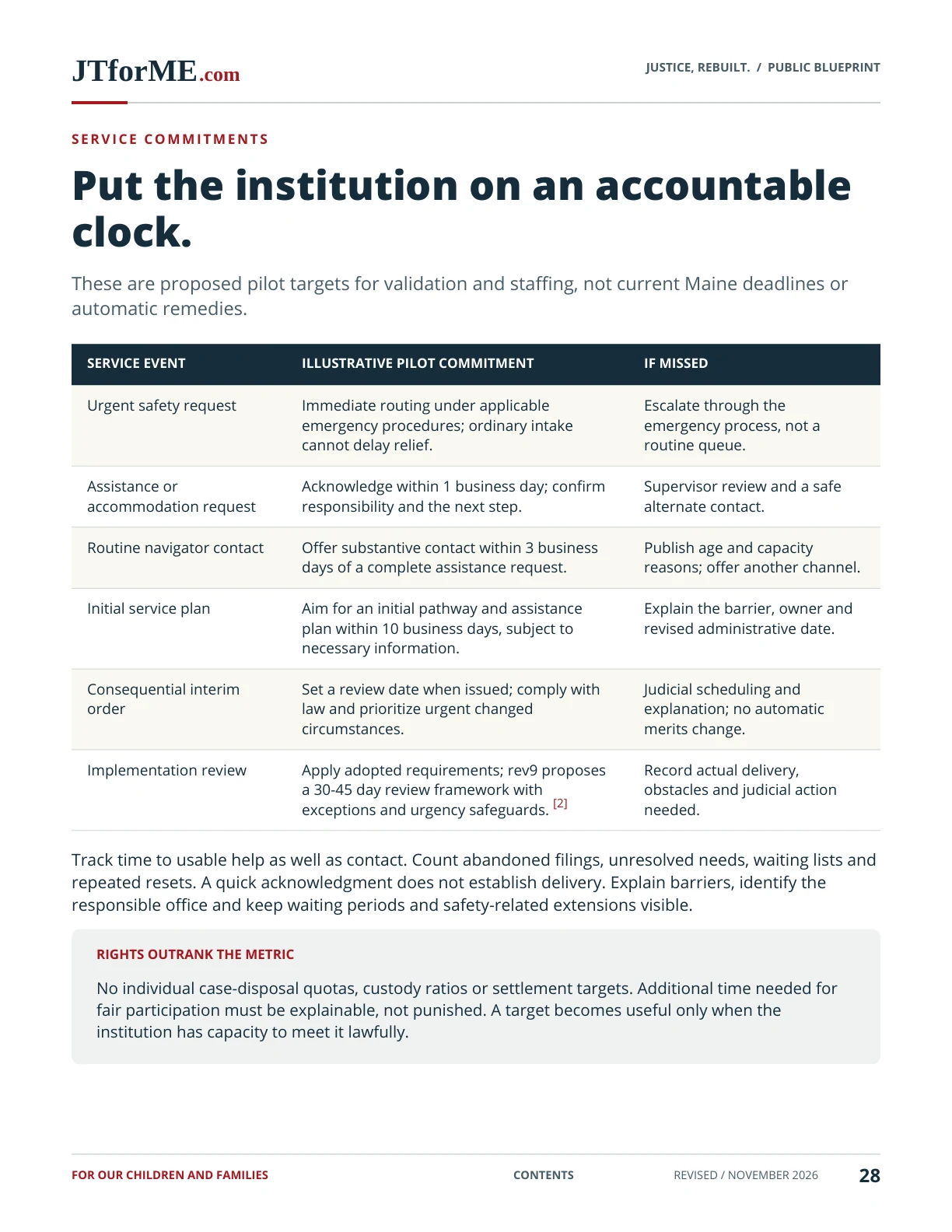
SERVICE COMMITMENTS
Put the institution on an accountable
clock.
These are proposed pilot targets for validation and staffing, not current Maine deadlines or
automatic remedies.
SERVICE EVENT
ILLUSTRATIVE PILOT COMMITMENT
IF MISSED
Urgent safety request
Immediate routing under applicable
emergency procedures; ordinary intake
cannot delay relief.
Escalate through the
emergency process, not a
routine queue.
Assistance or
accommodation request
Acknowledge within 1 business day; confirm
responsibility and the next step.
Supervisor review and a safe
alternate contact.
Routine navigator contact
Offer substantive contact within 3 business
days of a complete assistance request.
Publish age and capacity
reasons; offer another channel.
Initial service plan
Aim for an initial pathway and assistance
plan within 10 business days, subject to
necessary information.
Explain the barrier, owner and
revised administrative date.
Consequential interim
order
Set a review date when issued; comply with
law and prioritize urgent changed
circumstances.
Judicial scheduling and
explanation; no automatic
merits change.
Implementation review
Apply adopted requirements; rev9 proposes
a 30-45 day review framework with
exceptions and urgency safeguards. [2]
Record actual delivery,
obstacles and judicial action
needed.
Track time to usable help as well as contact. Count abandoned filings, unresolved needs, waiting lists and
repeated resets. A quick acknowledgment does not establish delivery. Explain barriers, identify the
responsible office and keep waiting periods and safety-related extensions visible.
RIGHTS OUTRANK THE METRIC
No individual case-disposal quotas, custody ratios or settlement targets. Additional time needed for
fair participation must be explainable, not punished. A target becomes useful only when the
institution has capacity to meet it lawfully.
FOR OUR CHILDREN AND FAMILIES
CONTENTS
REVISED / NOVEMBER 2026
28
Blueprint page 29: Independent judging. Accountable service.. Full page text follows.
Read selectable text — page 29

Text extracted from the revised PDF. The original page governs layout, tables and citation placement.

JTforME.com
JUSTICE, REBUILT.  /  PUBLIC BLUEPRINT
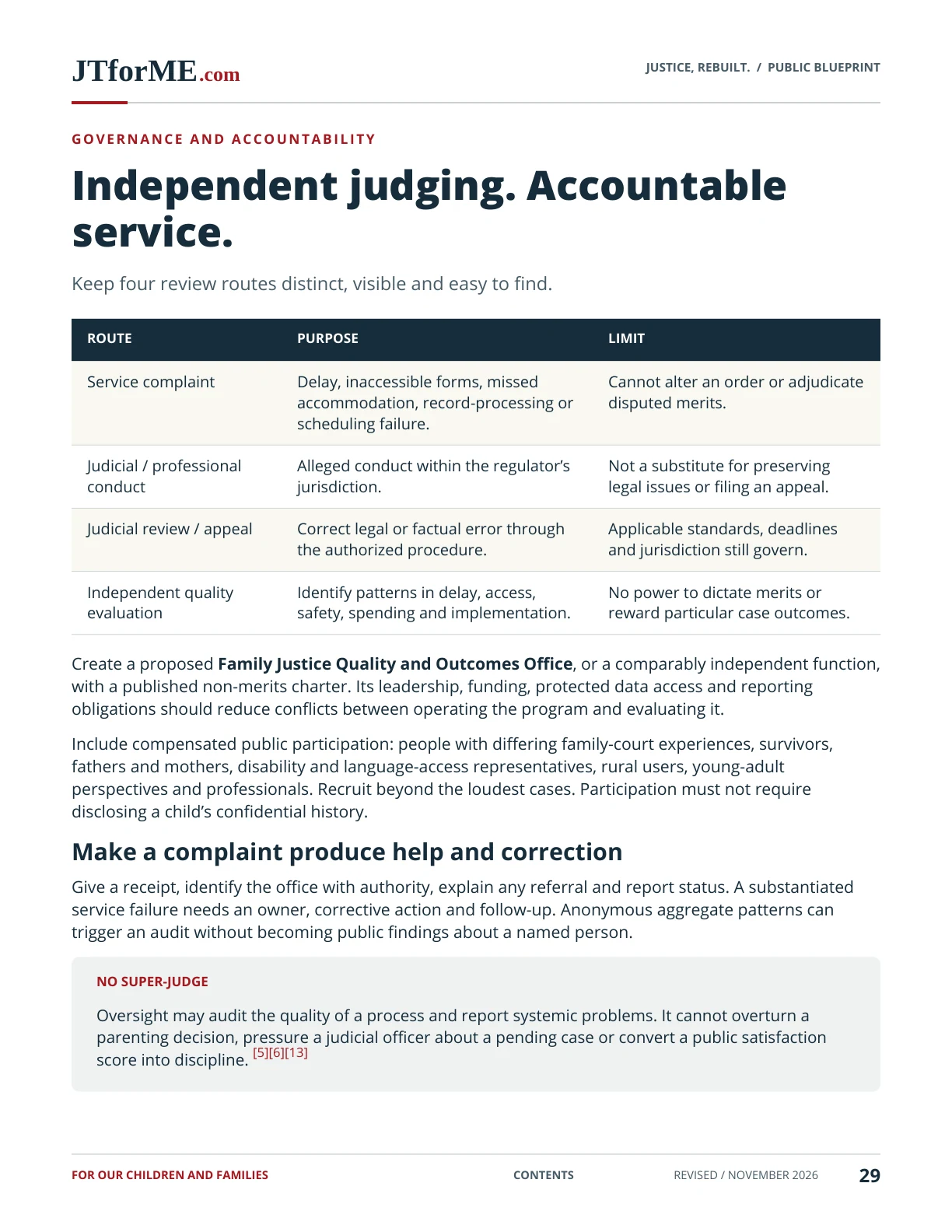
GOVERNANCE AND ACCOUNTABILITY
Independent judging. Accountable
service.
Keep four review routes distinct, visible and easy to find.
ROUTE
PURPOSE
LIMIT
Service complaint
Delay, inaccessible forms, missed
accommodation, record-processing or
scheduling failure.
Cannot alter an order or adjudicate
disputed merits.
Judicial / professional
conduct
Alleged conduct within the regulator’s
jurisdiction.
Not a substitute for preserving
legal issues or filing an appeal.
Judicial review / appeal
Correct legal or factual error through
the authorized procedure.
Applicable standards, deadlines
and jurisdiction still govern.
Independent quality
evaluation
Identify patterns in delay, access,
safety, spending and implementation.
No power to dictate merits or
reward particular case outcomes.
Create a proposed Family Justice Quality and Outcomes Office, or a comparably independent function,
with a published non-merits charter. Its leadership, funding, protected data access and reporting
obligations should reduce conflicts between operating the program and evaluating it.
Include compensated public participation: people with differing family-court experiences, survivors,
fathers and mothers, disability and language-access representatives, rural users, young-adult
perspectives and professionals. Recruit beyond the loudest cases. Participation must not require
disclosing a child’s confidential history.
Make a complaint produce help and correction
Give a receipt, identify the office with authority, explain any referral and report status. A substantiated
service failure needs an owner, corrective action and follow-up. Anonymous aggregate patterns can
trigger an audit without becoming public findings about a named person.
NO SUPER-JUDGE
Oversight may audit the quality of a process and report systemic problems. It cannot overturn a
parenting decision, pressure a judicial officer about a pending case or convert a public satisfaction
score into discipline. [5][6][13]
FOR OUR CHILDREN AND FAMILIES
CONTENTS
REVISED / NOVEMBER 2026
29
Blueprint page 30: Automate the burden. Keep judgment accountable.. Full page text follows.
Read selectable text — page 30

Text extracted from the revised PDF. The original page governs layout, tables and citation placement.

JTforME.com
JUSTICE, REBUILT.  /  PUBLIC BLUEPRINT
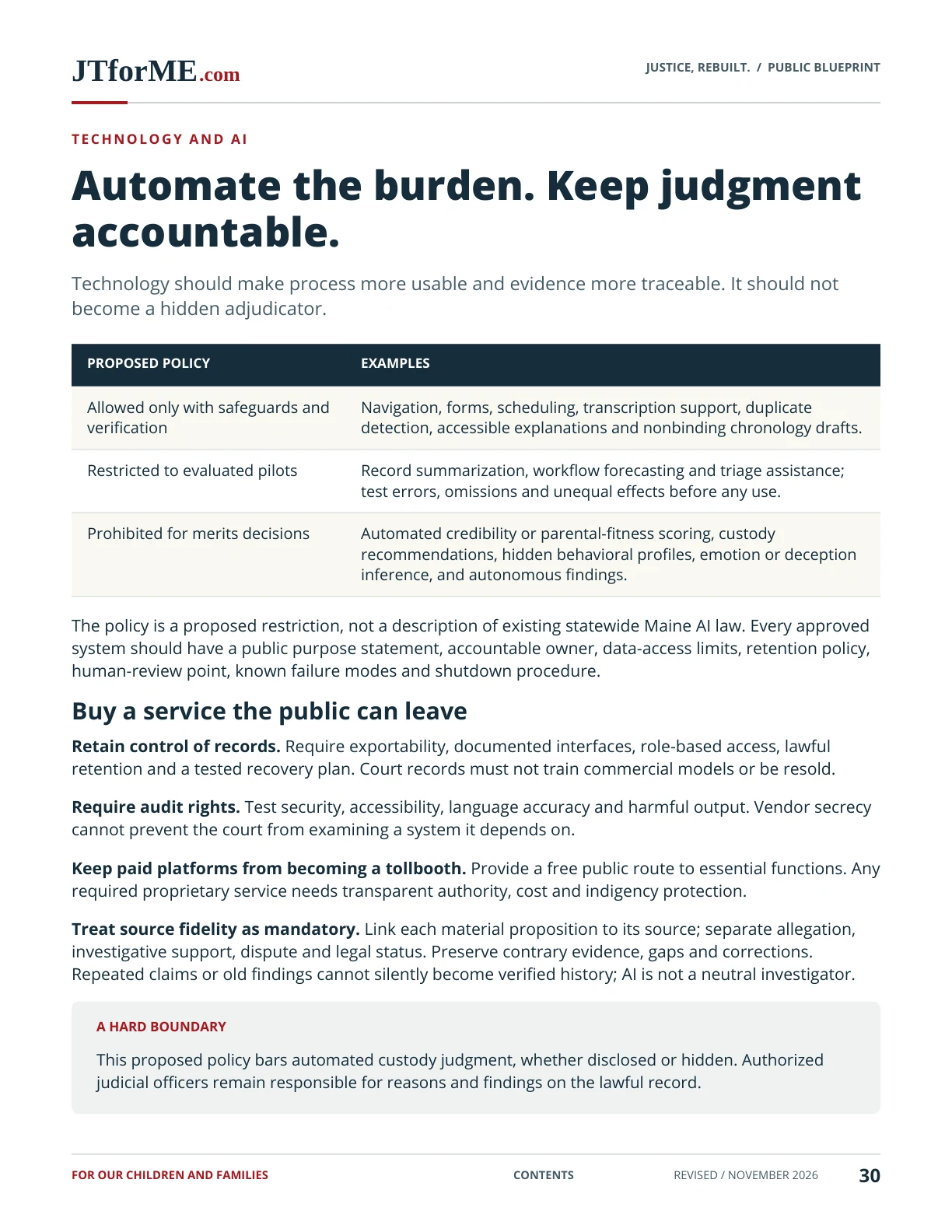
TECHNOLOGY AND AI
Automate the burden. Keep judgment
accountable.
Technology should make process more usable and evidence more traceable. It should not
become a hidden adjudicator.
PROPOSED POLICY
EXAMPLES
Allowed only with safeguards and
verification
Navigation, forms, scheduling, transcription support, duplicate
detection, accessible explanations and nonbinding chronology drafts.
Restricted to evaluated pilots
Record summarization, workflow forecasting and triage assistance;
test errors, omissions and unequal effects before any use.
Prohibited for merits decisions
Automated credibility or parental-fitness scoring, custody
recommendations, hidden behavioral profiles, emotion or deception
inference, and autonomous findings.
The policy is a proposed restriction, not a description of existing statewide Maine AI law. Every approved
system should have a public purpose statement, accountable owner, data-access limits, retention policy,
human-review point, known failure modes and shutdown procedure.
Buy a service the public can leave
Retain control of records. Require exportability, documented interfaces, role-based access, lawful
retention and a tested recovery plan. Court records must not train commercial models or be resold.
Require audit rights. Test security, accessibility, language accuracy and harmful output. Vendor secrecy
cannot prevent the court from examining a system it depends on.
Keep paid platforms from becoming a tollbooth. Provide a free public route to essential functions. Any
required proprietary service needs transparent authority, cost and indigency protection.
Treat source fidelity as mandatory. Link each material proposition to its source; separate allegation,
investigative support, dispute and legal status. Preserve contrary evidence, gaps and corrections.
Repeated claims or old findings cannot silently become verified history; AI is not a neutral investigator.
A HARD BOUNDARY
This proposed policy bars automated custody judgment, whether disclosed or hidden. Authorized
judicial officers remain responsible for reasons and findings on the lawful record.
FOR OUR CHILDREN AND FAMILIES
CONTENTS
REVISED / NOVEMBER 2026
30
Blueprint page 31: Fund the service. Show the arithmetic.. Full page text follows.
Read selectable text — page 31

Text extracted from the revised PDF. The original page governs layout, tables and citation placement.

JTforME.com
JUSTICE, REBUILT.  /  PUBLIC BLUEPRINT
COSTS WITH VISIBLE ASSUMPTIONS
Fund the service. Show the arithmetic.
Fund practical help and protect children’s futures. These 2026-dollar planning scenarios are
not fiscal notes or validated forecasts.
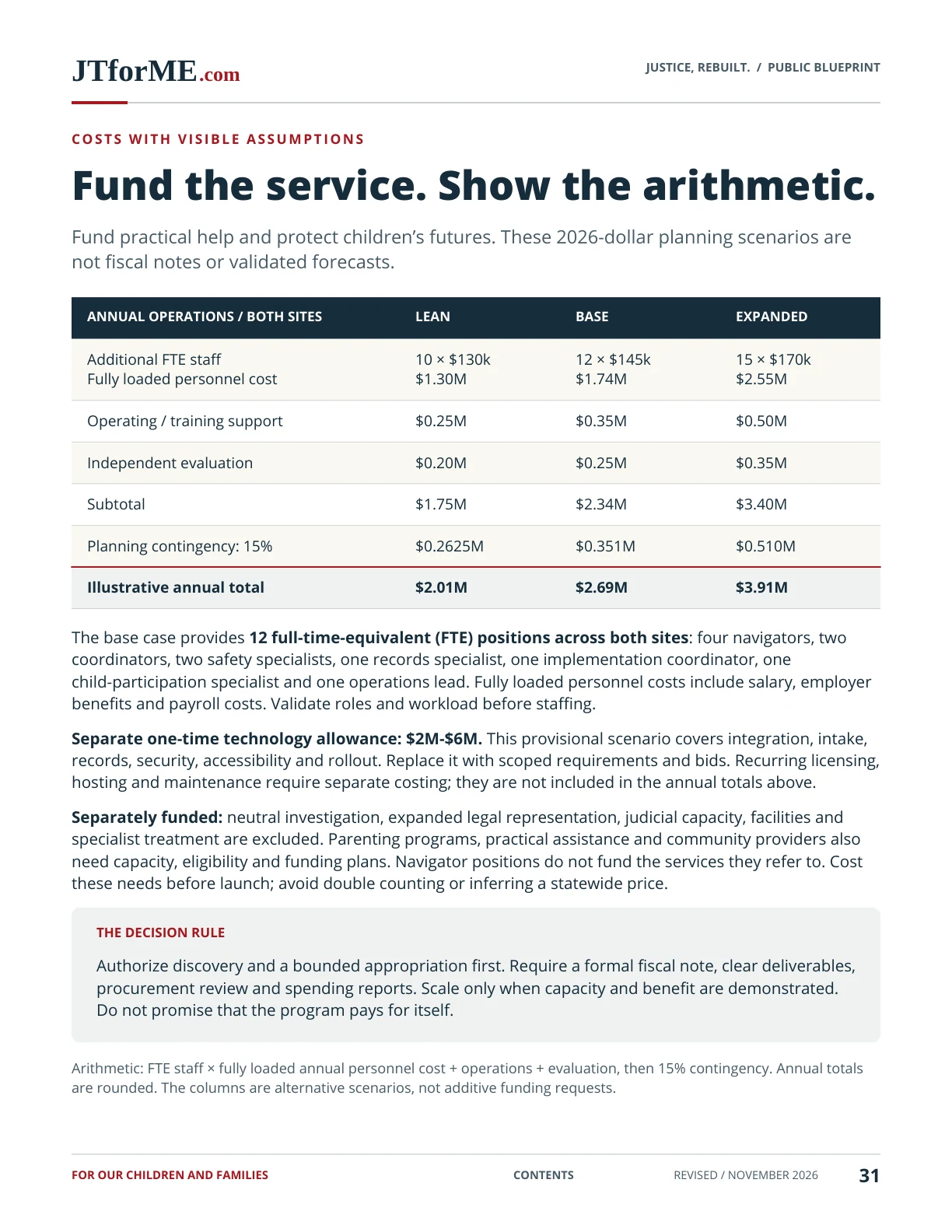
ANNUAL OPERATIONS / BOTH SITES
LEAN
BASE
EXPANDED
Additional FTE staff
Fully loaded personnel cost
10 × $130k
$1.30M
12 × $145k
$1.74M
15 × $170k
$2.55M
Operating / training support
$0.25M
$0.35M
$0.50M
Independent evaluation
$0.20M
$0.25M
$0.35M
Subtotal
$1.75M
$2.34M
$3.40M
Planning contingency: 15%
$0.2625M
$0.351M
$0.510M
Illustrative annual total
$2.01M
$2.69M
$3.91M
The base case provides 12 full-time-equivalent (FTE) positions across both sites: four navigators, two
coordinators, two safety specialists, one records specialist, one implementation coordinator, one
child-participation specialist and one operations lead. Fully loaded personnel costs include salary, employer
benefits and payroll costs. Validate roles and workload before staffing.
Separate one-time technology allowance: $2M-$6M. This provisional scenario covers integration, intake,
records, security, accessibility and rollout. Replace it with scoped requirements and bids. Recurring licensing,
hosting and maintenance require separate costing; they are not included in the annual totals above.
Separately funded: neutral investigation, expanded legal representation, judicial capacity, facilities and
specialist treatment are excluded. Parenting programs, practical assistance and community providers also
need capacity, eligibility and funding plans. Navigator positions do not fund the services they refer to. Cost
these needs before launch; avoid double counting or inferring a statewide price.
THE DECISION RULE
Authorize discovery and a bounded appropriation first. Require a formal fiscal note, clear deliverables,
procurement review and spending reports. Scale only when capacity and benefit are demonstrated.
Do not promise that the program pays for itself.
Arithmetic: FTE staff × fully loaded annual personnel cost + operations + evaluation, then 15% contingency. Annual totals
are rounded. The columns are alternative scenarios, not additive funding requests.
FOR OUR CHILDREN AND FAMILIES
CONTENTS
REVISED / NOVEMBER 2026
31
Blueprint page 32: Measure what families actually receive.. Full page text follows.
Read selectable text — page 32

Text extracted from the revised PDF. The original page governs layout, tables and citation placement.

JTforME.com
JUSTICE, REBUILT.  /  PUBLIC BLUEPRINT
THE PUBLIC SCORECARD
Measure what families actually
receive.
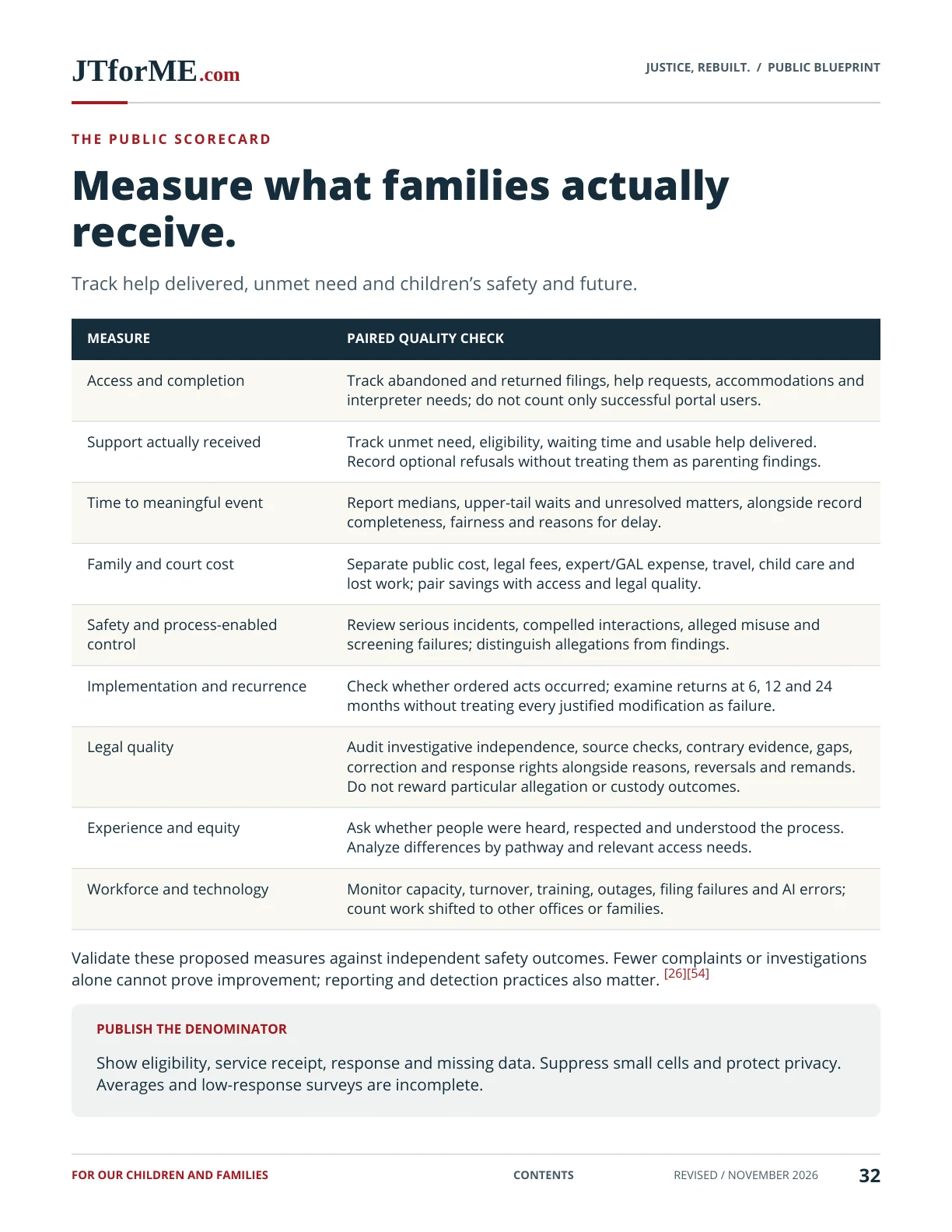
Track help delivered, unmet need and children’s safety and future.
MEASURE
PAIRED QUALITY CHECK
Access and completion
Track abandoned and returned filings, help requests, accommodations and
interpreter needs; do not count only successful portal users.
Support actually received
Track unmet need, eligibility, waiting time and usable help delivered.
Record optional refusals without treating them as parenting findings.
Time to meaningful event
Report medians, upper-tail waits and unresolved matters, alongside record
completeness, fairness and reasons for delay.
Family and court cost
Separate public cost, legal fees, expert/GAL expense, travel, child care and
lost work; pair savings with access and legal quality.
Safety and process-enabled
control
Review serious incidents, compelled interactions, alleged misuse and
screening failures; distinguish allegations from findings.
Implementation and recurrence
Check whether ordered acts occurred; examine returns at 6, 12 and 24
months without treating every justified modification as failure.
Legal quality
Audit investigative independence, source checks, contrary evidence, gaps,
correction and response rights alongside reasons, reversals and remands.
Do not reward particular allegation or custody outcomes.
Experience and equity
Ask whether people were heard, respected and understood the process.
Analyze differences by pathway and relevant access needs.
Workforce and technology
Monitor capacity, turnover, training, outages, filing failures and AI errors;
count work shifted to other offices or families.
Validate these proposed measures against independent safety outcomes. Fewer complaints or investigations
alone cannot prove improvement; reporting and detection practices also matter. [26][54]
PUBLISH THE DENOMINATOR
Show eligibility, service receipt, response and missing data. Suppress small cells and protect privacy.
Averages and low-response surveys are incomplete.
FOR OUR CHILDREN AND FAMILIES
CONTENTS
REVISED / NOVEMBER 2026
32
Blueprint page 33: Start now. Replace carefully.. Full page text follows.
Read selectable text — page 33

Text extracted from the revised PDF. The original page governs layout, tables and citation placement.

JTforME.com
JUSTICE, REBUILT.  /  PUBLIC BLUEPRINT
IMPLEMENTATION AND EVALUATION
Start now. Replace carefully.
Immediate service improvement and longer institutional redesign need coordinated timelines.
The early implementation clock
REV9 PROPOSES
BLUEPRINT DELIVERABLE
30 days
Identify executive and operational owners, backups and an initial controlled
register of work and failures.
90 days
Publish a costed plan, available baseline, data definitions and legal-coordination
work.
120 days
Begin a bounded operational pilot under lawful authority.
180 days
Put ownership, event tracking and escalation into use; publish the first privacy-safe
dashboard.
12 and 18 months
Independent operational/fiscal assessment, followed by broader child-and-family
impact evaluation.
These are the initiative’s proposed milestones from its lawful effective date, not existing deadlines. Do not
confuse a first bounded test with a completed statewide transformation. [1][2]
The transformation horizon
Year 1: map the actual journey with users and staff; establish baseline measures; resolve authority,
confidentiality and funding; select two different pilot sites; test navigation and manual tracking before
major procurement.
Years 2-3: run the integrated pathways, retain meaningful comparison data and publish adverse effects.
Examine staff work, cost, safety, fairness, implementation and recurring litigation.
Years 4-5: expand components supported by results, revise or stop the rest, and fund continuing
evaluation. Later adapt the architecture to other dockets with their own rights, users and risks.
EVALUATE BEFORE CLAIMING VICTORY
Pre-register the questions and measures. Use matched contemporaneous comparisons where
feasible, with historical baselines and transparent limits. An evaluator independent of program
delivery should publish negative findings. No experiment may withhold required protection, counsel
or a hearing.
FOR OUR CHILDREN AND FAMILIES
CONTENTS
REVISED / NOVEMBER 2026
33
Blueprint page 34: Define the service and its limits.. Full page text follows.
Read selectable text — page 34

Text extracted from the revised PDF. The original page governs layout, tables and citation placement.

JTforME.com
JUSTICE, REBUILT.  /  PUBLIC BLUEPRINT
DISCUSSION DRAFT PROVISIONS
Define the service and its limits.
Model concepts for coordinated legislative and SJC drafting. They are neither enacted language
nor a substitute for section-by-section legal review.
1. Purpose and accountable service
In covered Family Division matters, deliver the existing duty of responsive justice through safe, accessible,
understandable and timely service. Ask what help is needed, identify a responsible office and track actual
assistance. Preserve impartial adjudication, burdens of proof, evidentiary protections and review.
Optional support shall not become a condition of a hearing or urgent protection. Other proceedings
retain their governing law.
2. Role separation
A navigator or coordinator may provide authorized information, arrange assistance and manage
administrative progress. That role does not authorize adjudicative findings on disputed merits, alteration
of an order, individualized legal advice without appropriate authorization, or undisclosed communication
concerning disputed merits. Contested decisions remain with the authorized judicial officer.
3. Administrative pathways
Early assessment may identify service, accessibility, complexity and safety needs. Assignment governs
case-management resources only. It is not evidence, creates no presumption concerning a person’s
credibility or parenting, and does not change a burden of proof. Provide understandable notice and
timely human reconsideration, with protection for confidential screening disclosures.
4. Investigated history and protected records
Material disputed history shall receive substantive, proportionate inquiry by a qualified, conflict-checked
neutral. Disclose primary sources, competing explanations, contrary evidence, earlier findings’
investigative basis, gaps and corrections. Provide lawful notice and challenge before merits reliance
without delaying authorized emergency relief. Preserve mandatory reporting, privileges and separate
access rules for screening, mediation, advice, treatment and evidence; investigation creates no new
disclosure authority. Existing orders and binding findings retain legal effect until changed through an
authorized process.
REQUIRED COORDINATION
Integrate these concepts with rev9 §3, existing Family Division services and court-record rules. Do not
establish competing offices or a single unrestricted family record. Related proceedings retain their
separate jurisdiction and governing law. [2][4][11]
FOR OUR CHILDREN AND FAMILIES
CONTENTS
REVISED / NOVEMBER 2026
34
Blueprint page 35: Control misuse without closing the courthouse.. Full page text follows.
Read selectable text — page 35

Text extracted from the revised PDF. The original page governs layout, tables and citation placement.

JTforME.com
JUSTICE, REBUILT.  /  PUBLIC BLUEPRINT
DISCUSSION DRAFT PROVISIONS
Control misuse without closing the
courthouse.
Protect genuine safety reporting, legitimate advocacy and the ability to obtain timely
adjudication.
5. Process-enabled coercion
Provide a fair route to review alleged procedural abuse. Examine conduct, lawful purpose and harm
against history tested through substantive neutral investigation, with contrary evidence and gaps
disclosed. Sanctions or filing restrictions require authority, notice, response, reasoned findings and
proportionality. Preserve authorized temporary emergency relief, required service and prompt hearing or
review. Filing count, distress or an unsuccessful claim alone is insufficient. Preserve judicial access for
urgent or continuing safety concerns, material new information and lawful review. [46]
6. Interim-order and implementation review
A material interim restriction shall identify its basis and an appropriate review date, consistent with
controlling law. A missed review triggers accountable explanation and priority scheduling, not automatic
expiration or a parenting presumption. Orders shall assign practical adult duties, dates, safe
communication, contingencies and review where needed. Staff may verify delivery but may not modify
relief.
7. Informed resolution; proposed expanded choice
An additional reform option would make mediation participation voluntary and prohibit improper
adverse inference from declining it. This requires express amendments to 19-A §§251 and 1653(11),
coordinated rules and capacity for hearings. Until adopted, improve screening, safe formats and prompt
lawful waiver decisions within existing requirements. In every model, agreement must be informed and
settlement may not be a staff or judicial quota. [8]
8. Quality, spending and technology
Require a public service scorecard, independent evaluation, a non-merits complaint route and
transparent spending. Essential participation must have an accessible public route. Prohibit automated
credibility or parental-fitness scoring, custody recommendations and autonomous merits findings,
whether disclosed or hidden. Approved systems must be auditable, records portable and sensitive data
protected from unauthorized secondary use.
Drafting rule: choose the narrowest effective lawful remedy. Preserve judicial independence, due process,
statutory protections and review. Prevent abusive methods and institutional failures while leaving each family’s
merits to lawful adjudication. [6][15]
FOR OUR CHILDREN AND FAMILIES
CONTENTS
REVISED / NOVEMBER 2026
35
Blueprint page 36: A new system must answer harder questions.. Full page text follows.
Read selectable text — page 36

Text extracted from the revised PDF. The original page governs layout, tables and citation placement.

JTforME.com
JUSTICE, REBUILT.  /  PUBLIC BLUEPRINT
CHALLENGE THE REDESIGN
A new system must answer harder
questions.
Modern language is not proof of better practice. Build ways to detect failure before scaling it.
FAILURE MODE
CONTROL AND EVIDENCE TO DEMAND
Distributed power becomes
invisible
Publish role boundaries and decision logs. Administrative labels cannot
become secret merits findings; provide human challenge and audit.
Safety language becomes a
custody shortcut
Require case-specific evidence, substantive neutral inquiry and judicial
reasons. Neither a screening label nor an unexamined past finding
substitutes for investigated facts. Preserve urgent protection and a fair
response.
Therapeutic work becomes
coercion
Use defined roles, informed participation and a route to adjudication.
Do not equate anger, flat affect or refusal to settle with unfitness.
Speed becomes a quota
Pair timeliness with participation, safety, record quality and correction.
Investigate the slowest cases and publish reasons for exceptions.
Vendors create new compulsory
costs
Require public alternatives, indigency protection, transparent total cost,
data portability and termination assistance.
Data becomes surveillance
Collect the minimum necessary; separate permissions and research
consent. Publish aggregate institutional performance, not childhood
dossiers.
Success is defined by easy cases
Publish eligibility, exclusions, attrition, missing data and unequal
outcomes. Compare similar cases and examine recurring work.
The redesign weakens existing
capacity
Resource staff transition and legal assistance. Track whether help
merely shifts workload or delays to another office.
Stop or revise a component when it creates serious unmitigated harm, suppresses access, produces
material data failures or lacks a lawful basis. Immediate protective action must not wait for the annual
evaluation. Publicly explain the correction without exposing private families.
Accountability belongs in the design,
including accountability for this design.
FOR OUR CHILDREN AND FAMILIES
CONTENTS
REVISED / NOVEMBER 2026
36
Blueprint page 37: 05 / Public action. Full page text follows.
Read selectable text — page 37

Text extracted from the revised PDF. The original page governs layout, tables and citation placement.

JTforME.com
JUSTICE, REBUILT.  /  PUBLIC BLUEPRINT
THE PEOPLE’S CALL TO ACTION
STAND THE FUCK UP.
SPEAK OUT. ALL RISE.
Help families. Help children. Protect their futures.
The public obligation already exists. “How can we help?” is how the conversation should start. The People
are who these institutions serve. Require practical assistance, substantive neutral investigation, fair
decisions and accountability for what happens next.
Seats of authority, higher education and professional experience carry an inherent duty to use knowledge
and power in service of others. That responsibility must be visible in how children and families are
treated: “freely and without sale;” “promptly and without delay.”
We should never look down upon others
unless we are helping them up.
FOUR COMMITMENTS TO DEMAND
DEMAND
THE PUBLIC RESPONSE REQUIRED
Name the owner
Identify accountable leadership and meaningful roles for court users and staff.
Fund the help
Cost qualified staff, neutral investigation, practical assistance and provider
capacity; publish eligibility and the pilot budget.
Publish the test
Set baseline measures, service commitments, safety safeguards and independent
evaluation before rollout.
Correct the failure
Show what help arrived, what remains unmet, what harm occurred and what
changed. Publish failures alongside gains.
Continual Process Improvement practices, already proven throughout the
private sector, must be adopted immediately.
No “moore” games with children’s lives.
FOR OUR CHILDREN AND FAMILIES
JTforME.com/initiative/
Public Review Center | Reform Desk
Read the proposal and submit a specific improvement. Keep identifying child information and private
case records out of public channels. Proposed policy; not an official petition. [1][41][42][43]
FOR OUR CHILDREN AND FAMILIES
CONTENTS
REVISED / NOVEMBER 2026
37
Blueprint page 38: 06 / Sources and research notes. Full page text follows.
Read selectable text — page 38

Text extracted from the revised PDF. The original page governs layout, tables and citation placement.

JTforME.com
JUSTICE, REBUILT.  /  PUBLIC BLUEPRINT
SOURCE NOTES / METHOD
Evidence, authority and further
reading
Primary law, institutional models and selected research underpin the factual statements.
Proposed design choices are labeled as proposals.
Editorial review: November 21, 2026. This is a selected research synthesis, not an exhaustive systematic review or a
determination about any private case. Case summaries preserve their context. Program descriptions and stakeholder
surveys are distinguished from outcome studies. Cost figures and service targets are illustrative assumptions.
Revised public edition, linked to the initiative’s rev9 proposal. This companion does not amend the proposed Act. The
prevention expansion separates lived experience, historical fatality tracking, intervention results and proposed
delivery standards. NLM indexing and PMC hosting provide access, not endorsement. Sources identify designs,
limitations and material follow-up findings.
01. JTforME. For Our Children and Families: initiative overview, rev9 (13 Oct. 2026).
Primary campaign source. Proposed legislation and public review; no enactment or ballot qualification claimed.
Read source
02. JTforME. Proposed Act: An Act To Strengthen Maine Family Court Accountability and Protect Parent-Child
Relationships, rev9.
Operative proposal, including §§1-B, 3, 6-A, 14-A and 17-A-C. A companion blueprint does not amend this text.
Read source
03. JTforME. Initiative 2028 Roadmap and Outreach, rev9 (13 Oct. 2026).
Campaign planning document, including legislative route and contingency planning; dates are goals.
Read source
04. 4 M.R.S. §183. Family Division of District Court.
Opening paragraph: responsive family justice and SJC rulemaking. §4 is a narrow consent-based magistrate pilot, not general
authority to suspend law.
Read source
05. 4 M.R.S. §1. Judicial administration, supervision and budget.
Administrative authority supports redesign within lawful jurisdiction and appropriations.
Read source
06. Constitution of Maine, art. I, §19; art. III; art. VI, §1.
Prompt justice, separation of powers and judicial authority. These provisions do not decide every proposed reform’s
constitutionality.
Read source
FOR OUR CHILDREN AND FAMILIES
CONTENTS
REVISED / NOVEMBER 2026
38
Blueprint page 39: Sources 07 onward. Full page text follows.
Read selectable text — page 39

Text extracted from the revised PDF. The original page governs layout, tables and citation placement.

JTforME.com
JUSTICE, REBUILT.  /  PUBLIC BLUEPRINT
SOURCE NOTES / 2
Sources and reading notes
07. 19-A M.R.S. §1653. Parental rights and responsibilities.
Safety, best interests, meaningful child preference, no gender preference, abuse safeguards, enforcement and mediation.
Read source
08. 19-A M.R.S. §251. Mediation.
Covered contested matters require referral; affidavit-supported extraordinary-cause waiver, good-faith obligations and
sanctions must be addressed in reform drafting.
Read source
09. Maine Rules of Civil Procedure (effective 1 June 2026), Rules 92 and 100-127.
Includes family mediation, case management, limits on nonfinancial discovery, waiting periods, hearings and review.
Read source
10. 2026 Me. Rules 04. Amendment to M.R. Evid. 902(13)-(14) (effective 1 Nov. 2026).
Qualified certification and notice for certain electronic records/copied data. Authentication is distinct from truth, relevance
and hearsay.
Read source
11. Maine Rules of Electronic Court Systems (effective 31 Jan. 2026).
Governs electronic filing and access. Use current rules for protected records and access roles.
Read source
12. Maine Judicial Branch. Court rules and amendments.
Official index for checking the operative versions of conduct, civil, evidence and electronic court rules.
Read source
13. In re Dunleavy, 2003 ME 124, ¶¶6-9, 838 A.2d 338.
Maine separation of powers and judicial self-governance. Not a family-court misconduct decision.
Read source
14. In re Children of Destiny H., 2024 ME 66, ¶¶19, 38-40.
Termination-case due process and experience-based revision of ineffective-assistance procedures. Judgment affirmed.
Read source
15. Indorf v. Keep, 2023 ME 11, ¶17.
Inherent-power fee sanctions require extraordinary circumstances and clear litigation-process abuse. Fee award vacated.
Read source
16. 19-A M.R.S. §4102(1). Definitions of abuse.
Includes specified coercive conduct. A clinical or policy description is not automatically a finding satisfying statutory elements.
Read source
FOR OUR CHILDREN AND FAMILIES
CONTENTS
REVISED / NOVEMBER 2026
39
Blueprint page 40: Sources 17 onward. Full page text follows.
Read selectable text — page 40

Text extracted from the revised PDF. The original page governs layout, tables and citation placement.

JTforME.com
JUSTICE, REBUILT.  /  PUBLIC BLUEPRINT
SOURCE NOTES / 3
Sources and reading notes
17. Troxel v. Granville, 530 U.S. 57, 65-73 (2000) (plurality).
Fit-parent decision-making in a nonparent-visitation dispute; no universal parenting-time formula.
Read source
18. Santosky v. Kramer, 455 U.S. 745, 747-48, 769-70 (1982).
At least clear-and-convincing proof of the state’s allegations of parental unfitness before termination; not a rule for every
custody or interim-order issue.
Read source
19. Boddie v. Connecticut, 401 U.S. 371, 374, 382-83 (1971).
Indigent access to the state-monopolized divorce process; not a universal waiver of all civil litigation costs.
Read source
20. M.L.B. v. S.L.J., 519 U.S. 102, 123-28 (1996).
An unaffordable record fee could not bar review of a parental-rights termination judgment.
Read source
21. Lassiter v. Department of Social Services, 452 U.S. 18, 31-32 (1981).
Federal appointed-counsel analysis is contextual; state law can provide greater protection.
Read source
22. Turner v. Rogers, 564 U.S. 431, 447-49 (2011).
Context-specific civil contempt: notice, financial information, opportunity to respond and express ability-to-pay finding.
Navigators do not displace required counsel.
Read source
23. Tennessee v. Lane, 541 U.S. 509, 531-34 (2004).
Title II ADA and access to judicial services; does not mandate any particular technology.
Read source
24. Caperton v. A.T. Massey Coal Co., 556 U.S. 868, 884-87 (2009).
Exceptional objective risk of bias required recusal; adverse rulings alone do not establish constitutional bias.
Read source
25. NCSC, IAALS and NCJFCJ. Principles for Family Justice Reform (2019).
Expert institutional framework for pathways, support, safety, evaluation and technology; not an effectiveness trial.
Read source
FOR OUR CHILDREN AND FAMILIES
CONTENTS
REVISED / NOVEMBER 2026
40
Blueprint page 41: Sources 26 onward. Full page text follows.
Read selectable text — page 41

Text extracted from the revised PDF. The original page governs layout, tables and citation placement.

JTforME.com
JUSTICE, REBUILT.  /  PUBLIC BLUEPRINT
SOURCE NOTES / 4
Sources and reading notes
26. National Center for State Courts. Family justice performance measures.
Measures time, pending-case age, complexity, fairness, court and participant costs. Does not validate this blueprint’s
proposed targets.
Read source
27. Singapore Courts. Therapeutic Justice.
Operational model launched in October 2024: judge-led, multidisciplinary family work. A process description is not causal
evidence.
Read source
28. Singapore Courts. Annual Report 2025, p. 27.
Survey of 142 lawyers reports perceptions. It does not measure representative family outcomes or independently establish
child safety.
Read source
29. Federal Circuit and Family Court of Australia. Lighthouse: information for parties.
Voluntary screening, specialist triage and separation of screening responses from deciding officers and opposing parties
under Australian law.
Read source
30. Marz, S. Faster and as Satisfying: An Evaluation of Alaska’s Early Resolution Triage Program. Family Court
Review 57(4), 478-490 (2019).
DOI: 10.1111/fcre.12441. Comparison of selected settled ERP cases with regular-track matters; selection limits causal
conclusions.
Read source
31. Arizona Supreme Court. Administrative Order 2026-11 (28 Jan. 2026).
Authorizes a Family Court Pathways pilot with measures and evaluation. Authorization is not proof of success.
Read source
32. British Columbia Civil Resolution Tribunal. Annual Report 2024-2025, Appendix B.
Participant survey: 487 responses from approximately 11,000 invitations (4%). Different jurisdiction and case types from
parenting adjudication.
Read source
33. Butler, S., Mauet, S., Griffin, C.L., and Pish, M. The Utah Online Dispute Resolution Platform: A Usability
Evaluation and Report (2020; revised 2021).
Authors’ usability evaluation: two testing rounds, 16 participants. Identified barriers in small-claims debt workflow; not a
family-court outcome trial.
Read source
FOR OUR CHILDREN AND FAMILIES
CONTENTS
REVISED / NOVEMBER 2026
41
Blueprint page 42: Sources 34 onward. Full page text follows.
Read selectable text — page 42

Text extracted from the revised PDF. The original page governs layout, tables and citation placement.

JTforME.com
JUSTICE, REBUILT.  /  PUBLIC BLUEPRINT
SOURCE NOTES / 5
Sources and reading notes
34. van Dijk, R., et al. A meta-analysis on interparental conflict, parenting, and child adjustment in divorced
families: Examining mediation using meta-analytic structural equation models. Clinical Psychology Review 79,
101861 (2020).
115 samples, 24,854 families. Mostly small, heterogeneous associations; pooled correlational evidence. DOI:
10.1016/j.cpr.2020.101861; PMID: 32512420.
Read source | 2021 corrigendum, PMID 34183202
35. van Dijk, R., et al. Triangulation and child adjustment after parental divorce: Underlying mechanisms and
risk factors. Journal of Family Psychology 36(7), 1117-1131 (2022).
135 children in 77 families, two years; indirect pathways and differing informant results. DOI: 10.1037/fam0001008; PMID:
35771503.
Read source
36. Spearman, K.J., Vaughan-Eden, V., Hardesty, J.L., and Campbell, J. Post-separation abuse: A literature review
connecting tactics to harm. Journal of Family Trauma, Child Custody & Child Development 21(2), 145-164 (2024;
online 2023).
48 US/Canadian articles; legal, economic and systems abuse. No population prevalence estimate. DOI:
10.1080/26904586.2023.2177233; PMID: 38784521.
Read source
37. Gutowski, E.R., and Goodman, L.A. Coercive Control in the Courtroom: the Legal Abuse Scale (LAS). Journal of
Family Violence 38(3), 527-542 (2023; online 2022).
Measure development with 222 survivor-mothers. A 14-item research scale, not a judicial diagnostic instrument or
representative prevalence study. PMID: 35611345. DOI: 10.1007/s10896-022-00408-3.
Read source
38. Wilde, S., Sheeran, N., and Douglas, H. The psychological impact on mothers who have experienced
domestic violence when navigating the family court system: a scoping review. Psychiatry, Psychology and Law
31(4), 764-791 (2024; online 2023).
25 included articles. Themes include system-enabled control, secondary victimization and longer-term distress.
Sample/context limits matter. PMID: 39118786; PMCID: PMC11305050. DOI: 10.1080/13218719.2023.2214927.
Read source
39. Sandler, I., et al. Randomized Effectiveness Trial of the New Beginnings Program for Divorced Families with
Children and Adolescents. Journal of Clinical Child & Adolescent Psychology 49(1), 60-78 (2020; online 2019).
830 parents; active comparator; benefits differed across groups. Not a trial of court redesign. DOI:
10.1080/15374416.2018.1540008; PMID: 30644774.
Read source
FOR OUR CHILDREN AND FAMILIES
CONTENTS
REVISED / NOVEMBER 2026
42
Blueprint page 43: Sources 40 onward. Full page text follows.
Read selectable text — page 43

Text extracted from the revised PDF. The original page governs layout, tables and citation placement.

JTforME.com
JUSTICE, REBUILT.  /  PUBLIC BLUEPRINT
SOURCE NOTES / 6
Sources and reading notes
40. Garner, A., Yogman, M., and AAP committees. Preventing Childhood Toxic Stress: Partnering With Families
and Communities to Promote Relational Health. Pediatrics 148(2), e2021052582 (2021).
Clinical policy synthesis on protective relationships, not an individual diagnosis or proof that litigation necessarily causes
permanent injury. DOI: 10.1542/peds.2021-052582.
Read source
41. JTforME. Initiative Public Review Center.
Public policy review channel. Observe the site’s privacy and submission boundaries.
Read source
42. JTforME. Reform Desk.
Companion public research and institutional-accountability work.
Read source
43. JTforME. Judicial Systems Lab: Measure the Process.
Related citizen-journey and operational-measurement work; advocacy analysis, not binding law.
Read source
44. JTforME. Rights on Paper: Order Implementation.
Related implementation analysis. Public claims should remain tied to specific evidence and current law.
Read source
45. Hines, D.A., Douglas, E.M., and Berger, J.L. A self-report measure of legal and administrative aggression
within intimate relationships. Aggressive Behavior 41(4), 295-309 (2015).
611 help-seeking men and 1,601 population-sampled men; self-report measurement, not findings in individual cases or
cross-gender prevalence comparisons. DOI: 10.1002/ab.21540.
Read source
46. 19-A M.R.S. §§4108-4109. Temporary protection orders and hearings.
Express authority for specified ex parte temporary protection, with service, hearing and modification procedures.
Process-abuse safeguards must preserve lawful emergency relief.
Read source | Hearing procedures: §4109
47. Maine Judicial Branch. Board of Overseers of the Bar; Maine Bar Rules, Rules 1-2, 9 and 13-14.
The existing court-created regulator has lawyer and public members and established investigation and review procedures.
Structural replacement is this blueprint’s proposal; it requires lawful court rulemaking and a defined transfer of functions.
Read source | Current Bar Rules
FOR OUR CHILDREN AND FAMILIES
CONTENTS
REVISED / NOVEMBER 2026
43
Blueprint page 44: Sources 48 onward. Full page text follows.
Read selectable text — page 44

Text extracted from the revised PDF. The original page governs layout, tables and citation placement.

JTforME.com
JUSTICE, REBUILT.  /  PUBLIC BLUEPRINT
SOURCE NOTES / 7
Sources and reading notes
48. Center for Judicial Excellence. Child Safety First: Preventing Child Homicides During Divorce, Separation,
and Child Custody Disputes (2023).
Full report pp. 6, 10, 12-16; executive summary pp. 3, 6-7. News-based parent/parental-figure homicide collection: 944 victims
through June 30, 2023, including 925 minors and 19 adult children. Victims are not incidents; retrospective preventability
classifications are not judicial findings.
Read source | Executive summary
49. Center for Judicial Excellence. U.S. Child Murder and Divorce: A Snapshot.
Collection includes news references to divorce, separation, custody, visitation or child support, including killings before court
involvement. No complete national census, court-user risk denominator or causal estimate of this redesign’s effect.
Read source
50. Goodman, W.B., Dodge, K.A., Bai, Y., Murphy, R.A., and O’Donnell, K. Effect of a Universal Postpartum Nurse
Home Visiting Program on Child Maltreatment and Emergency Medical Care at 5 Years of Age. JAMA Network
Open 4(7), e2116024 (2021).
Randomized trial: 4,777 births; 531-child evaluation sample. Emergency visits plus hospital overnights: 338 versus 227 events
per 100 children (P=.001). CPS investigations: 44 versus 27; P=.09, with a 95% interval including no effect. DOI:
10.1001/jamanetworkopen.2021.16024; PMID: 34232300.
Read source | PubMed record
51. Wolchik, S.A., Sandler, I.N., Millsap, R.E., et al. Six-Year Follow-up of Preventive Interventions for Children of
Divorce: A Randomized Controlled Trial. JAMA 288(15), 1874-1881 (2002).
240 families randomized; 218 followed. Past-year mental-disorder prevalence at six years: 11.0% in the mother-plus-child arm
versus 23.5% in controls (P=.007). Selected, predominantly White sample; mother-only diagnostic comparison not significant.
Distinct from source 39. DOI: 10.1001/jama.288.15.1874; PMID: 12377086.
Read source
52. Sullivan, C.M., Simmons, C., Guerrero, M., et al. Domestic Violence Housing First Model and Association With
Survivors’ Housing Stability, Safety, and Well-being Over 2 Years. JAMA Network Open 6(6), e2320213 (2023).
Nonrandomized comparative study of 344 survivors. Housing advocacy and flexible funding were associated with greater
housing stability, safety and fewer mental-health symptoms over 24 months. Selection and other unmeasured differences
limit causal attribution. DOI: 10.1001/jamanetworkopen.2023.20213.
Read source
53. Kovski, N.L., Hill, H.D., Mooney, S.J., et al. Association of State-Level Earned Income Tax Credits With Rates of
Reported Child Maltreatment, 2004-2017. Child Maltreatment 27(3), 325-333 (2022).
Observational policy comparison, 689 state-years. A 10-percentage-point refundable state-credit increase, relative to the
federal credit, was associated with 241 fewer neglect reports per 100,000 children (95% CI: 33-449 fewer). Screened-in reports
regardless of substantiation; children deduplicated annually. DOI: 10.1177/1077559520987302; PMID: 33464121.
Read source
FOR OUR CHILDREN AND FAMILIES
CONTENTS
REVISED / NOVEMBER 2026
44

Blueprint page 45: Sources 54 onward. Full page text follows.
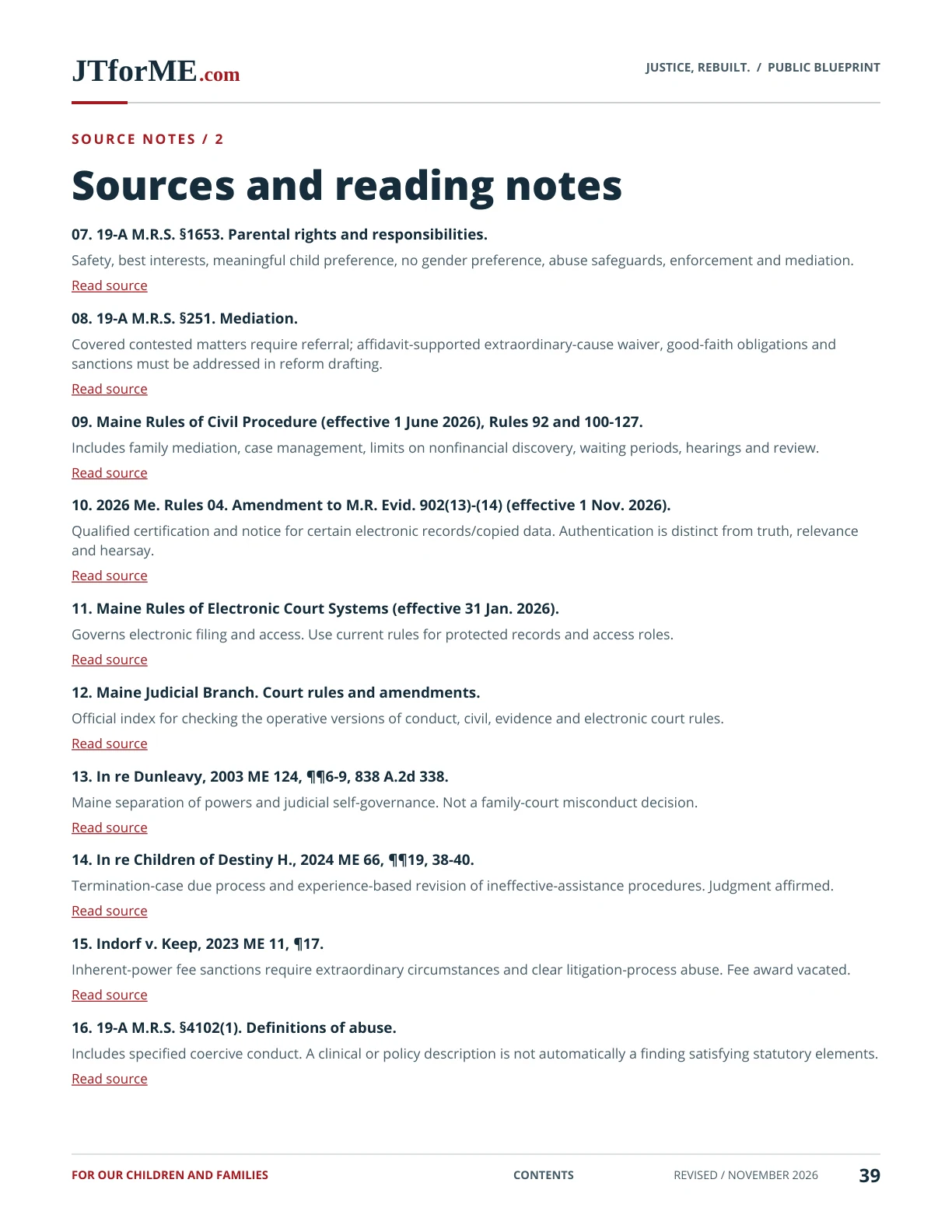
Read selectable text — page 45

Text extracted from the revised PDF. The original page governs layout, tables and citation placement.

JTforME.com
JUSTICE, REBUILT.  /  PUBLIC BLUEPRINT
SOURCE NOTES / 8
Sources and reading notes
54. Viswanathan, M., Rains, C., Hart, L.C., et al. Primary Care Interventions to Prevent Child Maltreatment:
Evidence Report and Systematic Review for the USPSTF. JAMA 331(11), 959-971 (2024).
25 randomized trials, 14,355 participants. Defined primary-care prevention scope, principally without known maltreatment or
its signs; most interventions included home visits. No benefit demonstrated or insufficient evidence for direct/proxy
maltreatment outcomes. CPS reports pooled OR 1.03 (95% CI 0.84-1.27). DOI: 10.1001/jama.2024.0276; PMID: 38502070.
Read source
55. Olds, D.L., Kitzman, H., Knudtson, M.D., et al. Effect of Home Visiting by Nurses on Maternal and Child
Mortality: Results of a 2-Decade Follow-up of a Randomized Clinical Trial. JAMA Pediatrics 168(9), 800-806 (2014).
Exploratory Memphis follow-up: preventable-cause mortality estimate at age 20, 1.6% versus 0% (P=.04); all-cause child
mortality difference not significant. Mortality was not an original trial hypothesis; few events. Read with the later analysis in
source 56. DOI: 10.1001/jamapediatrics.2014.472; PMID: 25003802.
Read source
56. Donelan-McCall, N.S., Knudtson, M.D., and Olds, D.L. Maternal and Child Mortality: Analysis of Nurse Home
Visiting in 3 RCTs. American Journal of Preventive Medicine 61(4), 483-491 (2021).
Later, broader follow-up of the original trials, not independent replication. Memphis preventable-cause child-mortality
comparison P=.09. Reviewed abstract and available primary journal excerpts; complete results tables were not available. DOI:
10.1016/j.amepre.2021.04.014.
Read source
57. Centers for Disease Control and Prevention. A Public Health Approach to Child Abuse and Neglect (28 July
2025).
Prevention framework includes economic support, childcare, parenting assistance, home visiting and interventions
addressing consequences and recurrence. It does not estimate this blueprint’s effect.
Read source
58. Centers for Disease Control and Prevention. A Public Health Approach to Intimate Partner Violence (22 Oct.
2026).
Combines economic and housing supports with survivor advocacy, protective measures and treatment. Match interventions
to safety needs; the framework is not proof of a particular custody outcome.
Read source
59. Lazarus, Emma. The New Colossus (2 Nov. 1883). National Park Service, Statue of Liberty National
Monument.
Public-domain poem. Closing five lines used as a civic epigraph. Source 4 separately identifies Maine’s existing Family Division
service responsibility. NPS page updated 9 April 2026.
Read source
FOR OUR CHILDREN AND FAMILIES
CONTENTS
REVISED / NOVEMBER 2026
45
Blueprint page 46: Sources 60 onward. Full page text follows.
Read selectable text — page 46

Text extracted from the revised PDF. The original page governs layout, tables and citation placement.

JTforME.com
JUSTICE, REBUILT.  /  PUBLIC BLUEPRINT
SOURCE NOTES / 9
Sources and reading notes
60. Swanson, K., Ayers, S., Oviedo, D., et al. Intensive Nurse Home Visiting and Early Childhood Outcomes: A
Randomized Clinical Trial. JAMA Pediatrics 179(8), 857-866 (2025).
South Carolina trial enrolled 5,670 Medicaid-eligible pregnant participants. No significant improvement in the primary
composite of mortality or health-care use associated with major injury or concern for abuse/neglect through age two.
Program, setting and follow-up matter. DOI: 10.1001/jamapediatrics.2025.1600.
Read source
61. Maine Secretary of State. The Great Seal of the State of Maine.
Identifies Dirigo as Maine’s motto. The cover uses it as a civic call for leadership, linked here to accountable public service.
Read source
62. National Archives. Original Design of the Great Seal of the United States (1782).
Documents E Pluribus Unum, “Out of Many, One.” This blueprint applies that civic theme to coordinated public service while
preserving independent roles and lawful authority.
Read source
63. National Archives. The Constitution of the United States: A Transcription, Preamble.
The Preamble includes “We the People” and “establish Justice.” The cover’s “[re-]establish JUSTICE” is an expressly marked
editorial adaptation, not a verbatim constitutional quotation.
Read source
FOR OUR CHILDREN AND FAMILIES
CONTENTS
REVISED / NOVEMBER 2026
46